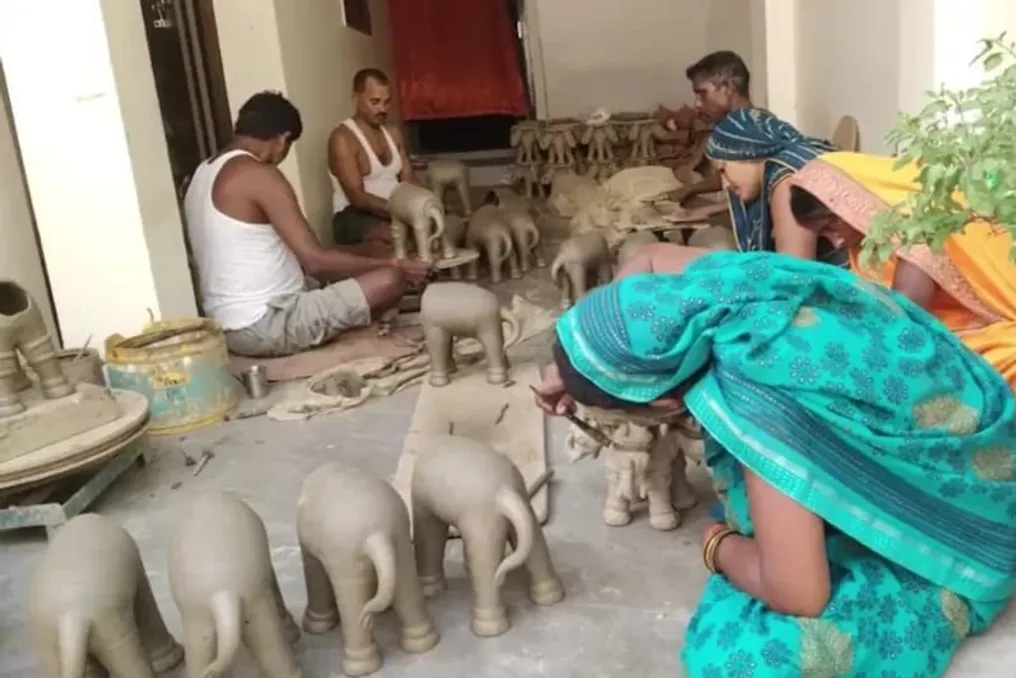
In the strong sun, Ramdulare, who shapes clay on the potter's wheel, no longer feels despair; a new hope is visible. Ramdulare, a resident of a village near Gorakhpur, is a hereditary potter. Several years ago, due to outdated working methods and lack of equipment, he could earn only 150–200 rupees per day, but today his family has become self-sufficient, and the demand for his ceramic products has increased.
This story applies not only to Ramsumer but also to thousands of working craftsmen. The 'Vishwakarma Shram Samman' program, launched by the Uttar Pradesh government, has changed both the status and the direction of life for thousands of traditional artisans in the state, including potters, cobblers, tailors, carpenters, and blacksmiths.
The 'Vishwakarma Shram Samman' program of the Uttar Pradesh government is an important social security measure aimed at strengthening the skills and livelihoods of traditional artisans and manual laborers, thereby transforming the lives of poor workers.
An examination of the daily activities and work of artisans in the villages of Uttar Pradesh made it clear what changes have occurred. Under the 'Vishwakarma Shram Samman' program, artisans and craftsmen in UP were provided with free skill training lasting from 6 to 10 days, after which they were given a free electric potter's wheel and a modern set of tools worth 15 thousand rupees.
Chhotelal, who is four years old and repairs shoes on the roadside in the Daliganj area, says that previously, when working with a hand needle and old tools, his fingers would get calluses, and he could sew only two to four pairs of shoes a day. After receiving a modern sewing machine and a set of tools under the Vishwakarma Shram program, his work speed tripled. Now he takes small orders not only for repair but also for making new shoes, which has significantly increased his income.
Rajan, whose terracotta products have received the Presidential Award, runs a large business. About 25 workers are employed in his factory. Up to two trucks of products are sent out annually in one go, and one truck contains goods worth about 4–5 lakh rupees. According to Rajan, about 24 trucks are sent out a year, providing an annual turnover of up to one and a half crore rupees. Rajan, who once lived in a mud house, now lives in a permanent structure, and his business provides jobs for other families.
Traditional artisans often had to turn to local moneylenders or middlemen to develop their businesses. The 'Vishwakarma Shram Samman' program broke this cycle. After training, artisans are provided with financial support to purchase modern equipment and tool sets. Furthermore, simple and concessional loans from banks for opening their own small enterprises or expanding shops are available, ranging from 10 thousand to 10 lakh rupees.
Ramdin, a 48-year-old resident of Aminabad in Lucknow, was long restricted to working on an old sewing machine in a cramped shop. For years, he barely made ends meet, sewing simple clothing for villagers and townspeople, and even working from morning till late night, he earned only 8–10 thousand rupees per month to support his family of four. However, Ramdin's life changed when he learned about the Prime Minister's Vishwakarma program.
Ramdin registered at the nearest government service center under the 'tailor' category. His application was approved shortly, and he was selected for free skill training for 6 days. During the training, he was not only taught new cutting methods and modern designs but also received a stipend of 500 rupees per day, which allowed him to cover family expenses during the training. As part of the program, Ramdin received an electronic voucher worth 15 thousand rupees for a set of tools, with which he bought his first modern electric sewing machine and an interlocking machine, starting to sew clothes.
Ramdin's life has completely transformed. Work that used to take two hours to sew a suit or jacket on an electric machine is now done in half an hour. Thanks to time savings and high quality of execution, new customers have started coming to him. Ramdin's monthly income has increased to 25–30 thousand rupees. He has also hired two local young men to work.
Stopping migration, the new generation is joining the family business. In Uttar Pradesh, professions such as potter, cobbler, tailor, carpenter, and blacksmith were often rejected by the public. The younger generation, which used to leave for cities considering traditional work unprofitable, is now returning and updating its ancestral skills with modern technology. Ramdulare's 22-year-old son, Amit, noted that the appearance of the electric potter's wheel reduced physical strain and increased production. They are now preparing to sell not only festive lamps but also designer pots, terracotta sculptures, and tableware on online markets.