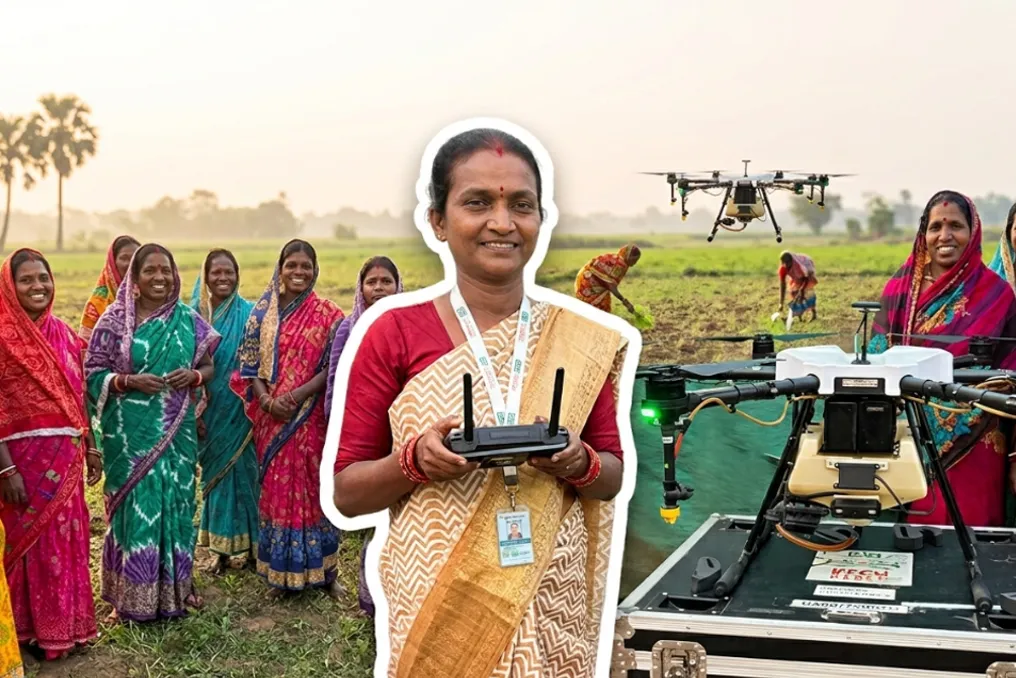
In the village of Sirampur, located in the Khorda district of Odisha state, a group of women observes a drone flying over agricultural fields. One of them operates the remote control while the machine sprays a fine mist of fertilizer onto the crops below.
Previously, for women farmers, spraying one acre required walking through the field with a heavy backpack, which took hours of labor and exposed them to chemicals. Today, a drone can treat one acre in about six minutes and cover up to 25 acres per day.
The central figure in this transformation is 40-year-old Kumudini Swain, affectionately known as the 'Drone Didi' of Odisha.
Pandemic and Unexpected Return to Agriculture
Kumudini shares with The Better India, recalling her journey that began during the uncertainty of the COVID-19 pandemic: 'I never imagined that in just a few years we could build something of this scale.'
Holding a Bachelor of Science degree, Kumudini worked for many years in Odisha's dairy sector, including with Milk Mantra and Sundarani Dairy. However, when the COVID-19 pandemic started, all operations halted. The company she worked at with her husband closed, leaving them without a livelihood.
'We returned home with our two sons. There was nowhere to go, nothing to do. And then we turned to the only thing we had: our land,' she recounts.
On their two-acre farm, the family began growing vegetables. What started as a measure of survival soon showed Kumudini that agriculture could become a viable source of income.
As months passed, she began to look beyond her own land. Around her were other farmers facing many of the same problems she encountered: limited access to better resources, market instability, and few opportunities to increase farming earnings.
'I started wondering: if it works for us, why wouldn't it work for others in the village?'
This question never left her. Kumudini began talking to surrounding farmers, trying to understand their needs and willingness to collaborate. The initial idea was simple: if farmers could pool resources, receive training, and find more efficient ways to grow and sell their produce, perhaps farming could become more profitable for more families.
Bringing Thousands of Farmers Together
These conversations eventually formalized into the Maheera Farmer Producer Company Limited (FPCL). What started as Kumudini's contacts with local farmers grew into a collective of 960 members.
With support from Krishi Vigyan Kendra (KVK) Khordha and the NGO NIGAM, Kumudini began mobilizing farmers, many of whom are women. Getting people to trust a new collective and invest their own funds required time.
'Convincing people was the hardest part,' she recalls. 'Most didn't want to invest money. I sometimes had to use my own funds and constantly explain why it would work.'
Initial capital came from the farmers themselves, with 5 lakh rupees collected through share contributions, as well as a loan from Samunnati Finance. This money gradually took physical form around them: the team rented five acres, built a 12,000 sq ft mushroom house, planted fruit trees, and equipped a poultry shed.
For Kumudini, each such addition gave the farmers another reason to believe that the collective they were hesitant to invest in could truly function. As new members joined, the collective grew. Today, Maheera FPCL demonstrates an annual turnover exceeding 1 crore rupees. Nearly 70% of the 960 members are women, and 60% are young farmers.
However, for Kumudini, the development of the collective also meant finding practical ways to make farming cheaper, safer, and more profitable for its members.
Simple Ideas Reducing Labor and Waste
For Kumudini, innovation did not always mean implementing expensive equipment in the field. Often, it started by studying what farmers were already using, discarding, or struggling with, and asking if there was a simpler way.
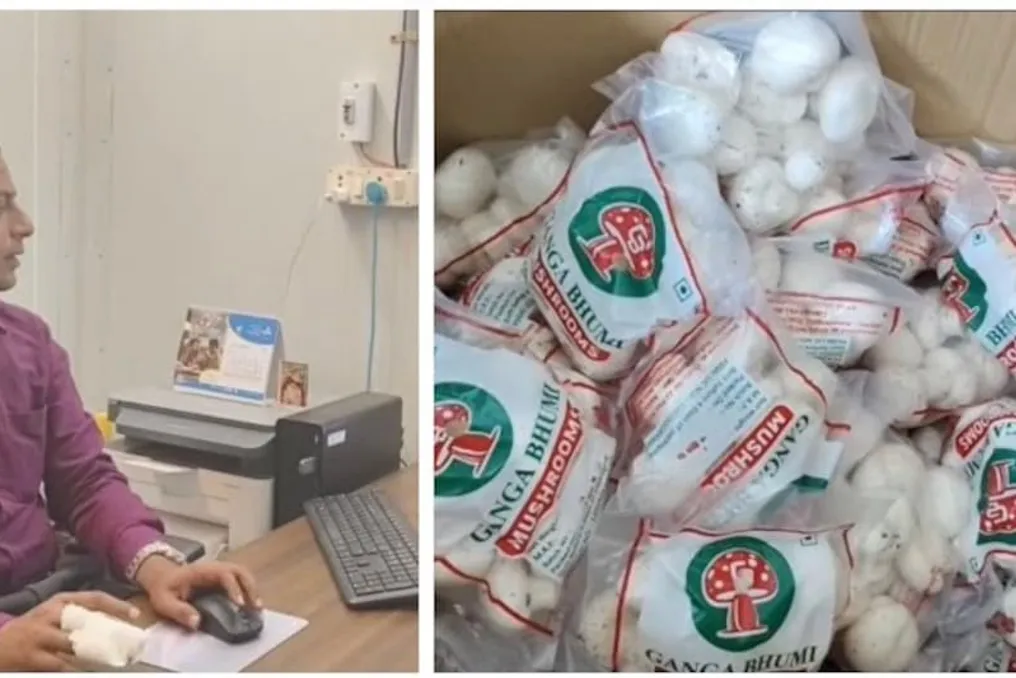
Rice straw, previously burned as waste, is now collected and used to grow mushrooms, creating an additional source of income for women working from home. Switching from glass bottles to polypropylene bags for storing mushroom mycelium made the process more accessible and reliable.
The same logic was applied to other activities. In goat husbandry, rotary feeders reduced labor and feed loss. Sewing machines helped women turn garment making into a stable source of income.
Then came the technology that made Kumudini famous as the 'Drone Didi.'
The Drone That Reduced Workday to 6 Minutes
In 2022, Kumudini learned about agricultural drones as part of a government-supported initiative. For a woman who returned home during the pandemic and started working again on two acres of vegetables, the next chapter took her hundreds of kilometers to Pune.
She spent 15 days there learning to operate agricultural drones and returned to Odisha with a DGCA-certified license.
Shortly after, her company Maheera acquired its first drone—a setup worth 15 lakh rupees, provided under a pilot project.
'People hesitated at first,' she says. 'Women had never operated such machines before. But once they saw the benefits, everything changed.'
Today, Maheera has two drones operated by trained staff, including Kumudini and her husband. These drones spray liquid fertilizers, such as nano-urea, and pesticides with striking efficiency.
'One acre can be sprayed in just six minutes,' she explains. 'Previously, it took a whole day.'
According to Kumudini, drone spraying reduced spraying costs by 60–70%, decreased direct contact with agricultural chemicals, and significantly sped up application.
The changes were noticeable outside the fields too. Kumudini began noticing how people looked at the women operating the machines.
'Women who had never touched machines are now piloting drones. People look at them differently, with respect,' notes Kumudini.
Eliminating Middlemen
Speeding up and cheapening farming solved only part of the problem. After harvesting, farmers still had to answer the familiar question: who will buy the harvest and at what price?
Technology soon entered this part of their work. Through the e-NAM platform (National Agricultural Market), Kumudini's company began connecting directly with buyers across India. By aggregating produce and listing it online, she claims that farmers have been able to secure prices 60% higher by reaching buyers directly.
'For the first time, farmers felt they controlled their produce,' explains Kumudini.
Alongside this, Maheera provides support at all stages of farming, including access to seeds and fertilizers, harvesting machinery, and market linkages.
'The farmer no longer has to go anywhere,' adds Kumudini. 'Everything is available through us.'
'I always wanted to support other women.'
The numbers tell one part of Maheera's success story. Changes within individual homes demonstrate another side.
For 40-year-old Sulochana Mohanty, work was never unfamiliar. Even before joining Maheera, she ran a small enterprise called Dakhya Foundation, where she produced disposable goods and tried to create opportunities for other women.
But, like many small rural enterprises, growth was slow and uncertain.
'Before, I earned about 25,000 rupees a month. That was enough to get by, but not enough to expand or support more women,' says Sulochana.
Joining Maheera FPCL changed this trajectory. With the collective's support, including market access and more stable demand, her business began to grow. They sell their products through Maheera FPCL and run a profitable business in parallel. Today, she employs about 30 women and earns between 40,000 to 50,000 rupees a month, with her business turnover reaching 50 lakh rupees.
'The biggest difference was the ecosystem,' shares Sulochana. 'Here you don't work alone. There is support, there are buyers, and there is a system that helps your work reach the market.'
Her connection with Maheera also introduced her to drone spraying. 'Before, pesticide spraying meant spending a whole day in the field, carrying heavy equipment and inhaling chemicals,' she says. 'Now, with drones, the same job is done in minutes. It is faster, safer, and much more efficient.'
However, for Sulochana, earning more income also allowed her to create jobs for other women. 'I always dreamed that I could help other women stand on their feet,' she says. 'Today, I can give jobs to 30–40 women. It brings me a different kind of happiness—the kind connected not just to earning, but to lifting others up with you.'
'Today, I don't have to ask anyone for money.'
For 30-year-old Chumini Patel, the journey started at home. For years, she was a homemaker, her days dedicated to household chores and childcare. She had no independent income and few opportunities outside the village.
This changed when she joined Maheera FPCL a year ago. Thanks to training programs supported by agricultural institutions, she started with two goats provided under a government initiative. With constant care, as she says, their number grew to 15 in two years.
Simultaneously, she underwent training in mushroom cultivation, learning how to use rice straw, previously considered waste, to create another source of income.
'Everything I learned, I applied at home,' she says. 'Today, I cultivate mushrooms, take care of my farm, and run a household simultaneously.'
Her two-acre farm now grows vegetables such as eggplant, cucumber, and beans, with the support of her husband and father-in-law. Mushroom cultivation waste is used as compost, reducing her dependence on chemical fertilizers and lowering costs.
For Chumini, the most personal change happens at the end of every month: she now has money she earned herself. 'Before, I earned nothing. Now I earn over 25,000 rupees a month, and I didn't have to take any loans to start.'
This income also changed her standing in the family. 'In my family, they look at me differently. I contribute to expenses, I save for the children, and I no longer have to ask anyone for money,' she shares.
Her neighbors also started approaching her, asking how she manages various activities on her farm. 'If a woman believes in herself, she can do anything she wants. Being part of such a group simplifies things; you get training, support, and guidance. It saves time, reduces risk, and helps earn more,' smiles Chumini.
More drone flights ahead
The collective, whose entry Kumudini once couldn't convince, now has nearly 1000 members, about 70% of whom are women. But the number she thinks about further is not just Maheera's turnover. She wants every woman associated with it to earn enough to make her own financial decisions.
'I want every women farmer associated with us to become independent. Not dependent on loans, but strong because of hard work.'
Returning to the fields, the drone finally makes its last pass and lands. The women gather around it—the same machine that can now complete in minutes the task that once took hours of their day.
For Kumudini, this technology is important because of what women can do. 'Farming is no longer just hard labor. With the right technology, it can become a source of dignity and leadership for women. We are just beginning.'