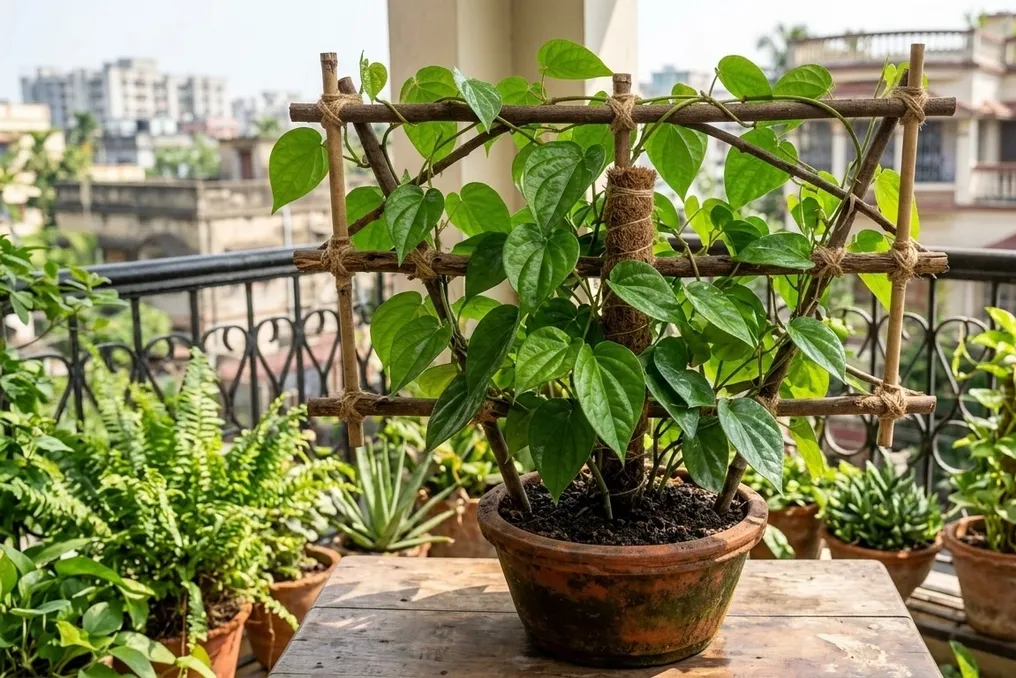
Betel leaves are used not only as food in India but also in various religious rituals and auspicious activities. Often, pandits request betel leaves during rituals, which forces people to rush to the market to find the required type of leaf. However, there is a way to grow the plant at home without visiting the market every time.
You can grow the betel plant in a pot on a balcony, roof, or in a semi-shaded area. For this, you do not need to look for seeds. It is enough to take a healthy cut branch (cutting) from any betel leaf to grow a healthy plant at home. To successfully grow it, several important rules must be followed.
Since betel seeds are difficult to find, it is usually cultivated using cuttings. To plant the plant in a pot on the balcony, take a healthy branch about 4–6 inches long from a healthy betel plant. It is important to ensure that the plant from which you take the cutting is not diseased.
When cutting the stem, make a cut at an angle of about 45 degrees, right below the leaf node. Remove the lower leaves, leaving only the two upper ones. This part will help in root development.
Instead of immediately planting the cutting in the pot soil, it is better to first stimulate root growth in water. This facilitates the process of growing the betel plant. Fill a clean glass or bottle with water and place the lower part of the cutting in it.
Place the container in a spot that receives good light, but avoid direct intense sunlight. Change the water every two to three days. After a few weeks, small roots will begin to appear from the lower part of the stem. When a good cluster of roots has formed, the plant can be transplanted into a pot.
The betel plant likes soil that does not retain water but is not completely dry. For this, you can mix garden soil with coconut substrate and well-rotted compost or old manure. If the soil is too heavy or clayey, it is recommended to add some coarse sand to make the soil loose and allow water to drain freely. Choose a sufficiently deep pot for planting and be sure to provide a drainage hole at the bottom.
After the cutting has rooted, plant it in the prepared pot to a depth of several inches and gently compact the surrounding soil. Since the betel plant is a vine, it needs support for growth. You can install a wooden stick, a small trellis, or a moss pole in the pot, along which the vine will gradually climb.
The betel plant is quite sensitive to the sun. Instead of keeping it under very bright direct sunlight, place it where there is soft light. Weak morning sun is suitable for it, whereas strong midday sun can damage the delicate and soft leaves. It is best to place it on a balcony in a spot where it receives light but is not constantly exposed to intense sun.
The betel plant's soil should remain slightly moist, but water should not stagnate in the pot. Water regularly according to the plant's needs, and be sure to drain excess water from the saucer. Especially during the rainy season, avoid overwatering, as high environmental humidity can cause root problems due to excess water.
For good development, the plant requires regular fertilization. Liquid fertilizer can be used every 3–6 weeks. If you want to avoid chemical fertilizers, you can apply well-rotted manure to the soil 2–3 times a year.
The betel plant can be affected by pests such as red mites, and leaf infections can occur. Therefore, it is necessary to inspect the leaves regularly. If contamination is found on a leaf or stem, it should be removed immediately. If pests appear, a mild soap insecticide can be used.
With proper care, the first healthy leaves may appear in about 4–6 months. When harvesting leaves, be careful not to collect too many at once. It is better to collect about a quarter of the plant's leaves at one time so that it does not weaken and continues to develop new leaves.