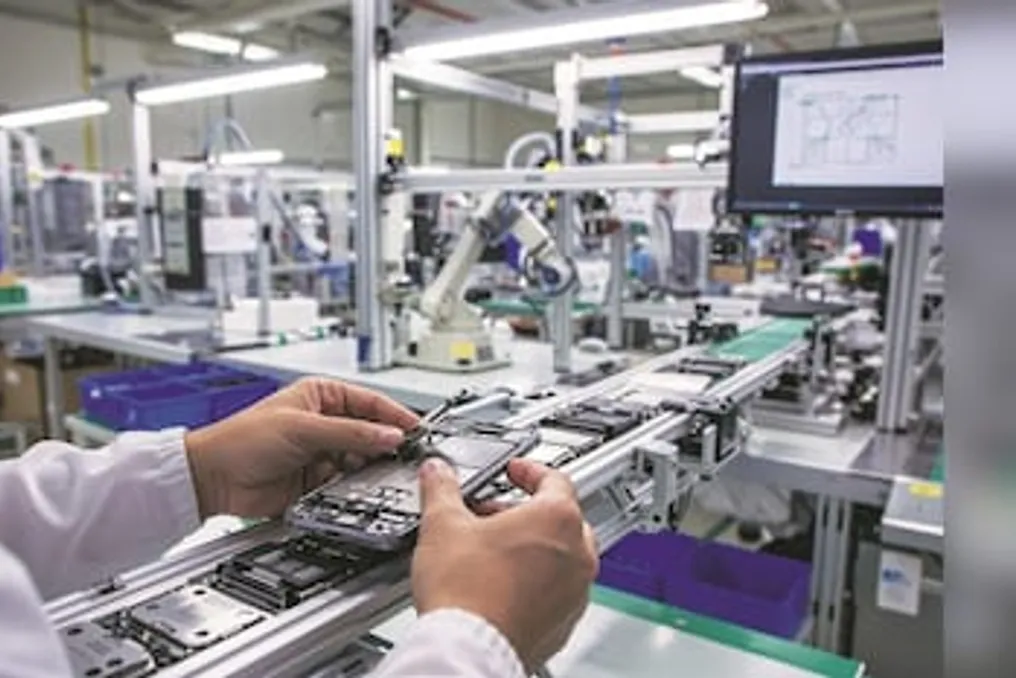
Despite the active expansion of local electronics manufacturing in India, the country remains heavily dependent on the import of chips and components. The new Electronic Component Manufacturing Scheme (ECMS) is designed to stimulate domestic production and reduce this reliance.
Last week, the government approved 31 new proposals under ECMS, involving investments worth 78,777 crore rupees. These projects cover 10 states and are expected to generate production valued at 82,243 crore rupees and create 9,588 direct jobs.
The approved projects relate to camera and display modules, anode materials, and other production resources. The government stated that some of these components, including filters, coils, speakers, and certain raw materials, will be produced domestically for the first time.
This momentum comes amid rapid growth in electronics manufacturing in India, yet the country continues to import many high-value components used in smartphones, televisions, laptops, and other devices.
What is the production volume in India?
According to government data, India has become the second-largest country globally in terms of mobile phone production volume. Mobile phone production in India has increased from 18,900 crore rupees in 2014–15 to 6.27 trillion rupees in 2025–26, while exports grew from 1,566 crore to 2.60 trillion rupees over the same period.
Government data also shows that electronics production has risen from approximately 1.9 trillion rupees in 2014–15 to 13.11 trillion rupees in 2025–26, and electronics exports have increased from 38,000 crore to 4.24 trillion rupees.
Nevertheless, a significant part of this growth is due to assembly rather than deep localization. Industry estimates provided by the Ministry of Electronics and Information Technology suggest that the domestic value addition in electronics manufacturing is 18–20 percent.
To encourage local production, the central government abolished customs duties last month on components used in automotive display assemblies, medical equipment, and industrial instrumentation. This exemption also applies to components for wireless charging modules in mobile phones and equipment used in lithium-ion cell production.
This customs duty exemption will be valid until March 31, 2029. Before the changes, these products were subject to customs duties ranging from 7.5–15 percent.
The government has also expanded the list of equipment eligible for duty-free import for lithium-ion cell production. The expanded list replaces an earlier, limited list and removes end-use restrictions.
What components does India still import?
India has built up significant capacity in smartphone assembly and now locally produces several components, including printed circuit boards, chargers, batteries, mechanical casings, and cables. However, it remains dependent on imports for advanced display panels, memory chips, image sensors, and a range of specialized components.
The biggest gap is observed in semiconductors and other high-value electronic components. A Crisil analysis from August 2026 showed that electronics was one of the three most import-intensive manufacturing sectors in India, with imports accounting for 29.8 percent of total supplies.
In fiscal year 26, India imported electronic integrated circuits worth $30 billion, while imports of tapes and reels amounted to $5.3 billion. Semiconductors and electric batteries cost $4.9 billion each, and the import of electrical apparatus circuits was $2.1 billion, according to Crisil data.
Crisil also noted India's high dependence on imports of electrical cables and wires (36.9 percent), organic chemicals (36.5 percent), batteries (29.7 percent), and plastic products (23.9 percent).
For some critical products, the dependence is even higher. NITI Aayog trade data indicated that in 2024, India had a net trade deficit in chips of $23.5 billion. The deficit stood at $4.3 billion for display panels and $2.7 billion for batteries. These figures highlight the gap between domestic component production and the growing needs of India's device assembly sector.
What will change thanks to ECMS?
ECMS aims to bridge this gap by shifting policy support from assembling finished devices towards components, sub-assemblies, materials, and capital goods.
The latest approvals cover 20 target product segments. These include camera, display, and optical transceiver modules; connectors, converters, speakers, microphones, relays, antennas, coils, filters, and capacitors; as well as anode materials, rare earth permanent magnets, acetylene black, and electrolyte additives.
The recent approvals included 106 applications covering 30 products across 15 states. They represent investments of 69,548 crore rupees and a projected production volume of 5.34 trillion rupees, with an expected creation of 74,628 direct jobs, according to the government.
The scheme was notified in 2025, and its budget was increased to 40,000 crore rupees in the Union Budget for 2026–27. Its broader goal is to build a domestic supplier base so that manufacturers do not have to import so many critical resources.
China and Vietnam offer lessons
India has made progress in electronics assembly, especially in smartphones, but lags behind China in the depth of its component ecosystem. China followed a similar path, starting with large-scale assembly and then developing capabilities in semiconductor packaging and chip fabrication.
According to a Reed Intelligence analysis, the Chinese consumer electronics market was valued at $50.1 million in 2025 and is projected to reach $84.66 million by 2034, demonstrating a Compound Annual Growth Rate (CAGR) of 5.97 percent from 2026 to 2034. Electronic devices were the largest product segment in 2025 and are expected to remain the most attractive segment with the fastest growth during the forecast period.
Meanwhile, Vietnam has established itself as another major electronics manufacturing base, particularly for global smartphone manufacturers. Its consumer electronics market was valued at $6.4 billion in 2025 and is projected to reach $9.8 billion by 2034, showing a CAGR of 4.68 percent from 2026 to 2034, according to IMARC Group. The market is expanding amid growing demand for smart, energy-efficient electronic devices and home appliances.