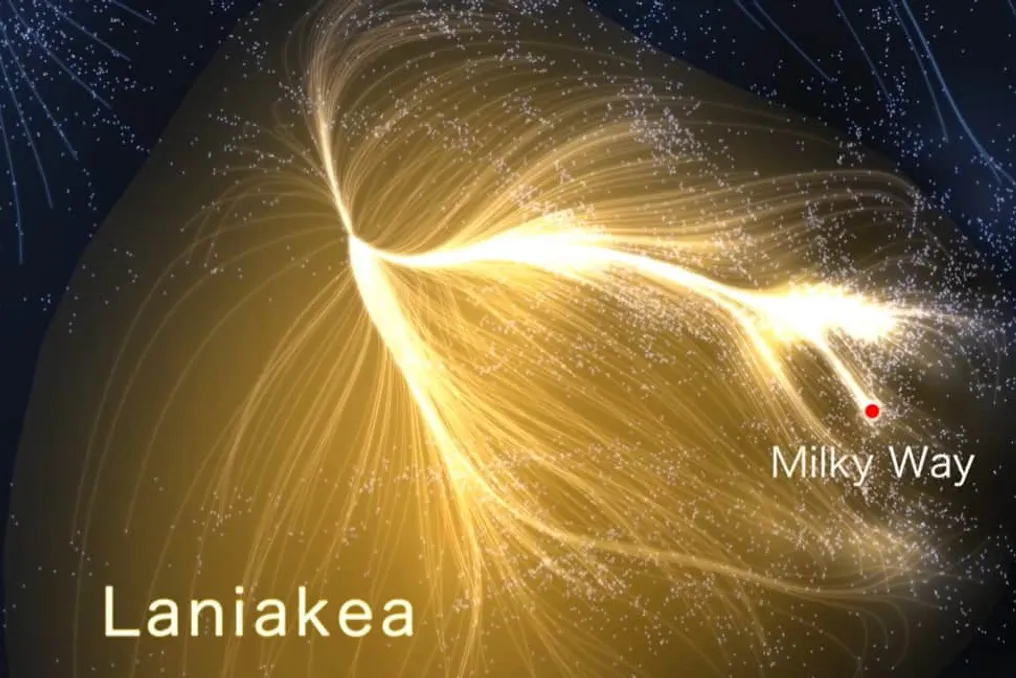
There exists a colossal force that pulls the Milky Way and the entire Local Group—a collection of about one hundred galaxies, including our own and Andromeda—at a speed of approximately 600 kilometers per second. Astronomers have named this force the Great Attractor, and it is hidden deep behind the disk of our own galaxy.
This attractor is not a giant black hole or a single object, but rather a concentration of mass composed of galaxies, gas, and dark matter. Dark matter is a form of substance that does not emit light, but its gravity is felt through the influence it exerts on everything around it, strong enough to alter the motion of the Sun and Earth along with the rest of the galaxy.
The Great Attractor is located in the direction of the Centaurus constellation, but it lies behind the plane of the Milky Way, in the so-called Zone of Occultation. This area of the sky is obscured by our galaxy's own disk: a large amount of stars, gas, and dust prevents optical telescopes from seeing what is beyond it.
To overcome this obstacle, astronomers use radio and X-ray telescopes, which are capable of penetrating this cosmic 'veil' and indirectly mapping hidden galaxies.
The phenomenon was first discovered in the 1970s and 1980s by a group of astronomers nicknamed the 'Seven Samurai.' They noticed that hundreds of elliptical galaxies were moving in the same direction at a speed that simple cosmic expansion could not explain.
Decades later, in 2014, a team led by astronomer R. Brent Tully modeled an even larger structure—the Laniakea Supercluster, which means 'endless sky' in Hawaiian. The supercluster is a combination of many galaxy clusters bound by gravity.
Laniakea has a diameter of about 500 million light-years and includes approximately 100 thousand galaxies, with a total mass estimated at about 100 quadrillion solar masses. The Milky Way is on the periphery of this structure, not at its center.
By studying the movement of galaxies within this vast volume, researchers found that they all converge toward one region—and the Great Attractor is located in the core of Laniakea. The distance to it is estimated to be between 150 and 250 million light-years, with a large margin of error due to difficulties in direct measurements in the Zone of Occultation.
Although the Milky Way is being pulled, the expansion of the universe acts in the opposite direction: the space between distant structures is constantly increasing, which is explained by dark energy—a hypothesis used to describe the acceleration of this expansion. The most accepted idea today is that the Local Group will never actually merge with the core of Laniakea.
This does not change the current situation: the Milky Way, the Sun, and the Earth continue to move along this gravitational flow at a speed of 600 km/s, and no one on the planet feels this push. Next time someone says the Earth is stationary in space, it is worth reminding them that it is actually participating in a cosmic race toward a destiny it may never reach.