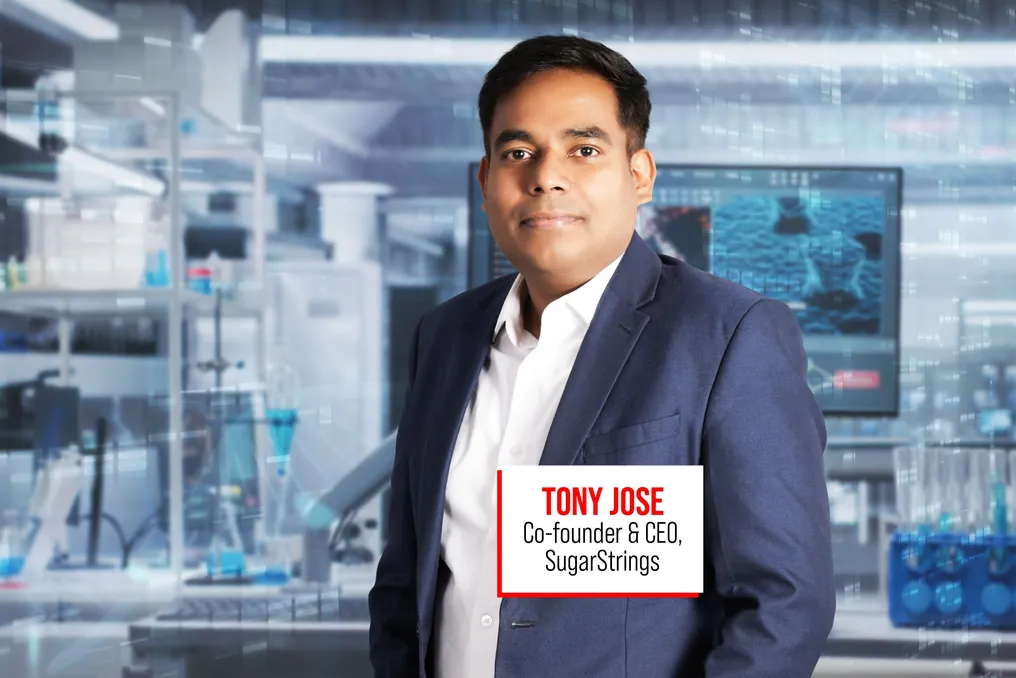
Tony Jose, who has spent many years conducting research and diagnostics in the field of genomics, observed that many genetic diseases classified as rare collectively affect significantly more people than previously thought.
Jose noted that although genetic disorders are essentially rare illnesses, their collective impact places a burden on the population. He cited hypertension as an example, which is currently considered a lifestyle disease, but there are underlying genetic conditions capable of triggering its onset.
This realization prompted Jose and Rajasekhara Reddy Ravuri, who was then the chief scientific officer at Clevergene Biocorp, to found SugarStrings in Bengaluru in 2023. The company derives its name from the sugar backbone of DNA (deoxyribose) and aims to help people better understand their genetic predisposition to diseases through a single DNA test.
Jose, now CEO of SugarStrings, stated that the company believes SugarStrings will be the best way to realize their idea for the general public, allowing individuals to conduct self-screening, understand their genetic tendencies, and work on preventing or managing these conditions.
In addition to Jose and Ravuri, the seven-member founding team includes co-founder Dhaneesh Jameson. Although Jose and Ravuri stepped down from executive roles at Clevergene Biocorp, Jose continues to serve as its director.
SugarStrings' core product, Healthstring, is a DNA sequencing test that analyzes a cheek swab sample to screen for over 7,442 genetic diseases in one analysis. Unlike blood-based tests, the company utilizes cheek swabs for sample collection.
Jose emphasized that this non-invasive method simplifies sample collection, bypasses cold chain issues, and offers a psychological advantage, as people are more proactive about their health when they can collect samples themselves.
Over the past five years, the cost of DNA sequencing has dropped by approximately one-third. The test currently costs 58,000 rupees, with reports delivered within five days to a month.
According to Jose, the company goes beyond simply determining the probability of developing a disease. They perform DNA sequencing, identify the exact mutation, and generate a detailed report on all potential diseases that may arise from that mutation, enabling clinical decisions based on this report.
HealthString screens for 7,442 diseases, including 188 hereditary types of cancer and 302 cardiovascular diseases. In comparison, Jose notes that Nucleus Genomics in New York screens for about 2,100 diseases, while Strand Life Sciences in Bengaluru screens for around 250.
The company deliberately chose to offer a comprehensive test rather than a specific disease screening. Jose explains that the key reason for maintaining a holistic approach is that the human body is an interconnected system, and diseases affecting one organ can influence overall bodily function.
He also added that the test could become more affordable as DNA sequencing becomes cheaper, as well as with increased volume and technological implementation.
Another area of the startup's work is improving genetic analysis across diverse populations. Many global gene databases are built predominantly on data from people of European descent, which hinders the identification of disease-causing mutations in other population groups.
SugarStrings claims that its proprietary machine learning-based parser can detect new mutations with 94.89% accuracy, allowing it to analyze genetic data from more diverse populations.
SugarStrings began operations in the last fiscal year and served about 100 clients, simultaneously validating its technology on over 1,800 patients. Jose reported that the company aims to increase its client base to 1,000 this year.
To support this growth, the startup has entered into partnerships with hospitals such as Narayana Health and Manipal Hospital in Bengaluru, as well as Aster Medcity in Kochi.
Dr. Nalanda Jayadev, Regional General Manager of Central Kerala and Aster Medcity, believes that genetic screening can transform healthcare delivery by shifting the focus from treatment to prevention. He argues that instead of waiting for a disease to manifest, individual risks can be identified early, allowing for preventive action and tailoring prevention and treatment to each person's unique genetic profile, making healthcare more predictive, precise, and patient-centric.
Jose added that SugarStrings sees growing interest from physicians in preventive DNA screening. He noted that currently, 80% of consumers come directly, and this will change as they collaborate with five more hospitals.
As genetic testing becomes more widespread, so does concern over data privacy, particularly following the data breach at the genetic testing company 23andMe, which affected 6.9 million users. Jose stressed that protecting sensitive genetic information has been a priority from the outset. The company decentralizes data to minimize hacking risks and complies with HIPAA guidelines and the American College of Medical Genetics and Genomics, as well as local certifications such as the Karnataka State Private Medical Institutions Act for providing diagnostic solutions.
Having secured initial funding of 3 crore rupees, SugarStrings earned 20 lakh rupees in its first year and targets an annual revenue of 4.5 crore rupees this year. The company plans to raise $1 million for R&D investment, platform improvements for doctors and patients, and expansion into the UAE, South Africa, Australia, and Canada.
According to Grandview, the genomic company market in India is currently valued at $482 million and is projected to reach $1.8 billion by 2033, indicating favorable prospects for companies like SugarStrings, provided they scale correctly.