Whenever one observes the sky, one is actually looking into the past. Although light is the fastest phenomenon in the Universe, it requires time to travel vast astronomical distances, turning the sky into a kind of cosmic clock.
The Sun serves as the most immediate example of this delay. Sunlight takes approximately eight minutes and twenty seconds to reach Earth. Consequently, the Sun we observe right now is not the current Sun, but rather the one from a few minutes ago.
With stars, this temporal difference becomes more pronounced. Astronomers use light-years to measure spatial distances; a light-year represents the distance light travels in one year, traveling at almost three hundred thousand kilometers per second.
Proxima Centauri, the star closest to the Sun after it, is located about 4.2 light-years away. Therefore, the light that Earth receives today left that star more than four years ago.
Stars visible to the naked eye are even farther away. Sirius, considered the brightest star in the night sky, is located approximately 8.6 light-years away. For relatively nearby objects like these, distance measurement is done through parallax, a geometric triangulation technique accepted by the scientific community with a low margin of error.
The greater the object's distance, the longer the represented time interval will be. A galaxy situated billions of light-years away offers a glimpse of what it was billions of years ago, long before the existence of the Sun and Earth.
Exploring Cosmic Time with the James Webb Telescope
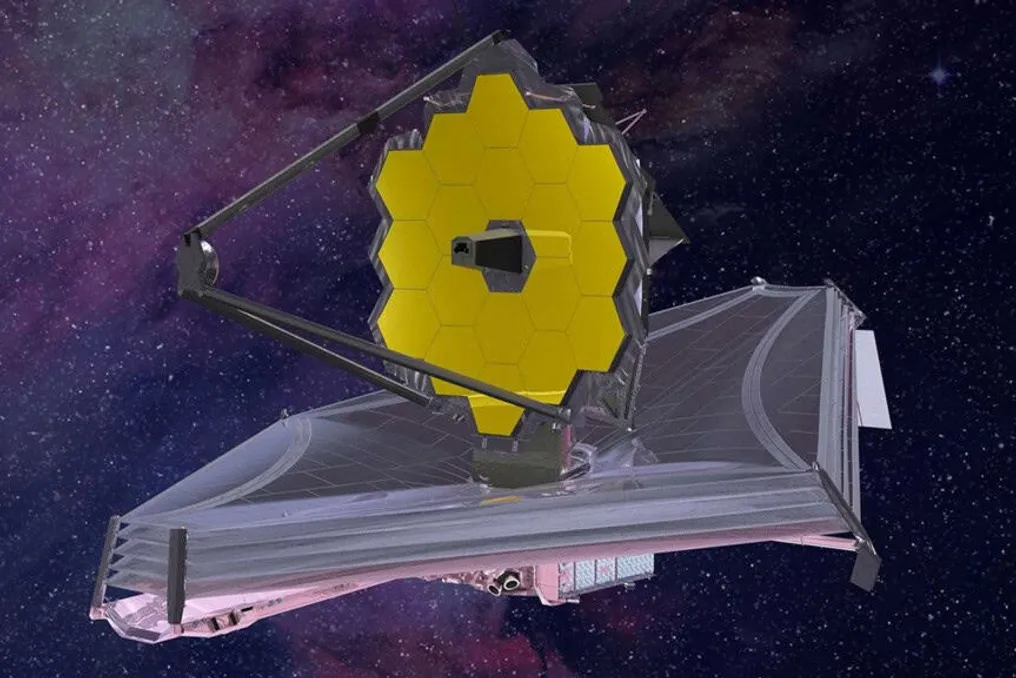
This principle is fully explored by the James Webb Space Telescope, operated by NASA. Launched in 2021, this instrument focuses on infrared observation, a light imperceptible to the human eye, which can penetrate clouds of cosmic dust more effectively than visible light.
This capability allows the telescope to record faint signals that took billions of years to reach its mirrors. One of the most distant galaxies ever confirmed, named JADES-GS-z14-0, had its light detected by the James Webb after an estimated journey of about 13.4 billion years.
Unlike the parallax used for nearby stars, such vast distances are calculated using redshift, which is the shift of light towards the red spectrum caused by the expansion of the Universe. This is a well-established method among astronomers, although the obtained distances are estimates with a higher margin of error than those of neighboring stars.
Considering that the Universe is about 13.8 billion years old, this image not only indicates great distance but also serves as a record of the Universe in its initial state, formed only a few hundred million years after the Big Bang. There is no way to see this galaxy as it is currently; only as it existed at that remote moment.
The next time you look at the sky on a clear night, remember that every point of light represents a distinct era. What you see is not a single representation of the Universe, but rather a mosaic of superimposed pasts, where each star tells its own version of the present.