Spacetech InspeCity, based in Thane, has raised funding of 100 crore rupees in a pre-Series A round. These funds will allow the company to accelerate the transition from laboratory research to active deployment in space.
The funding round was led by the venture fund Speciale Invest, with Ashish Kacholia serving as a notable technology investor. Antler Elevate, Antler India, Manish Gandhi, Shastra VC, and other participants also took part in the round.
InspeCity's main goal is to become an orbital service provider, offering satellite servicing, repair, and refueling services in orbit, as well as engaging in safe space debris removal.
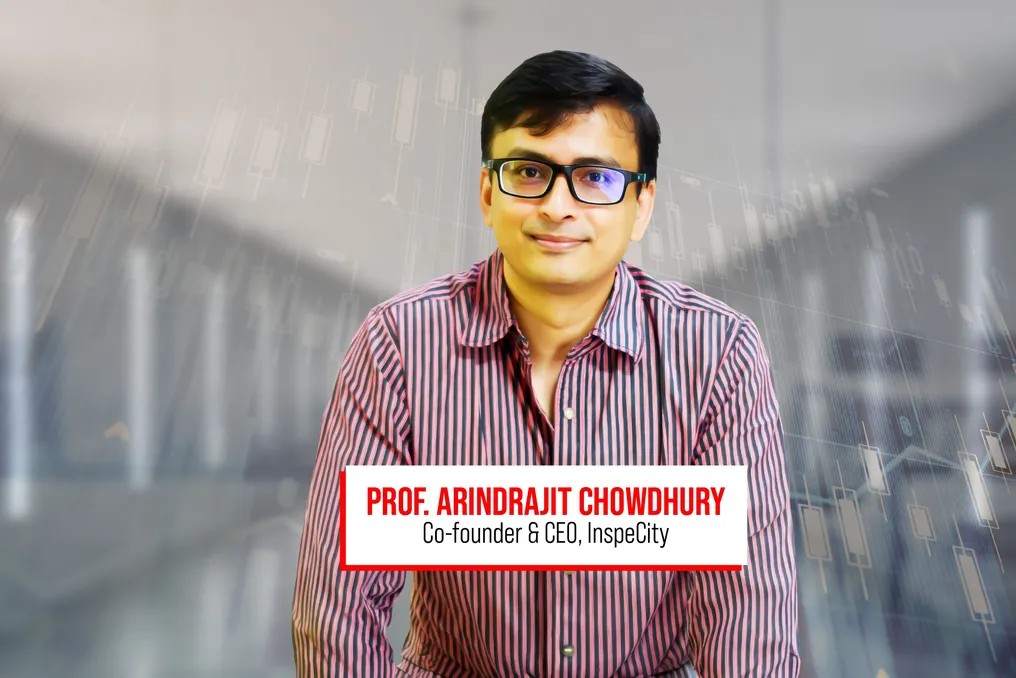
Arindrajit Choudhury, co-founder and CEO of InspeCity, stated that the first portion of the new funds will be directed towards meeting government grants for active projects under India's Innovation for Defence Excellence (iDEX) program. The second portion is intended for creating and launching the first series of orbital missions. The final part of the funds will be used to strengthen the startup's team and establish a new research center, as the company transitions from a research entity to a commercially oriented, execution-focused organization.
InspeCity was founded in 2022 by Choudhury, a professor at the Indian Institute of Technology Bombay (IIT Bombay) and an alumnus of IIT Kharagpur, and Tauseef Shaikh, an IIT Bombay alumnus. Choudhury's academic background influenced the initial approach to creating InspeCity, as he began his journey with a deep appreciation for technical rigor accompanied by a degree of apprehension.
In an interview with YourStory, Choudhury recalls his student years when writing research proposals for government agencies often seemed tedious due to endless checks and balances. This experience taught him patience and administrative persistence, which proved invaluable during InspeCity's transition into private business. He shows immense interest in the human aspect of deep technology development, viewing systems engineering not merely as a technical exercise but as a profound human challenge. For him, the process of uniting exceptionally talented and diverse minds to achieve a single goal is a wonderful puzzle.
The commercial space industry is experiencing an unprecedented boom, but this has also created a massive logistical problem. The number of operational satellites has sharply increased, leading to a rise in dangerous space debris. The rotation and vibration of defunct satellites and fragments pose a constant threat of collisions capable of destroying active space infrastructure. Nevertheless, the congested orbit represents a significant business opportunity for 'in-space servicing, assembly, and manufacturing.' Instead of constantly launching replacement satellites and increasing orbital clutter, the company aims to help satellite operators extend the lifespan of existing assets while reducing costs.
The startup is developing robotic and propulsion systems for servicing satellites in orbit and mitigating space debris. Choudhury notes: 'When we started InspeCity, Earth 2.0 was intentionally a long-term thesis. We asked ourselves: if significant economic activity extends beyond Earth, what machines and infrastructure must exist first? This question led us to VEDA and to the propulsion, sensing, autonomous, robotic, docking, and refueling technologies that we have been developing over the past few years.'
VEDA is an autonomous in-orbit servicing platform developed by InspeCity. Vishesh Rajaram, Managing Partner at Speciale Invest, supports this view, explaining: 'In-space servicing is one of the few categories where the technical barrier and commercial need coincide simultaneously. InspeCity has developed a complete stack of propulsion systems, robotics, and RPOD (Rendezvous, Proximity Operations, and Docking) in-house, which is rare globally and even rarer at this cost point (cheaper than global offerings). '
The company has developed a suite of patented building blocks, including GITA (Green Impulse Transmitter)—a refuelable propulsion unit designed to move satellites with high thrust and minimal environmental impact. CHAKSU, an AI-based comprehensive sensor, is used for navigation, tracking objects in real-time to ensure precise docking maneuvers. Physical repair and maintenance work is performed by RAMA, a remotely controlled robotic arm that very accurately mimics the movements and dexterity of a human hand. All these components are integrated into VEDA, which serves as the primary transport and service vehicle.
To validate these technologies, InspeCity plans four sequential missions. The first mission, RIG-E (Remote Inspection and Guidance), involves mapping trajectories to locate specific targets. Subsequent missions, RIG-X, VEDA-X, and SAMA-X (Space Asset for Servicing), will gradually test the propulsion systems, robotic manipulation, and cooperative docking. In cooperative docking, two spacecraft actively work together to align, approach, and connect in orbit. Choudhury emphasizes that this phased approach allows the company to learn from each flight and gradually build confidence.
Global partnership is a key growth strategy for InspeCity. Since traditional methods of physically capturing rotating objects in space are complex and dangerous, InspeCity has signed a memorandum of understanding with the Japanese firm Orbital Lasers. This will allow combining space lasers with robotic arms to remove debris without direct physical contact. The company is also collaborating with hardware ecosystems in Taiwan.
In April 2023, InspeCity raised a seed round of $1.5 million, jointly led by Speciale Invest, Antler India, and Veda VC. This was followed by a seed round of $5.6 million last May, led by Kacholia. Kacholia noted: 'Professor Arin and the InspeCity team have set out to solve some of the most complex problems in the space sector. Their success in several iDEX competitions and government grants is strong confirmation of both the team's technological capabilities and the potential of their vision.'
InspeCity's business model includes direct product sales and specialized orbital services. The company plans to commercialize its GITA propulsion units and RIG systems for other satellite operators, offering customized servicing contracts. In the long term, the company envisions creating true 'space cities' in orbit to address resource scarcity on Earth.
Looking ahead, Choudhury demonstrates pragmatism regarding fundraising and commercialization. He is not rushing into a Series A round, preferring to let his team focus on technical milestones. He states: 'I will base the timelines (for fundraising) on what the team can show me. If a good deal comes along, we will definitely take the money, but I am waiting for confirming moments.'