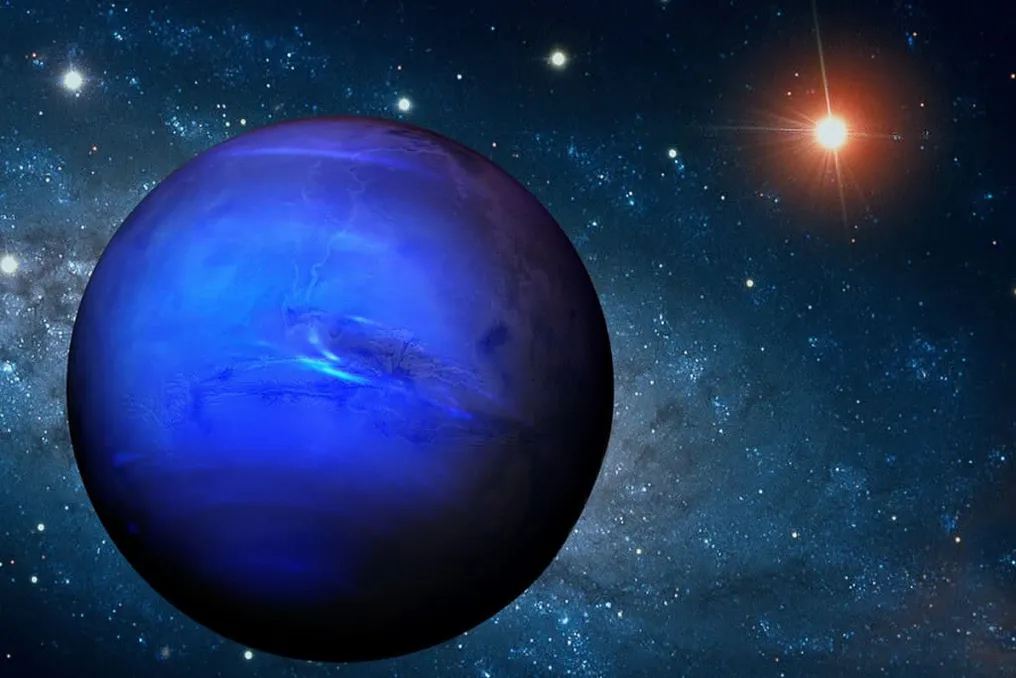
Neptune was anticipated through mathematical calculations before it was actually detected as a planet. Deviations in Uranus's orbit, when compared with observations, indicated that the gravitational influence of another celestial body might be affecting its path. In this context, Urbain Jean Joseph Le Verrier, in France, performed calculations to locate this planet, while John Couch Adams, in England, arrived at a similar prediction independently.
The confirmation occurred during the night of September 23rd to 24th, 1846. At the Berlin Observatory, astronomer Johann Gottfried Galle and Heinrich Louis d’Arrest compared the area pointed out by Le Verrier with a celestial map and identified an object missing from the catalog. Subsequent observations showed that this object exhibited movement relative to the stars, thus confirming it as Neptune.
The crucial factor in solving the enigma lay in gravity. As established by Isaac Newton's law of universal gravitation, masses exert mutual attraction. In a complex planetary system, this attraction generates minuscule modifications in trajectories. This turned Uranus into a kind of cosmic indicator; if there were an unknown planet beyond its orbit, its gravity would cause small perturbations in Uranus's movement, allowing astronomers to use these variations to estimate the position of the causative body.
This problem had already drawn the attention of the French astronomer Alexis Bouvard, who compiled tables for Uranus's orbit in 1821. Later measurements did not align perfectly with the projections, strengthening the theory of an unmapped body. Both Le Verrier and Adams approached the challenge independently. Instead of starting with the observation of a planet, they started from the gravitational effect noted on Uranus to calculate its origin, thus conducting an inverse investigation: the trajectory of a known planet served to search for another still invisible one.
Adams concluded his calculations before the disclosure of Le Verrier's prediction, but his findings were not published at that time. Le Verrier published his studies and sent his estimate to the Berlin Observatory, where it was directly used in the search. Galle received the coordinate calculated by Le Verrier and began the search. On the night of September 23rd, he and d’Arrest located a celestial body near the predicted location that did not correspond to the stars on the map used for the observation. The deviation of this object relative to the stars proved that it was not a fixed star; Neptune was present.
NASA sources classify this event as a great triumph of celestial mechanics, as the existence of a planet was deduced from its gravitational impacts before its visualization in the sky. Le Verrier's prediction demonstrated high accuracy for the time, with NASA recording that Galle found the planet less than a degree from the indicated position. Neptune orbits the Sun on average 30 times farther from Earth and is not visible to the naked eye.
There is also a relevant detail in this narrative: Galle was not the first to spot Neptune. The British astronomer James Challis had recorded the object in August 1846, before the identification in Berlin. He monitored the celestial region on August 8th and 12th, but did not recognize that luminous point as a planet. The distinction lies between observing and identifying; Challis recorded the point, but did not understand its nature, whereas Galle and d’Arrest made the identification that validated the discovery.
The success of the calculations generated a dispute over precedence between the French and the British. Adams had worked on the problem independently and achieved results before Le Verrier, but his prediction was not disclosed in the same way nor did it directly lead to the planet's location. Le Verrier, on the other hand, published his calculations, which were used by Galle in the search that culminated in the discovery of Neptune. Thus, the attribution of merit became a sensitive issue between the two countries.
The most accepted historical view today recognizes the independent contributions of Adams and Le Verrier to the prediction, without disregarding that it was Le Verrier's published estimate that directly guided the identification of Neptune by Galle and d’Arrest. Therefore, the controversy is not just about defining who 'discovered' the planet. This episode teaches a lasting lesson in astronomy: it is not always necessary to see an object directly to know that it exists; often, it is enough to precisely analyze what its gravity does to another body. In the case of Neptune, a small variation in Uranus's movement served as the clue that led scientists to a planet billions of kilometers away.