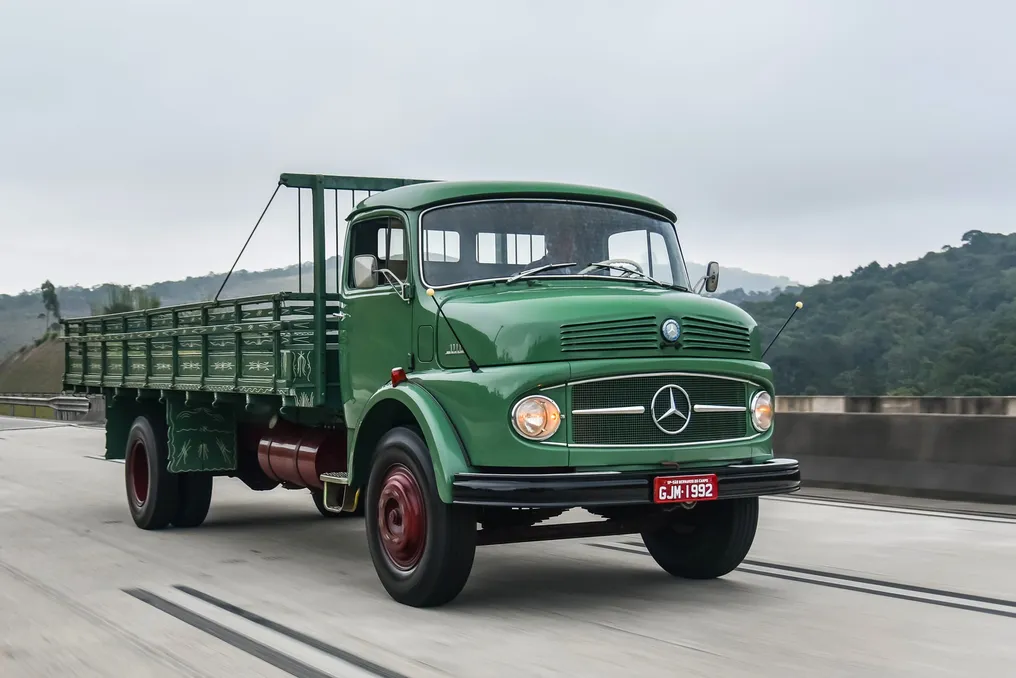
Some time ago, the timeless characteristic of heavy equipment, such as trains, airplanes, ships, and trucks, was mentioned, which seem to follow an evolutionary rhythm distinct from passenger cars. Although the passage of time is more noticeable in a truck than in a boat or military equipment, trucks share ties with cars and frequently attract commercial interest. Some models maintain their visual identity for a longer period, such as certain American and Australian vintage-style trucks, even if technologically advanced, or like the Scania Series 4, which seems to resist aging.
Conversely, there are trucks that persist for too long, resorting to invasive plastic and technical refinements to maintain consumer interest. In these cases, the end of a generation is usually foreshadowed. However, what may seem like an inadequate conclusion is actually the final brilliance of a successful project, otherwise, it would not have lasted so long.
Vehicles that were not discarded or scrapped before the arrival of a completely renewed product were cited. The Opala Diplomata, for example, is a classic case of an aged vehicle that received technical improvements in the last two years, reaching the peak of the Opala as a luxury sedan, despite its aesthetics being criticized by some enthusiasts. This occurred before it was simplified and remodeled with little creativity, as happened with Santana, Monza, or Tempra. The result of these changes was a reduction in internal quality, with inferior finishes and instrumentation, simpler seats, and more rustic steering wheels, in addition to the loss of equipment. Even the Opala's successor suffered this degradation: the 1998 national Chevrolet Omega underwent a process of downgrading, even using a steering wheel from the lower-segment Vectra in the luxurious Omega CD.
Another example cited was the Ford F-1000 equipped with a turbo engine unprecedented in 1991. Although its generational successor was already defined and close to entering production, the old F-1000 concluded its twenty-year bodywork with distinction, driven by a pioneering engine in the segment, significantly more powerful than the naturally aspirated versions. Its finish was meticulous, including commemorative stripes of its unique status, accessories on auxiliary headlights, elaborate paintwork on the front grille, and excellent taste wheels that became highly desired among owners of the time.
Finally, the last vehicle mentioned as one that ended its journey with distinction at the height of its line was the Mercedes-Benz LS 1934 truck. This truck, launched in 1988, represented the highest point of the German manufacturer's AGL cabin. It combined the general circular lines of the cabin with aerodynamic additions and elongated shapes at the front, designed to accommodate the long inline six-cylinder engine (present since 1974). To compete with serious competitors such as the Scania T/R 112 HS Intercooler and Volvo NL 10 340 Power, the new 1934 had crucial mechanical modifications to the OM-355/6 LA engine. However, the most notable aspect was its appearance, which was almost exotic for such a durable platform.
The complete fairings that entirely enveloped the chassis possessed a class and elegance that seemed out of place with the raw nature of a truck built, assembled, and bolted together to pull tens of tons of cargo under any weather or road conditions. Simultaneously, they gave the truck a sporty touch, especially when unhitched, leading to the imagination of a competition truck, a complete subversion of its basic function of heavy cargo transport. It was a Formula Truck before it even existed on Brazilian tracks (the 1987 experience failed deeply, delaying the local category for several years), representing an impressive sight on the roads, although it was still a Mercedes-Benz with an AGL cabin, whose simpler versions were common like bison in the American prairies two hundred years ago.
To understand the arrival of the LS-1934, it is necessary to go back and narrate the creation of what became a Brazilian national institution, nicknamed the 'Fusca of heavy vehicles'. Mercedes-Benz initially introduced its semi-advanced cabin in Germany. Thus, despite the strong cultural association of this model with Brazil, it is important to note that all its planning and development took place at the headquarters, aiming to be a large export product. In March 1959, the company launched this new configuration in Mannheim, following German regulations of 1956, which defined the dimensions and length of trucks. This law, similar to CONTRAN standards in Brazil, forced local manufacturers to adopt the European standard (flat face) to optimize cargo space. Ironically, this national regulation ended the trajectory of a direct successor to the 1959 Mercedes, the Mercedes-Benz Artron, the last blunt heavy truck, in 2020.
Laws that dictate the births and deaths of lineages have existed for ages. To the benefit of its manufacturer, the L Family (Lastwagen - truck in German) quickly conquered the market. Its precise development was crucial for the company's strategic goals of internationalizing its proudly German products. World War II had ended less than eleven years earlier, and Germany was still in the reconstruction phase. Local employment and foreign currency from exports or outsourced production were vital for resuming development, and Mercedes was one of the pillars of the nation, free from the negative influence of the former regime.
Besides the design, the cabin was supported by a large transverse semi-circular spring and a shock absorber, providing better isolation for the driver and passenger from road irregularities, sharing this function with the vehicle's suspension. The German models of that time were designated L-322 and L-327, differing only in load capacity, and the base engine was consistently a six-cylinder inline engine with just over five liters and 110 horsepower at low 3,000 rpm.
In Brazil, this innovation took five years to arrive. Five years may seem like a long time in today's globalized world, but in the 1960s, perhaps not so much. The country was predominantly agricultural and backward, with little information about the outside world; most people were concerned only with other borders, except during the World Cup broadcast on the radio or in cinemas. Imported trucks, on the other hand, kept the country minimally connected to the outside world (something that changed in 1976), but trucks were a niche restricted to companies and industry professionals.
In 1964, a rounded Mercedes truck, quite different from the traditional 'flat face' or 'Torpedo'—the slender, long-nosed LP-312 similar to the German model produced at the same Daimler plant—came off the assembly line at Mercedes in São Bernardo do Campo (factory established in 1956). The L-1111, light aqua green, with an interior made of a checkered twill and using the same 1959 engine from Germany, marked the beginning of a long lineage. Besides being aesthetically pleasing and comfortable due to the mentioned suspension system, its initial line was quite varied to meet various activities. It was available as a standard chassis, short, towed for heavier uses (4x4 in the 'toco'), and even as a light tractor unit.
There was no gasoline engine option, as in the more popular Ford F series or Chevrolet models, and compared to FNM and Scania, the new Mercedes operated in a more modest category, incorporating strengths from both: American versatility and the durable and economical European engine. The diesel engine in 1964 was still an exception, as most powerplants were gasoline-powered, due to the North American origin of light and medium trucks, while diesel faced some resistance due to the perception of expensive maintenance. It became evident that the success of the truck would not depend solely on its appearance or engine; comfort and safety also needed to be differentiators.
In this aspect, the brakes were also superior by using pneumatic assistance, being much safer and more precise than the vacuum systems of trucks in the same category. With a load, a more robust braking system was essential. Thus, the truck was modern and safe, but the engine—and here a questionable tradition was almost consolidated—was limited in power and torque, failing to surpass direct competitors. A Ford V8 offered more speed to medium trucks, preferred for transporting perishable goods before the era of refrigerated trailers, and even the second-generation Chevrolet six-cylinder had more power and torque, both being American gasoline engines.
Almost five years later, in 1969, the engine received a new name and pioneering direct diesel injection was introduced. Power increased to 130 horsepower, and with this change, the truck gained a designation that became synonymous with commercial dominance: 1113. At that time, the Ford F-600 and Chevrolet C-60 no longer had an advantage. The Mercedes-Benz 1113 was a true tank in terms of robustness, combining economy, modern solutions, and simplicity. This technical reliability was not accidental; Karl Benz and Gottlieb Daimler were not just inventors of the automobile and locomotion. Benz developed the first bus in 1895, and Daimler did the same with the truck in 1896. Thus, the history of the brand's improved truck already counted over sixty years of continuous development, which was reflected in the 1113.
Hydraulic steering was also introduced as an option in 1969, a feature that met with some reluctance among Brazilian drivers, despite its approval in automobiles since 1967, such as in the Galaxie line. Many considered the system unsafe in such a large and slow vehicle. The huge, classic white bakelite steering wheel of the Mercedes-Benz resembled the rudder of a ship; the larger the diameter, the greater the leverage to move the front wheels, providing more control when maneuvering a heavy vehicle in case of a tire blowout. Educating the driver about the ease and safety of assisted steering was not a simple process.
On the other hand, the 5.7-liter engine was widely accepted for its efficiency and robustness, serving as a primary power source for other trucks, such as various Ford and Chevrolet models worn out by the war, which originally had expensive gasoline engines. In addition to them, the OM 352 was used in numerous transplants, from tracked tractors to vessels, making it a truly 'global' engine. In the 70s, the cabin...