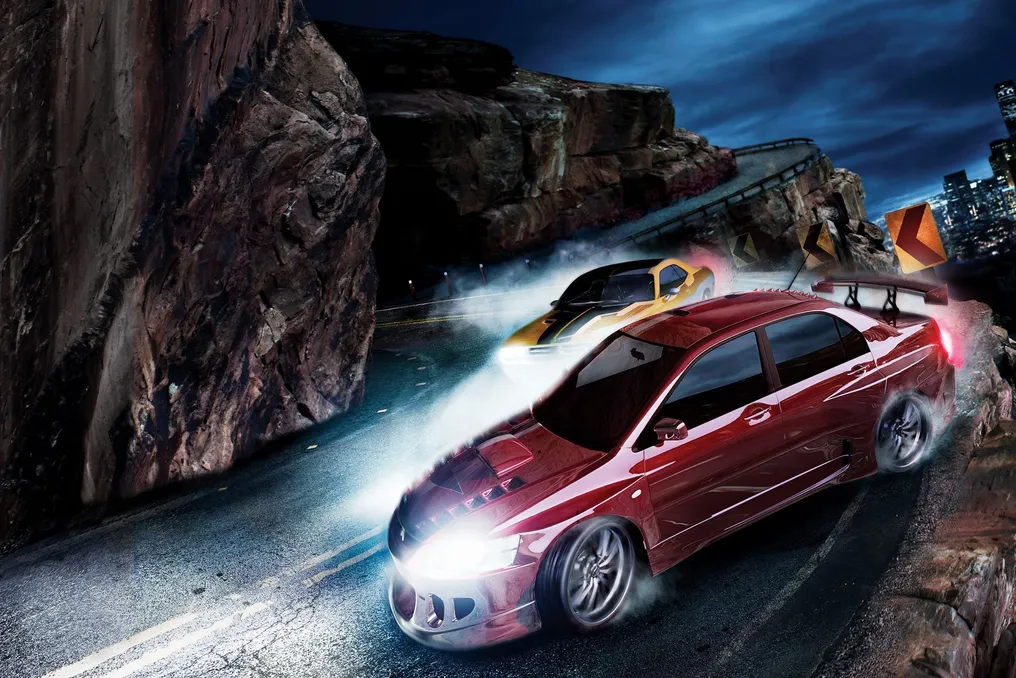
Although it may seem like an outdated commentary, many players feel that Electronic Arts has not produced a truly good Need for Speed in decades. This perception might be due to nostalgia or a reflection of the current state of racing games. A recent analysis of new titles suggests that the franchise struggles to break away from the formula established by Forza Horizon in 2012: open world, racing festival, and a map filled with iconic missions.
The Need for Speed franchise has roots in another era. The first game, The Need for Speed, released in 1994, focused on driving desired sports cars on long road circuits. Its partnership with Road and Track magazine emphasized classic automotive culture, comparing performance and power with detailed visual and narrative content.
This approach continued with the third title, Need for Speed III: Hot Pursuit, from 1998, which introduced the famous high-speed police chases, becoming a trademark of the series.
For many, the peak of Need for Speed occurred in the 2000s, aligning with the cultural wave popularized by action movies. With Underground (2003) and Underground 2 (2004), the series embraced tuning and night racing culture, echoing the aesthetic of Fast and Furious, with elements like neon, NOS, and American rap soundtracks.
Subsequently, Most Wanted (2005) solidified this formula by blending urban culture with daytime police chases and legendary vehicles, such as the BMW M3 GTR, which became a video game icon and inspired BMW's own M division.
Some critics argue that the franchise stagnated after Most Wanted, and that EA failed to reach that level again. Although the 2012 remake was well-received, subsequent attempts at innovation were seen as forced. However, the text presents Need for Speed: Carbon, the direct successor to Most Wanted, which turns 20 in 2026, as an underrated title.
'Most Wanted, but at night'
Need for Speed: Carbon followed the structure of Most Wanted, allowing the player to explore an open map while progressing through a defined narrative. A notable aspect is that its story is a direct continuation of Most Wanted, starting years after the end of the previous game, with the unnamed protagonist returning to the city of Palmont.
From the beginning, the plot sets the tone: after being cornered by the ex-police officer Cross in Carbon Canyon, the character is forced to destroy the M3 GTR and start over. His return revives a turbulent past, involving a rigged race where he was accused of fleeing with money. To restore his reputation, he must conquer Palmont territory by territory.
This storyline connects directly to the mechanics, as the city is divided among dominant gangs, each associated with a distinct vehicle class: Tuners, Muscles, and Exotics, and the player must choose one upon starting.
Carbon's gameplay is very similar to Most Wanted, described as a 'nightly Most Wanted,' although its aesthetic is more subdued than the neon glow of the Underground games. The handling is also similar, demonstrating that EA maintained successful essential elements.
The main evolution lies in car customization through the Autosculpt system, which allowed shaping aerodynamic components and freely placing decals. Furthermore, exclusive parts obtained by completing challenges were available, which could also yield new vehicles.
There was a clear differentiation between car types: Muscles were fast but less dynamic; Tuners were stable and good at corners but slow in acceleration and top speed; and Exotics had higher top speed and better cornering ability than Muscles, but were less stable than Tuners. Fortunately, it was possible to equip the cars to compensate for these weaknesses.
An interesting detail was that the car choice influenced the soundtrack. Imported Japanese cars were accompanied by electronic music from Gary Numan and The Presets; American muscle cars, by rock from Wolfmother and Eagles of Death Metal; and European exotics, by hip-hop from Pharrell and Dynamite MC. In story races or chases, Trevor Morris' original soundtrack was used.
The initial car class determined the player's geographical location on the map. Depending on the chosen class, the campaign began in one of the three main districts of Palmont, transforming the objective of challenging individual racers into a territorial war against gangs. It was necessary to win most races in a region to take control, risking attacks from smaller factions.
Due to the city's division, Carbon introduced the team formation mechanic, allowing the recruitment of track partners (wingmen). During races, a recharge bar limited the use of offensive tactics, such as the Blocker, which collided with opponents, or the Drafter, which created a vacuum to boost the car. Scouts, meanwhile, guided the squad to reveal shortcuts on the minimap.
The climax was the confrontation with the local gang leader upon taking a district. These duels took place on the dangerous mountain roads of Carbon Canyon, in two-phase touge battles, requiring the player to stick close to the opponent and then escape on the descent.
A major highlight of the return to the mountains was the recovery of drifting races, a mode present in the Undergrounds but removed in Most Wanted. In Carbon, drifting was crucial both in urban circuits and on canyon descents. In addition to dedicated scoring, the drifting mechanic aided in recharging Nitro (NOS) and Speedbreaker bars, providing extra boost or controlled deceleration.
This atmosphere of drifting in the abyss mirrored the movies. If the Undergrounds reflected the beginning of Brian and Toretto, Carbon was seen as the counterpart to Fast & Furious: Tokyo Drift (2006). The thematic coincidence was strong, with EA replicating the Japanese mountain subculture in video games.
With the focus on gang rivalry and drift tension, the role of the police changed. Although chases still existed, they were no longer the main objective of the campaign, serving more as an unwanted obstacle.
Despite the innovations and positive critical reception at the time, Carbon carries the stigma of being a secondary game or merely an expansion of Most Wanted, frustrating players accustomed to the police focus of previous titles. However, in retrospect, the text suggests that Carbon was the true peak of the golden age of Need for Speed, surpassing the expectation set by Most Wanted.