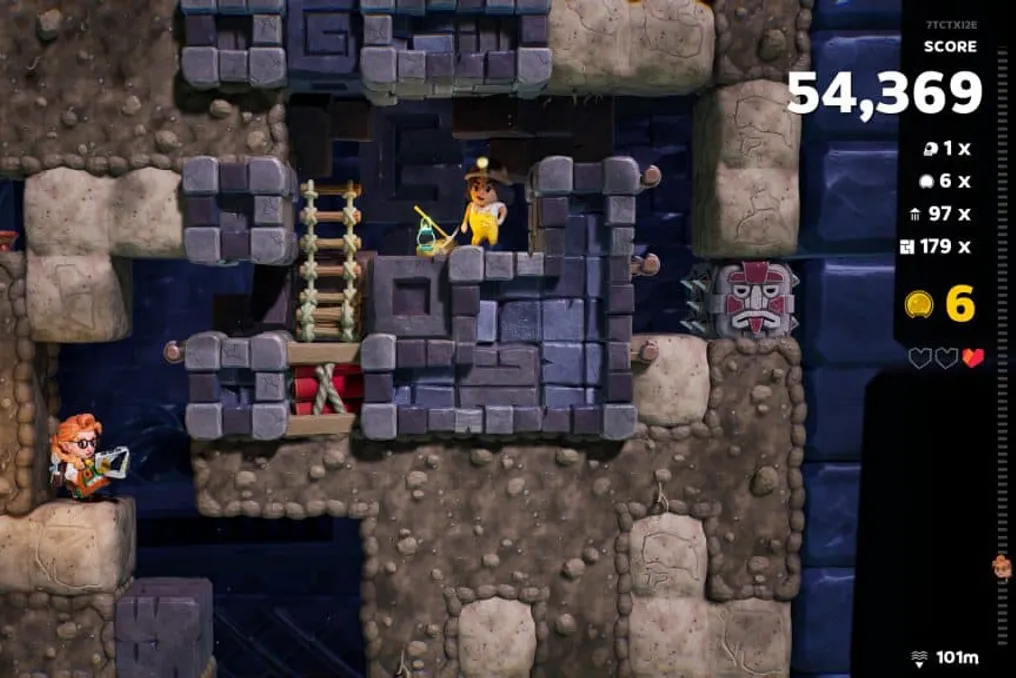
Pit Panic presents a charming facade, but the gameplay experience is marked by constant tension, as it places the player in the role of an archaeologist trapped in a submerging Aztec temple. The core premise requires the player to continuously climb before the structure collapses and the water floods the environment, hence the title's name.
During the ascent, the game introduces various mechanics, including traps, terrain changes, and a versatile grappling hook, which can be used both to destroy blocks and to traverse between platforms and locate hidden treasures. The variation in the order and combination of these elements in each session ensures a continuous sense of discovery.
Developed by the independent studio Flying Rat Studio, Pit Panic was released on July 21, 2026, for multiple platforms, such as PC, PlayStation 5, Xbox, Nintendo Switch, and Switch 2. The review presented in this text was conducted using the PC version.
The title is configured as a precision platformer with a roguelike structure, characterized by permanent death and progression based on player skill rather than permanent upgrades. The maps consist of over a thousand manually designed rooms, which are shuffled into a distinct sequence every playthrough. These rooms are distributed across four biomes, each with its own environmental transformations and traps, such as sand turning into glass or flammable jelly. Furthermore, the game offers leaderboards and daily challenges, as well as a level editor for creating custom challenges.
The first impression of Pit Panic is intentionally misleading. Its cartoonish aesthetic, vibrant colors, and light tone suggest a relaxing and accessible game, but in reality, it is an extremely challenging precision platformer that penalizes minimal errors with severe consequences, potentially deceiving players looking for something more casual.
The most positive aspect of the game lies in how its over a thousand hand-crafted rooms are reorganized into a different sequence with every attempt. This provides a unique experience in each playthrough, requiring the learning of new mechanics or the resolution of unprecedented trap combinations.
However, this random shuffling system carries a drawback: occasionally, rooms are combined in an unsolvable manner, either because blocks do not return or the next block is inaccessible. During testing, this flaw occurred twice in six hours of gameplay, with the only recourse being to wait for the water to reach the character or practice diving to force a restart.
The main obstacle pointed out is the control system. The game requires the player to aim the hook using the right analog stick, while character movement is controlled by the left analog stick, and jumping is triggered by a separate button (X on the PS5 controller), decoupled from the analog sticks. This arrangement results in unintuitive and excessively complex gameplay that does not flow even after long gaming sessions.
A simple alternative, seen in similar games, would be to have the hook aim always follow the direction the character is facing, allowing the player to move and aim simultaneously without relying on two analog sticks executing concurrent functions. The current configuration is what generates the feeling of 'panic' in Pit Panic, not enjoyment.
This detail is crucial, given that in a game like this, control is fundamental. Many of the deaths in Pit Panic are frustrating not due to the intrinsic difficulty of the challenge, but due to the additional difficulty imposed by the command scheme itself.
Another negative point is the absence of any progression goal. Regardless of how far the player advances, death is likely to occur for a trivial reason, such as an object falling on their head out of sight. Upon failing, the player immediately returns to the beginning, at the first temple. There are no checkpoint systems or permanent upgrades that offer a sense of advancement between attempts. After repeating the first temple countless times just to chase a record, the experience becomes tedious, despite the technically variable nature of each round.
The inclusion of some progression element would significantly improve the game. Pit Panic seems designed to be played standing up, in an arcade, competing with friends for the highest score.
In summary, Pit Panic has a solid creative foundation: captivating visuals, handcrafted rooms that reconfigure, and a constant flow of new mechanics. However, this potential is hampered by two critical points: a non-fluid control scheme and the complete lack of progression between attempts. Added to this are the rare but real unsolvable maps generated by random shuffling, resulting in a frustrating game, although rewarding for those who tackle the challenges rigorously.
The game is worth it for those who appreciate precision platformers and possess the necessary patience to get used to the controls. Overcoming these issues, it offers vast content and hours of entertainment. However, those seeking a calmer experience with fewer frustrations may find satisfaction in other similar titles.