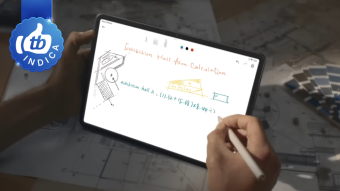
The definition of the best Xiaomi tablet depends on the available budget and the required hardware and features to meet the consumer's usage profile. There are premium models, which are powerful but more expensive; mid-range tablets, which offer a good balance between cost and benefit; and entry-level devices, ideal for simple activities like studying and streaming, suitable for tighter budgets.
To aid in the purchasing decision in 2026, Tecnoblog compiled a list with six Xiaomi tablet models, detailing the pros and cons of each.
Xiaomi Pad 8
The Xiaomi Pad 8 is classified as a premium and robust tablet. It integrates the Snapdragon 8s Gen 4 (4 nm) processor with options for 8 GB or 12 GB of RAM, providing high performance for complex video editing and gaming. Its 11.2-inch LCD screen has a 3.2K resolution (344 PPI) and offers excellent scrolling smoothness thanks to the up to 144 Hz refresh rate. In terms of cameras, the 8 MP (f/2.28) front camera records in Full HD at 30 fps, while the 13 MP (f/2.2) rear lens supports 4K recording at 30 fps.
A feature of the Xiaomi Pad 8 is its large 9,200 mAh battery, which guarantees about 18 hours of continuous video playback. Furthermore, it supports fast charging up to 45 W.
Xiaomi Pad 7
The Xiaomi Pad 7 represents a top-tier option with a more accessible cost. This model is equipped with the Snapdragon 7+ Gen 3 (4 nm) SoC and can be found with 8 GB or 12 GB of RAM. Although its processing power is slightly less than the latest model, it is capable of handling multitasking and gaming without major difficulties.
The screen and camera specifications of the Xiaomi Pad 7 are identical to those of the Xiaomi Pad 8. This includes an 11-inch screen with a 144 Hz refresh rate and a maximum brightness of 800 nits, in addition to a 13 MP (f/2.2) rear camera and an 8 MP (f/2.28) front camera. The device's battery has 8,850 mAh and can last up to 20.4 hours watching videos, with a maximum charging power also set at 45 W.
Poco Pad M1
The Poco Pad M1 is a mid-range tablet suggested for those who need a device for productivity, multitasking, or less demanding gaming. It uses the Snapdragon 7s Gen 4 (4 nm) processor and has a single memory configuration, offering 8 GB of RAM and 256 GB of storage. The camera setup is considered basic, featuring a front lens (8 MP, f/2.3) and a rear lens (8 MP, f/2.0), both recording in 1080p at 30 frames per second.
Its 12.1-inch LCD screen with 2.5K resolution and 120 Hz refresh rate provides good fluidity, but the maximum brightness of 600 nits limits its visibility in direct sunlight. Conversely, the Poco Pad M1 boasts the largest battery ever seen in a brand tablet, with 12,000 mAh, and supports 33 W fast charging, in addition to reverse charging limited to 27 W.
Redmi Pad 2 Pro
The Redmi Pad 2 Pro shares the same Snapdragon 7s Gen 4 (4 nm) processor as the Poco Pad M1 and is recommended for intermediate tasks and not very intensive gaming. The main distinction lies in the memory configurations: the Redmi Pad 2 Pro is available in versions with 6 GB of RAM and 128 GB of storage, or 8 GB of RAM with 256 GB of internal memory.
This tablet has a 12.1-inch 2.5K LCD screen with a 120 Hz refresh rate and a peak brightness of 600 nits, including an 8 MP (f/2.28) selfie front camera. The rear camera consists of a single 8 MP (f/2.0) lens, and both record up to 1080p at 30 fps. The 12,000 mAh battery offers autonomy for up to 14.2 hours of continuous video playback and supports 33 W fast charging. Additionally, there is a 5G variant that allows internet access via mobile data.
Redmi Pad 2
The Redmi Pad 2 is powered by the MediaTek Helio G100-Ultra (6 nm) chip and features 8 GB of RAM. Its specifications make it ideal for web browsing, streaming, and studying. The 11-inch display with 2.5K resolution offers good fluidity, although its 90 Hz refresh rate is lower than the other listed models. Both the rear camera (8 MP, f/2.0) and the front camera (5 MP, f/2.2) record in Full HD at 30 frames per second.
This model's battery has a capacity of 9,000 mAh and promises up to 17 hours of video playback. The 4G variant allows the use of a SIM chip for internet connection without relying on Wi-Fi networks.
Redmi Pad SE
Considered the most basic Xiaomi tablet in the selection, the Redmi Pad SE uses the Snapdragon 680 (6 nm) processor and offers options of 4 GB, 6 GB, or 8 GB of RAM. It is designed for simple daily tasks, and it is advisable to opt for the version with more memory to prevent crashes. The rear (8 MP, f/2.0) and front (5 MP, f/2.2) lenses are modest but manage to record in Full HD at 30 fps. The 11-inch FHD+ LCD screen offers good fluidity, despite having reduced visibility in sunlight due to a maximum brightness of only 400 nits.
The 8,000 mAh battery offers good duration, reaching up to 14 hours of video, but charging is slower, limited to 10 W.
When choosing the best Xiaomi tablet, it is essential to weigh the available budget against the necessary specifications to meet your own demands. The Redmi Pad 2 is pointed out as an economical option for limited budgets, with a fluid screen (90 Hz) and a battery that lasts all day, in addition to 4G functionality. Meanwhile, the Xiaomi Pad 8 stands out for offering the best specifications for gaming, driven by the Snapdragon 8s Gen 4 chip and 144 Hz screen, complemented by a 9,200 mAh battery for long sessions.
It is important to note that none of the Xiaomi tablets presented in the list include a stylus in the box. For those looking for a tablet with an included stylus, alternative models such as Galaxy Tab S10 FE, Lenovo Idea Tab, and Vaio TL 12 are suggested.