The first photograph of a black hole, published in 2019, was not transmitted over the internet or via flash drives; instead, it traveled inside hard drives, luggage, and airplanes. The volume of collected data proved too large for any network transmission.
The image shows M87*, a supermassive black hole located at the center of the Messier 87 galaxy, approximately 55 million light-years from Earth. To obtain this picture, the Event Horizon Telescope (EHT) collaboration had to solve a logistical problem comparable to a scientific challenge.
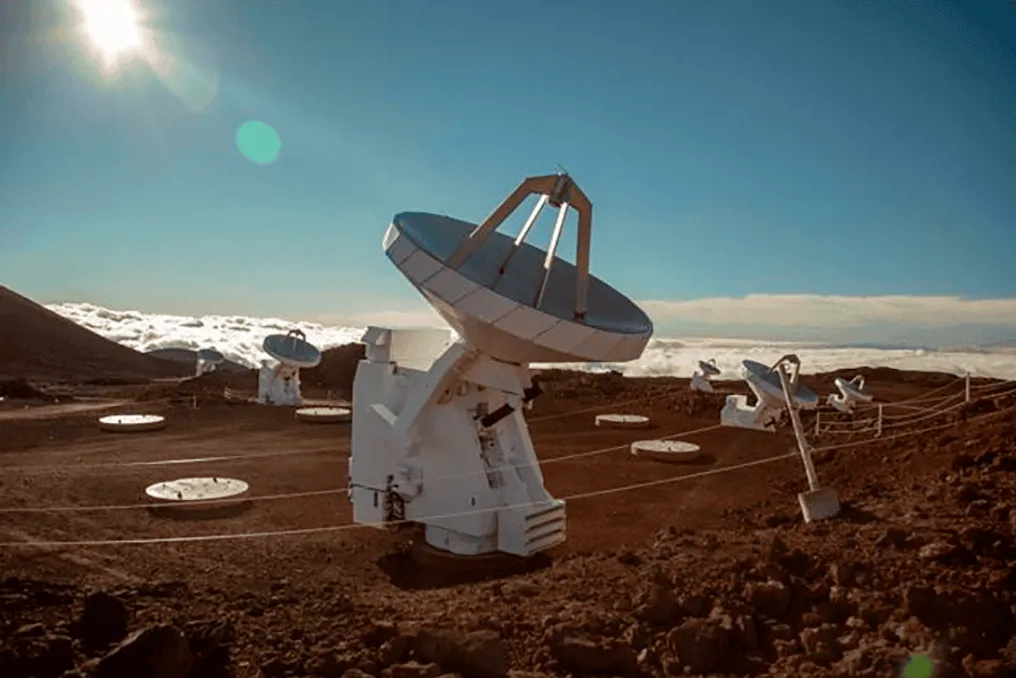
No single radio telescope has sufficient range to photograph something as tiny and distant as the shadow of a black hole. The solution was to combine antennas scattered across the globe: in Hawaii (USA), Arizona (USA), Mexico, Chile, Spain, and Antarctica. Together, they functioned as a single Earth-sized instrument.
This method is called Very Long Baseline Interferometry, or VLBI. Each antenna records the same cosmic radio signal, using atomic clocks to precisely determine the moment the wave arrived. Supercomputers then combine the recordings from all stations, much like assembling a puzzle.
In April 2017, eight radio telescopes simultaneously targeted the center of M87 during a favorable weather window across all locations. The result was about five petabytes of raw data—equivalent to thousands of filled home hard drives. One petabyte equals one thousand terabytes, an unmanageable volume for internet transfer even today.
The solution was to record everything onto hard drives and physically ship them—by plane, ship, and truck—to two processing centers: the Max Planck Institute for Radio Astronomy in Germany and the High Tech Massachusetts Institute of Technology (MIT) observatory in the United States. This worked in most places. A problem arose with the South Pole Telescope in Antarctica. This continent is isolated by winds and snowfall from February to October, a period when no cargo planes can land or take off from there. The drives collected in April 2017 could only leave the continent months later, when the Antarctic summer allowed flights to resume.
After the data merging, the work was not finished. Researchers independently ran various image reconstruction algorithms to ensure that the detected ring of light was not a processing error. Only after this cross-verification was the result presented to the world on April 10, 2019: an orange and irregular ring outlining a dark area—the shadow cast by M87* onto the surrounding glowing gas.
Next time someone mentions 'moving to the cloud,' remember that the greatest astronomical discovery of the decade traveled by airplane, tucked away in a suitcase.