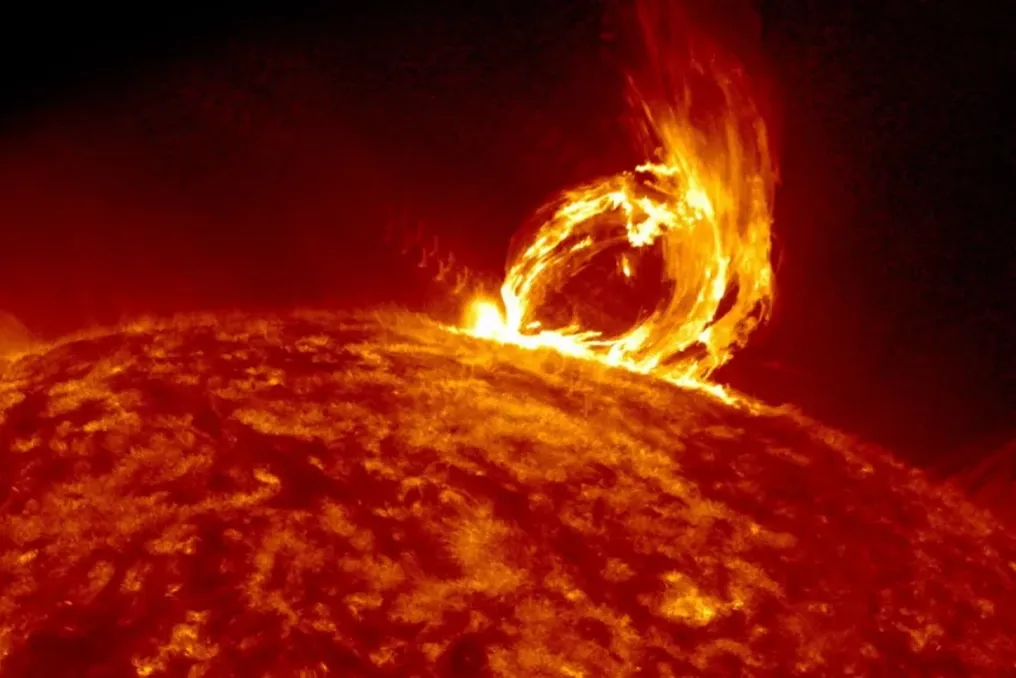
According to the NOAA Space Weather Prediction Center (SWPC), a solar storm may reach Earth between Thursday (27) and Friday (28). This phenomenon will be caused by a combination of faster solar winds and particles released by the Sun during recent flares.
The forecast intensified after an M6.9 class flare registered on August 25. Depending on the intensity of these particles' arrival at Earth, polar lights may be observed in regions located further south than usual.
The flare occurred in the area of sunspot 4513, which was highly active. According to SpaceWeatherLive, five M-class solar flares were recorded in the previous 24 hours. Solar flares are classified into five levels: A, B, C, M, and X; the higher the letter, the more intense the flare. M-class flares are considered among the strongest, second only to class X.
Solar activity also triggered moderate radio interference, classified as R2. This incident affected high-frequency communication on the Earth side facing the Sun, particularly in regions of Africa, Europe, and the Arctic.
Before the Coronal Mass Ejections (CMEs) reach Earth, a faster stream of solar wind must arrive at the planet. This stream is associated with a so-called coronal hole—an area on the Sun from which material can exit at an increased speed.
Geomagnetic Activity Forecasts
Because of this, NOAA forecasts a G1 level geomagnetic storm on Thursday (27), with the forecast increasing to G2 on Friday (28), which is considered a moderate level.
The aurora borealis occurs when particles from the Sun interact with the Earth's magnetic field and atmospheric gases. This phenomenon is usually observed more frequently near the poles.
Possible Expansion of Visibility Zone
However, a G2 storm is capable of expanding this interaction zone. As a result, northern regions of the United States and Europe may have favorable conditions for observing the lights.
A key element in this process is the direction of the magnetic field of the particles arriving from the Sun. If this field is oriented southward, the interaction with the Earth's magnetic field generally becomes more intense. This can enhance geomagnetic activity and cause stronger lights visible in areas further from the poles.
The arrival time of the CMEs will also be important. Therefore, the intensity and visibility zone of the lights may change as new data is incorporated into forecasting models.