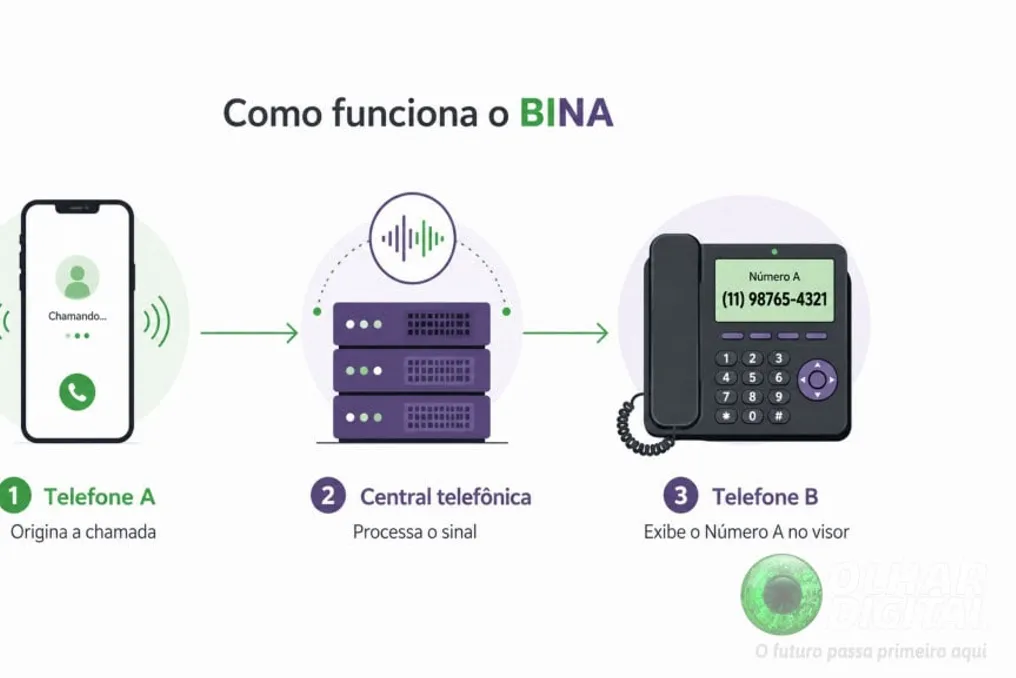
The Bina technology, an essential feature in modern smartphones for identifying calls, has its roots in an invention made by Nélio José Nicolai, a resident of Minas Gerais. Although it is seemingly a simple system today, knowing who was calling was a challenge in the era of landlines.
The idea came to Nicolai's mind in 1977 while he worked at the state telephone company in Brasília. His goal was to solve the problem of anonymous pranks that affected both providers and users. After creating the caller identification technology, he named it Bina, which is an acronym for 'B Identifies the Number A.'
Born in Belo Horizonte (MG), Nélio José Nicolai was the son of one of the founders of Cruzeiro and played football until the age of 21, before enrolling in a technical course and graduating in electrical engineering. He always considered himself an inventor.
In an interview given to Piauí magazine in 2012, Nicolai revealed that many of his ideas came from dreams. Bina was one of them, and he filed the patent in 1980, obtaining registration eight years later. Telephone companies began adopting Bina globally, and Nicolai, known as Nicolai do Bina, traveled the world lecturing about his creation.
However, in Brazil, he faced long legal disputes to obtain due recognition and, especially, royalties. According to Nicolai, during the conversation with Piauí, the telephone companies owed R$ 185 billion in royalties, already monetarily corrected. Despite receiving some amount, it did not approach the billion-dollar figure.
His legal battle in Brazil began in 1998, when he claimed royalties related to a 1997 patent, which was an adaptation of Bina for digital telephone exchanges, a period when mobile phones were beginning to appear on the market. When he charged the operators for using the technology, he was met with disdain, being told that he would have to resort to the courts.
In September 2012, he achieved his first legal victory. The 2nd Civil Court of Brasília determined that Vivo must pay in court 25% of the amount requested by Nicolai. At that time, he informed Piauí that the company had not yet made the payment. Furthermore, he mentioned having signed an agreement with Claro, which recognized the patent, although a confidentiality clause prevented the disclosure of the amount, stating that it was 'a few million, but not even a tenth of what they owe me.'
Nicolai died on October 11, 2017, at the age of 77, in Brasília (DF), without seeing the full outcome of his legal actions. His processes were inherited by his family and his company, named Lune, and remain ongoing.