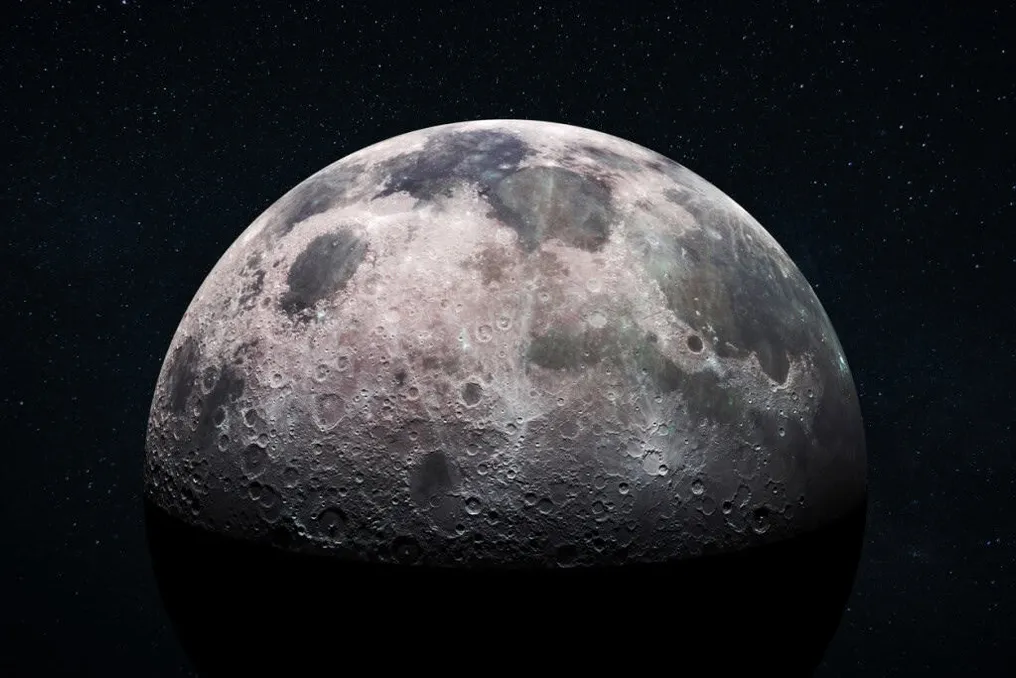
The Moon is moving away from the Earth by approximately 3.8 centimeters annually. Scientists track this movement using laser pulses sent from Earth to reflectors installed on the lunar surface. This method allows for the measurement of the distance between the Earth and the Moon with exceptional accuracy.
The key to this process is the lunar reflectors—optical devices that return light in the direction it arrived. Three sets were installed by astronauts during the Apollo 11, Apollo 14, and Apollo 15 missions. Similar equipment was delivered by two Soviet missions: Luna-17 with the Lunokhod-1 rover and Luna-21 with Lunokhod-2.
The procedure is straightforward: an ground observatory directs a laser pulse at a reflector. The equipment returns a small portion of the light, which is then recorded on Earth. Researchers calculate the distance traveled by the light by measuring the interval between sending and receiving the pulse. Since the speed of light is known, even the slightest deviations in flight time indicate a change in the Moon's position.
In practice, the task is highly complex. On average, the Moon is located about 385 thousand kilometers from Earth, and the laser beam scatters as it passes through the atmosphere. Only an infinitesimally small amount of the light sent reaches the ground equipment.
Nevertheless, decades of observations allow scientists to monitor lunar movement with high precision. The reflectors continue to be used in studies of the dynamics of the Earth-Moon system and gravity. The Lunokhod rovers' equipment also has an interesting history: the reflectors installed on the two Soviet rovers were manufactured in France and delivered to the lunar surface by Soviet missions. The Lunokhod-1 rover, which was long missing its precise location, was found in 2010, allowing laser measurements to resume from its reflector.
The Moon's recession is linked to tides, primarily caused by the gravitational pull of the Moon on Earth's oceans. Because the Earth rotates faster than the Moon completes its orbit, the distribution of tides slightly precedes the satellite's position. This configuration facilitates the transfer of some angular momentum—a quantity related to rotational and orbital motion—from the Earth to the Moon.
Essentially, the Earth is slowly losing some of its rotational speed, while the Moon gains orbital energy and occupies a slightly more distant orbit. The result observed today is an average recession of about 3.8 centimeters per year. It is important to understand that this does not mean the Moon is simply leaving Earth's gravitational field; it remains bound to Earth by gravity and continues to orbit. The change occurs extremely slowly.
A similar process also affects the length of the day. Tidal friction slows down the Earth's rotation, contributing to a gradual increase in the length of days. The contribution related to tides is estimated at about 2.3–2.4 milliseconds per century. However, this does not mean that all days have exactly this additional duration, as the Earth's rotation is also subject to the influence of other phenomena, including changes in the atmosphere, oceans, the planet's core, as well as the distribution of ice and water. In daily life, this difference is imperceptible, but instruments capable of measuring time and Earth's rotation record these minor fluctuations. Thus, the equipment installed on the Moon over fifty years ago continues to help scientists track a change that is also occurring slowly in the Earth's natural clock.