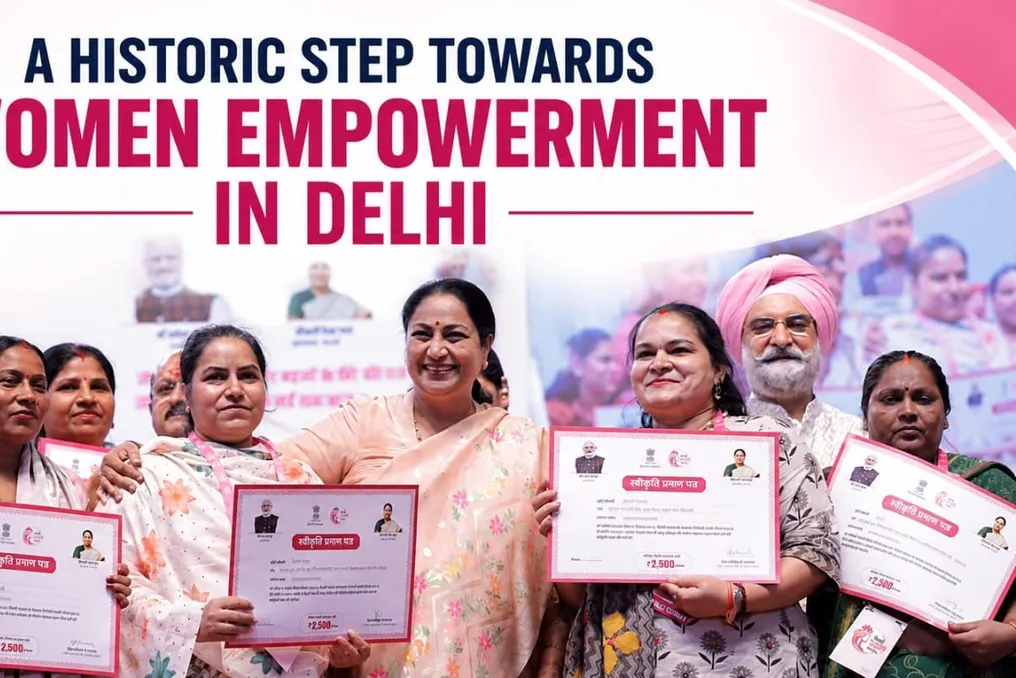
The Delhi Lakshmi Yojana program was officially launched on August 26, 2026. During the event, Minister Rekha Gupta handed over the first batch of sanction letters to beneficiary women at the Talkatora Stadium in New Delhi. This scheme provides eligible women aged between 21 and 60 from low-income families in the capital with a monthly sum of 2500 rupees, with the first transfers scheduled for September 1, 2026.
Present at the ceremony were Deputy Governor Taranjit Singh Sandhu and Union Minister Harsh Malhotra. A distinguishing feature of this program compared to similar government initiatives is not only the declared amount. A significant portion of the funds is directed into a blocked savings instrument, and the government openly positions the payment as seed capital rather than monthly assistance.
From Portal to Payment in Less Than a Month
Registration began on August 1, 2026, through the portal of the Department of Women and Child Affairs. As of noon on August 25, official statistics showed that 913,495 people had registered, and the number of completed applications reached 652,223. Gupta stated at the launch ceremony that nearly 9.5 lakh women had registered in a month. The Delhi government has allocated 5,100 crore rupees for this scheme for 2026–27 and aims to ultimately cover more than 17 lakh women. Initially, the initiative was announced as Mahila Samriddhi Yojana before being implemented under its current name.
According to the Delhi government release, the first batch of sanction letters amounted to about 4000, whereas PTI reported that approximately 2500 women received approval at the ceremony itself.
1000 Rupees for Expenses, 1500 Rupees for Savings
Under the standard option, 1500 rupees in monthly support is deposited into a term or fixed deposit account with a lock-in period until July 31, 2029. The remaining 1000 rupees are credited to a bank account linked to the Central Bank Digital Currency (CBDC) wallet. Recipients can choose the option of directing the entire amount of 2500 rupees into an RD or FD, provided the same lock-in period is observed.
Spending through the CBDC wallet is restricted to a list of goods approved by the government, including alcohol, tobacco products, narcotics and psychotropic substances, lottery tickets, as well as gambling and betting. Applicants choosing the wallet-linked option must confirm they have a smartphone and a bank account participating in the CBDC ecosystem.
Eligibility criteria are strictly set. The annual income ceiling for a family is 2.5 lakh rupees; applicants must be registered voters in Delhi and meet the residency requirement of 10 years. Generally, only the eldest suitable woman in the household is eligible. Households consuming more than 2400 units of electricity per year, owning a four-wheeler, or having more than three children are excluded, as are income tax payers filing GST returns, government employees, persons holding public office, and recipients of certain government pensions.
Entrepreneurial Approach from the Scheme Managing Department
Speaking at the launch, Dr. Rashmi Singh, IAS, Secretary of the Department of Women and Child Affairs of the NCT of Delhi Government, presented the money not as a right, but as a starting point. According to her, 'this is not just a means of providing financial aid, it is also a powerful opportunity for our recipient sisters to realize their boldest dreams.'
She clarified how this opportunity looks. In her assertion, thanks to the program, 'our sisters can start new businesses, join self-help groups, and develop their talents and skills.' Singh, who also chairs the Delhi Commission for Women, noted that the pace of implementation is determined by district-level approval committees, district administrations, departmental staff, and Anganwadi workers.
How Exactly Does Savings Lock-in Help the Recipient?
Most direct cash transfer schemes for women, including Karnataka's Gruha Lakshmi scheme of 2000 rupees per month and Haryana's Deendayal Lado Lakshmi Yojana of 2100 rupees, provide the full amount directly to the recipient every month. Delhi separates income support from asset creation.
The calculation is simple: with a monthly contribution of 1500 rupees, the recipient accumulates a principal capital of 54,000 rupees over three years, excluding interest. Choosing the option with the full amount of 2500 rupees increases this sum to 90,000 rupees. For a household with an income below the 2.5 lakh rupee threshold, this capital can finance a small business or a skills upgrade course instead of being consumed by monthly expenses.
The compromise lies in liquidity. A family under immediate pressure receives 1000 rupees per month in usable cash, not 2500 rupees, unless the design allows for early withdrawal in difficult cases.
What to Watch Out For Starting in September
Registration remains open throughout the year, with the last day of each month considered the deadline, meaning the recipient base will continue to grow far beyond the initial cohort. The real test begins on September 1, when the first transfers arrive, making clear the difference between the 9.5 lakh registered and the number actually verified and approved. A more complex question will arise later. If the program's entrepreneurial and self-help group focus is meaningful, it will require a visible link to existing Delhi training and self-help group mechanisms, not just a deposit whose maturity date is July 2029.
}, {