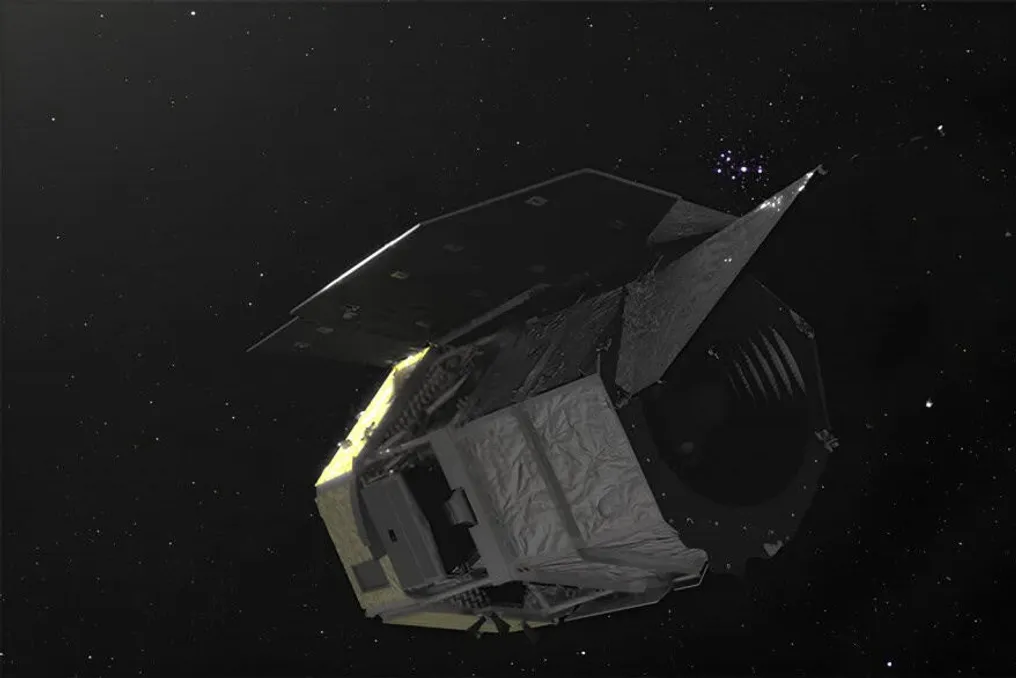
A new phase in space exploration is about to begin with the launch of the Nancy Grace Roman Space Telescope by NASA. The event will take place this Sunday, the 30th, at 8:26 AM Brasília time.
This observatory was designed to investigate how the Universe originated, how it has evolved over time, and what its future transformations might be. Thanks to its sophisticated instruments, Roman will enable the observation of vast portions of the sky, allowing scientists to deepen their understanding of galaxy formation and evolution.
Furthermore, the telescope will be used to investigate concepts such as dark energy and dark matter, as well as to study planets orbiting other stars. One of the main focuses is the search for distant planets, whose observations will help determine if there are worlds capable of sustaining life in the Universe.
The equipment, named in honor of astronomer Nancy Grace Roman, considered a pioneer of the Hubble Space Telescope, will be placed into orbit aboard a Falcon Heavy rocket provided by SpaceX. After the launch, it will proceed to Lagrange Point 2, located approximately 1.5 million kilometers from Earth.
With a field of view greater than that of Hubble, Roman will be able to map large celestial areas quickly, generating an extensive survey of galaxies, stars, and other celestial bodies. The mission will also pay special attention to exoplanets, using methods such as coronography and gravitational microlensing to identify and analyze various types of worlds outside our Solar System.
Investigation of Cosmic Mysteries
Another fundamental objective of the mission is to investigate dark matter and dark energy, which represent two of the greatest enigmas of cosmology. The data collected will contribute significantly to a better understanding of the expansion and evolution of the Universe.
Although Roman does not have the capacity to directly detect signs of life on Earth-like planets, it will aid in developing essential knowledge and technologies for future expeditions aimed at finding habitable environments.
NASA plans for the observatory's operation to last at least five years, during which time it is expected to produce about 20 petabytes of data. This will allow Roman to considerably expand knowledge about the Universe, paving the way for the next generations of space telescopes.
To follow this historic event, Olhar Digital will broadcast live, starting at 7:45 AM, with the participation of Bruno Capozzi, the site's executive editor, and astronomer Marcelo Zurita.