
Agentrys raised $24.5 million to automate chip design using AI agents
Read more
Ventureburn
ventureburn.com

Agentrys raised $24.5 million to automate chip design using AI agents

Agentrys has successfully raised $24.5 million to integrate intelligent AI agents into the microchip development automation process. This funding comprises a $19.1 million seed round that was oversubscribed, and a $5.4 million pre-seed round.

Etna Labs led the seed round financing, while MediaTek spearheaded the earlier pre-seed investment. The capital raised will be used for hiring personnel, developing agent-specific tools, and expanding client engagement.

Founded by Mark Ren, Agentrys develops a concept it calls Agentic Design Automation (ADA). This approach goes beyond traditional EDA software, which only automates individual engineering tasks. Instead, it enables semiconductor teams to create AI-based workforces capable of managing and refining entire design cycles.

Chip development traditionally relies heavily on highly skilled engineers and thousands of hours of manual labor. Agentrys aims to reduce this burden by integrating autonomous agents directly into existing engineering environments. The company's platform is compatible with commercial EDA tools, proprietary software, and infrastructure.

The company asserts that its open architecture allows clients to build and own agent workforces tailored to their unique processes. Furthermore, the intelligent design layer learns from client data, workflow activity, and evaluation signals.

Agentrys demonstrated its platform using an autonomous multi-agent workflow for a 32-bit central processor. The system progressed from specification to final GDS layout with verification, requiring no human intervention. The company also reported achieving over 90% accuracy when tested against NVIDIA's public CVDP benchmark.

The new funding will provide Agentrys with additional resources to advance its engineering and research capabilities. Plans include hiring specialists and creating agent-focused tools for semiconductor workflows. The company also intends to expand collaboration with clients in verification and physical design areas.

Mark Ren, founder and CEO, noted that 'creating production agents that reliably automate real engineering work is far from simple.' He emphasized that Agentrys helps engineering teams transform manual operations into continuously improving agent workforces.

Representatives from Etna Labs noted that chip design is particularly suited for recursive improvement via AI, as engineering outcomes can be objectively assessed. MediaTek also highlighted the potential for extracting and systematically reusing semiconductor knowledge during the chip design process.

Agentrys currently works with fabless design companies, global foundries, and emerging chip startups. Their current projects cover digital and analog design schemes, while system design is planned for the company.

The company's long-term goal is to make AI systems increasingly competent throughout the entire semiconductor design lifecycle. Each workflow execution can generate engineering insights that are then used for subsequent evaluation and improvements.

This model potentially allows companies to retain specialized knowledge while reducing dependence on scarce engineering expertise. It also empowers design teams to customize AI agents to their specific processes and infrastructure. Agentrys believes this approach can create a cumulative advantage for semiconductor companies, allowing clients to develop systems perfectly aligned with their workflows rather than renting generic AI capabilities.

Ren previously worked in AI and EDA research at NVIDIA Research and IBM Research. He also led the ChipNeMo initiative, an early industrial effort to create large language models focused on chip design. This creates a system designed to enhance its capabilities with repeated use by engineers.

Similar stories

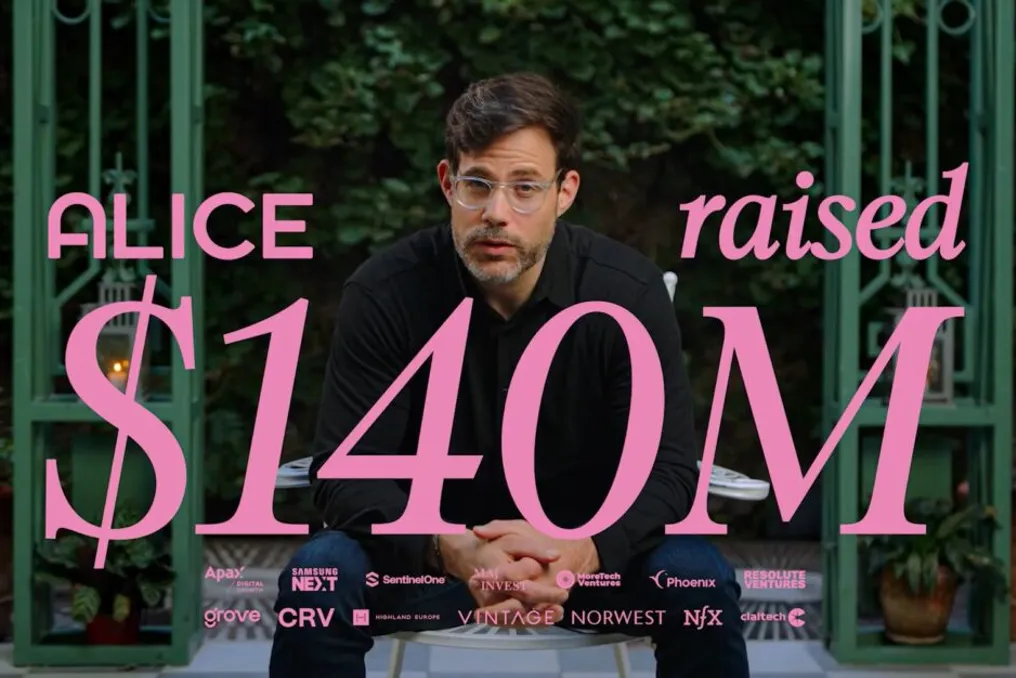
Company Alice raises $140 million to secure AI amid rising number of attacks
Read more
ventureburn.com

Company Alice raises $140 million to secure AI amid rising number of attacks

Alice, a company specializing in artificial intelligence security, has raised $140 million in a new funding round. These funds are intended to help businesses defend against attacks that have only emerged in the last year.

The startup aims to solve the problem of democratizing AI capabilities without democratizing defense methods, which leaves large corporations vulnerable to malicious prompt injections.

Apax Digital Funds led this round. Other participants included Samsung, SentinelOne, MoreTech, Phoenix Financial, as well as existing investors such as CRV, Norwest, and NFX. With this new capital, Alice's total funding has reached $280 million. Apax Digital will also take a seat on the company's board of directors. Alice plans to use the received money to develop its AI platform, expand its data team, and scale sales.

The company is demonstrating rapid growth: its AI business has increased by over 500% in the last two years, and revenue has approached $100 million in Annual Recurring Revenue (ARR).

Alice, formerly known as ActiveFence, is an AI trust and security company based in New York and Tel Aviv. Its core value is a dataset called Rabbit Hole. This massive dataset was collected over nearly ten years by tracking fraud, extremism, and manipulation on platforms like Google, Meta, TikTok, and Amazon, representing one of the largest global collections of real attack data.

Thanks to this history, Alice can recognize new AI attacks because it has seen similar tricks before. Currently, the company protects over 3 billion users online and collaborates with eight out of ten leading AI labs. It is important to note that the company does not sell its services to individual consumers; its target audience is labs developing foundational models and enterprises implementing internal AI agents.

CEO Noam Schwartz emphasizes: 'There are infinite ways to hack AI, and you cannot defend against what you have never seen.' The main challenge is speed, as AI capabilities are released publicly very quickly, while defense systems cannot keep up with this pace.

As AI agents gain greater autonomy, they can perform actions that developers did not anticipate. Furthermore, hackers are using AI to conduct attacks, significantly expanding the attack surface. According to the International AI Security Report for 2026, defenses remain vulnerable as new attack methods emerge, prompting labs and enterprises to prioritize AI security right now.

Alice was founded in 2018. The team spent years combating fraud and extremism on major global platforms, and now this experience is being applied to the AI sector. The company manages one of the largest AI security research labs, comprising over 150 researchers who study AI manipulations and methods to prevent them.

Apax partner Patrick Kane noted that just as cloud technologies created a new security category, AI is doing the same. Since adversaries are using AI, defenders will need tests and guardrails from Alice.

Keenable raises $26 million to build search engine for AI agents
Read more
ventureburn.com

Keenable raises $26 million to build search engine for AI agents

Keenable, a San Francisco startup, has raised $26 million in a seed funding round to develop a search engine specifically designed for artificial intelligence. Unlike traditional search engines like Google, which were built for humans where entering a few words and clicking the first result is sufficient, an AI agent may require analyzing thousands of pages to answer a single question.

Accel led this round, with participation from Conviction Partners and investors from Amazon, Google, and Databricks. The company was founded by Andrey Styskin and Matthias Petri in 2025.

Both founders spent twenty years working at major search engines before observing how AI is transforming the field. As early as 2024, at the USC-Amazon symposium, Styskin warned that scanning the entire internet for large language models (LLMs) would become too expensive without a new index design. Petri's research focused on low-latency retrieval and compression—problems currently faced by AI agents.

After leaving Amazon, they decided to 'separate' search from large tech companies and offer it as infrastructure accessible to any AI company. Keenable has already amassed a massive library of internet data for AI use, boasting a web index of over one hundred billion documents. AI laboratories are already using their API for both training and live searching. Furthermore, the company has partnered with the voice AI company Gradium.

Keenable is developing a 'Web Query Language' that will allow AI to synthesize answers from multiple websites. They also provide a 'point-in-time retrieval' feature, enabling AI to view the appearance of a webpage on a specific date. Service costs start at $1 per 1000 API queries.

Keenable's technology allows for rapid narrowing of searches based on AI prompts, which, according to the founders, makes web search approximately 10 times cheaper for AI workloads. This is becoming relevant as Google and Microsoft restrict access to their search APIs, leaving AI companies searching for new solutions. Keenable is not aimed at standard Google searches but at AI agents performing tasks such as market mapping, price monitoring, and lead research—any work requiring fast reading and summarization of large volumes of web pages.

With the new capital, Keenable plans to double its staff by the end of the year, growing its current team of about fifteen people to thirty by the end of 2026. The main product goal is the 'Web Query Language,' and the ultimate goal is to make full-scale web search significantly more accessible so that every AI application can afford to stay up-to-date.

Twin1 AI raises $20 million to scale AI-powered digital twins for professionals
Read more
ventureburn.com

Twin1 AI raises $20 million to scale AI-powered digital twins for professionals

Twin1 AI has successfully raised $20 million in a seed funding round while simultaneously moving its product out of stealth development. The company creates artificial intelligence-based digital twins designed for knowledge workers.

The funding round was co-led by venture capital firms Bessemer Venture Partners, Tribeca Venture Partners, and Aramco Ventures. The company plans to expand its teams in San Mateo and London, as well as invest in technology development and marketing activities. The Twin1 platform is designed to preserve professional knowledge, judgment, and work context.

The company's goal is to help organizations scale this expertise through artificial intelligence. Twin1's approach prioritizes privacy and human oversight when implementing enterprise AI. This provides the company with capital for developing commercial operations and technologies.

Twin1 provides every specialist with an AI-managed digital twin that evolves alongside their work. These twins have access to authorized emails, meetings, documents, and work systems. Using this context, they can respond to queries and assist in completing business tasks.

The company claims that its system can enhance existing AI agents through deeper professional context, leading to more personalized enterprise AI implementation. Twin1 has developed six levels of privacy and governance control. These mechanisms regulate interactions between humans, digital twins, and AI systems, integrating corporate policies, existing permissions, and human approval requirements, which prevents unauthorized access to confidential knowledge.

Furthermore, Twin1 manages a network that connects individual digital twins across different organizations. This allows for the identification of relevant expertise and coordination of work by gathering information while respecting permissions, yet maintaining human control. This forms a level of coordination between humans and enterprise AI agents. The company also offers a model context protocol server for enterprises, which grants approved AI agents and corporate tools access to controlled context.

The system can also initiate actions based on information contained within individual twins. Twin1 calls this approach the foundation for sovereign enterprise AI. The platform has already been implemented by partners in various industries, including legal, financial, and energy companies. Clients mentioned include Linklaters, Orrick, Dechert, Customers Bank, and Aegis Energy; the company reports that some clients have automated between 30% and 50% of communication work.

Twin1 was founded in 2025 by individuals such as Lewis Liu, Tom Cahn, Huiting Liu, and Jonathan Budd. The founders previously worked on enterprise AI through Eigen Technologies. Several investors from Eigen also participated in the new funding round. This support reflects continued confidence in the team's experience in enterprise technologies. CEO Lewis Liu emphasized that human expertise remains central to knowledge-based organizations, stating that AI should augment individual knowledge, not generate generic outputs.

Twin1 aims to preserve professional judgment while increasing the reach of each employee, believing this will help expertise accumulate across different organizations. Bessemer Venture Partners noted that corporate knowledge remains fragmented across organizations and believes Twin1 can provide a contextual layer between teams and systems. Tribeca Venture Partners described the platform as a coordination layer for enterprise AI, while Aramco Ventures highlighted the team's experience working with regulated corporate environments. The next phase of work will focus on increasing adoption in knowledge-intensive industries. The company positions individual digital twins as a new interface for enterprise AI, and its success will depend on the balance between automation, privacy, governance, and human agency.

Popular