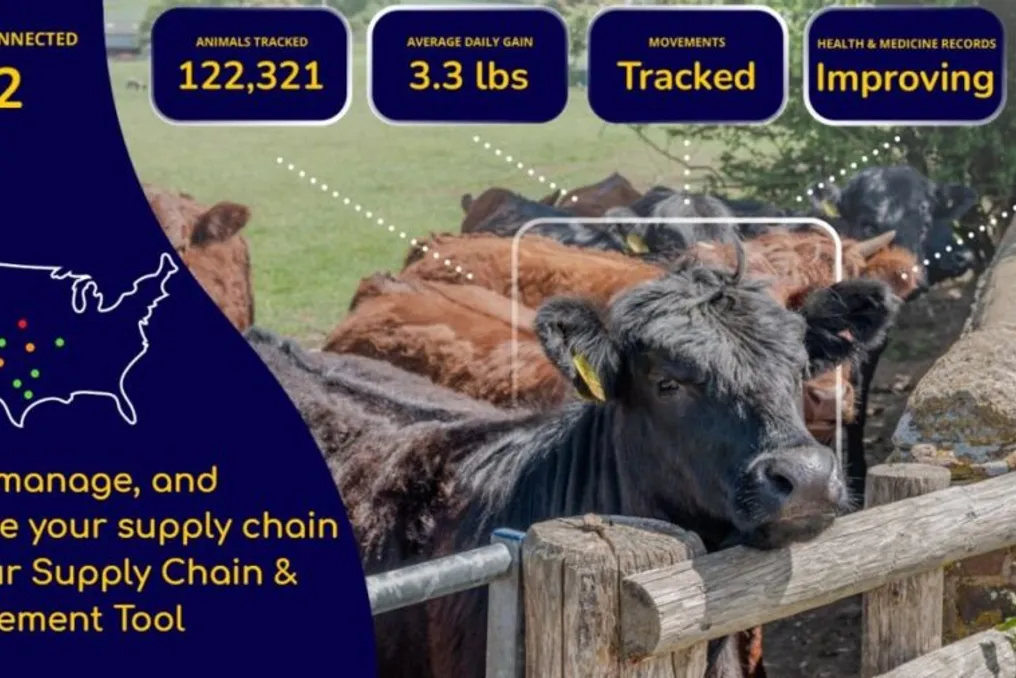
Livestock Tech Platform Breedr has successfully raised €23 million to implement its plans for global expansion. This funding will enable the company to develop its application, marketplace, and financing platform, which are essential for farmers looking to modernize the industry.
The funding round was led by the Partech fund through its impact fund, with participation from Latitude, the growth-stage fund LocalGlobe, and Outsiders Fund.
Breedr's core objective is to transition livestock record-keeping from paper logs and spreadsheets to a digital format. The platform integrates a livestock management application, a verified cattle trading marketplace, and financing tools.
Farmers can record data such as weight, health status, genetics, breeding information, and administered medications for each animal. By scanning an electronic ear tag, they gain instant access to the entire animal history. Furthermore, they can buy and sell livestock directly on the platform with attached verified data, guaranteeing buyers accurate information about the acquired animal.
Since the data validates the herd's value, farmers can use their animals to secure loans and reinvest funds into their farms.
CEO Ian Wheal emphasized the urgency of the issue, stating: 'We created Breedr to return value to people who raise livestock. Beef demand is rising while herds are at their smallest in 75 years. The industry must derive more benefit from every animal, which is impossible to do on paper.'
For a long time, livestock data was kept either in paper form or in local systems. Breedr moves this data to the cloud and makes it usable.
Investor Arnaud Minvielle, General Partner at Partech, explained the reason for supporting the project: 'Beef is one of the most complex decarbonization challenges. Breedr reduces emissions while helping producers become more profitable.'
He added that Ian and the Breedr team are creating a transactional layer for one of the world's largest unmodernized markets, earning revenue every time an animal changes ownership.
Minvielle noted that this alignment between a commercial mechanism and an environmental outcome is precisely what their impact fund supports. He expressed confidence that Ian, being an insider in this industry, and his team are capable of fundamentally transforming this value chain using smart data.
The Breedr platform does not start from scratch; it already helps farmers track hundreds of thousands of animals. Data centralization allows farmers to raise healthier livestock using growth algorithms. They can also predict future weight and optimal selling times. Moreover, by making decisions about feeding and health based on real data rather than guesswork, farmers can reduce waste and emissions.
Trading is also simplified, as buyers receive verified information on genetics and health instead of relying solely on visual inspection. With herd data serving as proof of value, farmers have easier access to financing and loans from creditors. The company reports that it has previously helped over 1,100 farmers in the UK and has already facilitated millions of beef transactions through its marketplace.
The new funding will be directed towards two main goals. Firstly, expanding reach to a larger number of farmers and livestock breeders. The US, UK, and Australia are major markets, but most livestock there is still tracked manually. Secondly, collecting additional data points for each animal.
The next crucial step is collecting genomic data, which involves studying the animal's DNA for earlier prediction of health, growth, and meat quality. More data means more accurate predictions, which in turn brings more money to farmers.