The night between Thursday (27th) and Friday (28th) will feature the last eclipse of 2026, which will be a partial lunar event. This phenomenon is expected to attract significant attention due to the high level of darkness that will cover the lunar surface, potentially giving it dark hues ranging from brown to coppery red, resembling almost a total lunar eclipse.
The good news is that this partial lunar eclipse, with characteristics similar to a total one, can be observed anywhere in Brazil, provided weather conditions are favorable and the sky is clear. If there is cloudiness or other obstructions to direct viewing, the public can follow the spectacle in real-time online, as Olhar Digital will broadcast starting at 11 PM Brasília time, using images provided by the National Observatory.
According to the platform Starwalk.space, the coverage of the lunar disk will exceed 96%. In technical assessments, the event is also registered with a magnitude of 0.93. This discrepancy between 96% and 93% is attributed to different calculation methods, but both indicators point to an event very close to a total eclipse.
It is important to note that despite the reddish coloration and high coverage, this is not a 'Blood Moon' (popular term for a total lunar eclipse). This occurs because a small portion of the Moon will remain outside Earth's densest shadow, continuing to receive direct sunlight, although this difference is subtle to the naked eye during the peak of the event.
Eclipse Schedule
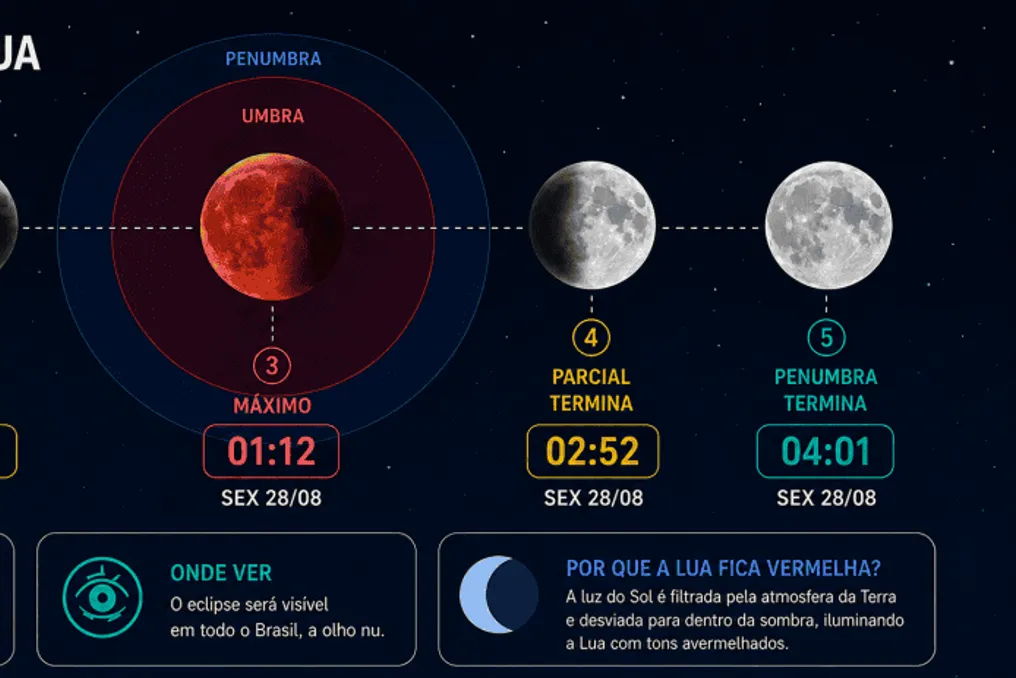
The eclipse will begin discreetly at 10:23 PM on Thursday, when the Moon enters the penumbra, the outermost area of Earth's shadow, without major perceptible changes in the celestial body's brightness. The partial phase, characterized by the darker shadow beginning to cover the Moon directly, will start around 11:33 PM. The moment of maximum coverage will occur at 1:12 AM on Friday, when approximately 96% of the lunar disk is obscured. The partial phase should end around 2:52 AM, and the penumbral stage will continue until shortly after 4 AM.
Brazil is well positioned to observe the phenomenon, as the Moon will remain high in the sky for much of the early morning hours, benefiting observation in various regions. The Moon's altitude will fluctuate between 59 and 85 degrees relative to the ground. In the North, Northeast, and Central-West areas, the satellite will be nearly at the zenith of the celestial dome during the early morning. In the Southeast and South states, the practical suggestion is to look north to locate the bright and high satellite.
Cause of Reddish Coloration
The reddish coloration is a result of the Earth's atmosphere. During the eclipse, sunlight must pass through the planet's gaseous layer before reaching the Moon. Along this path, the atmosphere scatters blue light more easily, allowing orange and red tones to penetrate the air and reach the shadowed region of the Moon. Some of this light is then reflected by the lunar surface and returns toward Earth. This same principle explains why the sky takes on reddish tones during sunrise and sunset. However, the appearance of the Moon can change depending on the presence of dust, smoke, pollution, and atmospheric humidity, making a clear sky ideal for a clearer view and to enhance the coppery tones of the satellite.