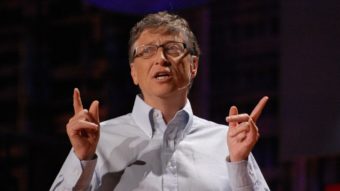
Bill Gates, co-founder of Microsoft, stated that the technology sector has been downplaying the dangers of artificial intelligence (AI) to avoid business losses. In an article published on his personal blog this Wednesday, August 26th, the billionaire issued a warning, indicating that AI already poses a threat to both employment and global security.
Gates maintains that executives are aware of the risks internally but choose not to discuss such issues publicly to prevent panic among investors. According to him, it is imperative to establish regulations to mitigate the potential harms of AI, suggesting the implementation of a tax on corporate use of the technology and the creation of new supervisory bodies for the sector.
The motivation for this public statement, according to the businessman, lies in the rapid pace of technological evolution. The billionaire argues that corporations tend to accept these risks under the premise that the benefits of AI will ultimately outweigh its adverse effects.
The application of artificial intelligence has been used to replace parts of human cognitive work in various fields, such as customer support, sales, software development, and legal advice. Gates estimates that the massive adoption of this technology will trigger a turbulent economic shift, resulting in increased unemployment.
This threat may extend to manual labor as the cost of robotics decreases. The billionaire predicts that sophisticated robots will begin competing for positions in civil construction and hospitality by the end of this decade.
To seek a balance, the executive proposes a 'token tax,' which would tax the fundamental unit of AI processing and the corporate use of robots. The generated revenue would be allocated to fund professional retraining and strengthen social safety nets.
Additionally, Gates advocates for establishing a policy that legally prohibits replacing humans with machines in roles requiring empathy, such as caring for the elderly and terminally ill patients.
The proliferation of AI also facilitates access to harmful tools. Gates warns that AI can assist terrorists in developing new viruses. Beyond bioterrorism, the misuse of the technology tends to intensify financial fraud, facilitate disinformation campaigns through deepfakes, and expand cyberattacks.
On a social level, the popularization of 'virtual companions' raises another point of concern, particularly among children and adolescents. The use of assistants that simulate human bonds can distance young people from authentic social interactions. According to Gates, this scenario leads to isolation and emotional dependence.
Gates rejects the notion that regulation should be conducted by the large technology companies themselves, classifying such a suggestion as inadmissible given 'the most impactful technology ever invented.' He argues that current government agencies are not prepared to manage a tool that simultaneously impacts national security, the economy, education, and health.
The primary solution advocated by Gates is the creation of a new international organization, following the models of entities responsible for monitoring nuclear weapons.
Despite the sense of urgency, the executive emphasizes that technology holds unprecedented potential to solve crises if applied correctly for 'good things.' In healthcare, AI platforms already assist hospitals in emergency diagnosis, exam analysis, and accelerating the development of vaccines and medicines. Its impact also promises to be transformative in the agriculture of developing countries, providing accurate climate forecasts and guidance to optimize food production. In the public sector, AI has the potential to simplify bureaucracy, making the distribution of social aid faster and more effective.