For railway employees working in the cities of Akola, Jalgaon, or Manmad in Maharashtra state, visiting a doctor often requires a two-to-three-hour trip to the Divisional Railway Hospital in Bhusawal. A routine consultation can require employees to spend time traveling and also to decide if their symptoms are serious enough for such a journey.
Punit Agrawal, Divisional Manager of the Bhusawal railway, notes that 'a two-to-three-hour journey for a consultation is something people cannot do regularly.' He adds that because of this, people tend to postpone visits, and this is the problem that the 'Rudra' project—the mobile hospital of the Bhusawal railway division—aimed to solve.
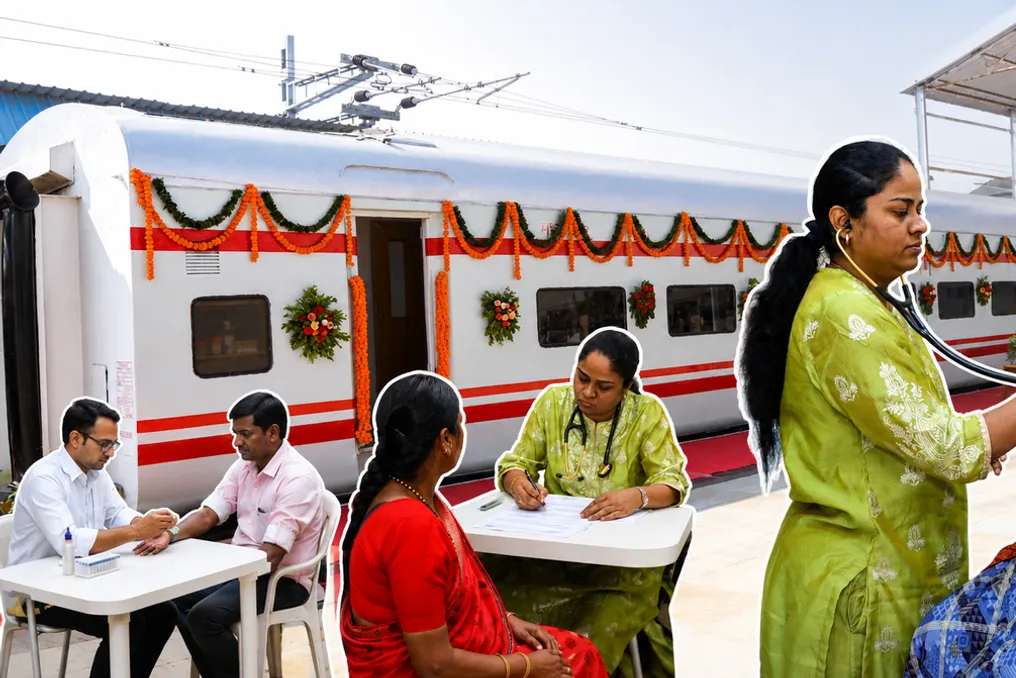
Launched in January 2025, 'Rudra' is a refurbished railway carriage equipped with consultation rooms, diagnostic equipment, and medicines. This carriage travels throughout the division, stopping at various stations so that railway employees and their families can receive basic medical care closer to their homes and workplaces.
How an old railway carriage turned into a medical facility
The scale of the Bhusawal railway division makes the task particularly challenging: it spans over 1200 kilometers and serves more than 225 passenger trains daily, covering employees and families far beyond Bhusawal itself.
Initially, 'Rudra' arose from a practical idea—to utilize existing railway assets. Punit told The Better India that every asset in the railway system has a certain lifecycle, and some decommissioned carriages can be reused after proper rehabilitation. They selected such a carriage and converted it into a medical unit.
The carriage was renovated at the railway workshop and equipped with all necessary medical infrastructure for diagnosis and consultations. The result is a compact and functional medical space containing diagnostic tools, patient reception areas, and medicines. Patients can undergo basic examinations, such as ECGs and pathological tests, and consult with both general practitioners and invited specialists. For employees and families living far from Bhusawal, this means access to services that would otherwise require a long journey, and now they are available much closer to home.
When healthcare arrives before it is too late
Since its launch in January 2025, the mobile hospital has been touring the division, conducting medical camps at various stations. Each visit lasts several hours, allowing people to come at a time convenient for them.
A longer appointment window is significant in places where traditional doctor appointments traditionally required planning the entire trip around that meeting. As of March 2026, 'Rudra' has conducted 28 camps and provided direct assistance to 4321 beneficiaries. For Punit, one of the most important results has been detecting health problems before they worsen.
He noted: 'There were people who were unaware that they had certain medical conditions. When they came for a routine check-up, problems were detected early, and they could start treatment on time.' For many families, especially those living far from Bhusawal, the ability to receive help without long commutes has changed their approach to health. He added: 'When the facility is nearby, people are more willing to take the initiative. This is where the prevention of fatal diseases is possible.'
Care beyond the mobile carriage
Although mobile camps form the core of 'Rudra's' activities, the team had to consider an obvious limitation: the carriage can only be in one place at a time. Therefore, the technology proposed a way to expand access between visits.
The division implemented teleconsultation services. This allows patients to communicate with doctors remotely, even when the 'hospital on wheels' is not nearby. Punit explains: 'People in remote areas can at least get a primary consultation without traveling. Once we understand their condition, we advise them on what to do next.'
Digital medical record and identification systems were also introduced, which simplifies tracking patients' medical history and maintaining continuity of care. Together, these systems allow support to be provided even after the camp has moved to the next location.
For communities and institutions considering a similar model of mobile healthcare, Punit believes that the experience of 'Rudra' offers several practical lessons.
Step 1: Start with needs assessment
For those hoping to replicate this model, the first step is understanding the real situation on the ground. Punit clarifies: 'You must determine who needs the service and where the gaps exist. Without this, you might create something that does not achieve its goal.'
This includes mapping the population, studying existing healthcare access, and identifying areas where intervention is most needed.
Step 2: Map resources and develop a plan
After establishing the need, the focus shifts to resources. This involves identifying medical personnel, equipment, and a suitable mobile platform. In rural areas, this might be a bus or a van instead of a railway carriage.
Mr. Punit emphasizes: 'You might have a good idea, but it must be supported by proper planning. Resources must be identified and organized so that they can be used without difficulty.'
It is equally important to link the mobile unit with a larger medical institution, especially when patients require further monitoring.
Step 3: Start with a pilot project
Instead of immediately trying to implement the project on a large scale, starting small can be crucial. Punit notes: 'The mobile hospital is an investment. Before scaling it up, you must see if it works in practice.'
A pilot project allows organizers to test logistics, understand patient response, and refine the model based on real experience.
Step 4: Ensure convenience of location and time for people
Accessibility depends both on where the help is provided and how much time people have to receive it. He explains: 'There should not be a short window that makes the medical care seem rushed. We found that opening for five to six hours gives people enough time to come.'
Choosing easily and safely accessible locations is also important to ensure that more people can benefit.
Step 5: Create a team behind the unit
The foundation of any such initiative is the team that supports it. The system involves doctors, paramedical staff, technicians, and administrative personnel.
He says: 'There must be a central body to coordinate everything. At the same time, local teams must be responsible on the ground.'
This combination of leadership and local involvement helps maintain both efficiency and accountability.
Step 6: Maintain coordination at the center
Operating a mobile medical unit requires close coordination between multiple groups. From scheduling movements to ensuring electricity, water, and other basic amenities—every detail matters.
Punit concludes: 'Ultimately, it all comes down to coordination. Without it, even a well-planned initiative can face difficulties.'
Clear communication between teams, along with regular checks, helps prevent logistical gaps that disrupt care delivery.
Step 7: Plan for problems before they arise
No model is without problems. In Bhusawal, these include managing train schedules, confirming the availability of medical staff, and raising awareness among beneficiaries. He explains: 'Our network is already very busy; adding another run requires careful planning.'
Identifying these limitations early helped the team plan the movement and camps of 'Rudra' taking into account the already overloaded railway network.
Step 8: Use technology for scaling
Technology has facilitated the expansion and improvement of the model. Capabilities such as telemedicine, digital records, and patient tracking systems have increased the efficiency and accessibility of the initiative. Punit notes: 'Technology helps us reach more people and provide better care. It makes the system more responsive.'
Can this model work outside of railways?
Although 'Rudra' was developed within the railway system, its principles can be applied in many other fields. In rural areas, mobile medical units can be created using buses or vans, with the support of local administrations, medical service providers, or organizations.
Mr. Punit asserts: 'There must be someone who takes responsibility—not just to start, but to continue and see how it develops over time.'
This responsibility becomes especially important when the novelty of launching a mobile unit gives way to the daily work of staffing, moving, equipment maintenance, follow-up care for patients, and coordination with local teams.
Sustaining an initiative like 'Rudra' depends on what happens after the first camp: whether teams keep appearing, whether patients return, whether follow-up care is available, and whether the system continues to function according to people's lives.
For employees and their families across the Bhusawal division, this has fundamentally changed something. Consultation no longer has to begin with a two-to-three-hour journey. The strength of 'Rudra' lies in its simplicity. The railway services did not wait for the construction of a new hospital; they took an existing carriage, equipped it for medical service, and moved this care closer to the people who were postponing their visits. Sometimes access starts with one practical question: if people cannot reach medical care in time, can medical care reach them first?
}, {