
Uzbekistan plans to train 5,000 fintech specialists by 2030
Read more
UzDaily
uzdaily.uz

Uzbekistan plans to train 5,000 fintech specialists by 2030

Uzbekistan has set a goal to prepare 5,000 specialists in financial technology by 2030. However, participants at the Silk Road Finance and Technology Forum in Tashkent noted that retaining trained personnel in the country is a serious problem.

The discussion took place on August 25 as part of a session titled 'School on the Silk Road: Demographic Dividend or Demographic Debt?'. Peter Franken, a professor at Keio University and founder of the Safecast project, moderated the session.

When asked what was most important—training, funding, or talent retention—Patrick Nyoroge, former manager of the Central Bank of Kenya, named training as the main constraint, believing that the other two issues could be solved in different ways.

Laiming Chen, Senior Vice President and Director of Sustainable Development at Ant International, and Abdel Aziz Nassir, Executive Director of the Egyptian Banking Institute, held a different view, considering talent retention a key factor. They emphasized that fintech specialists are in high global demand and may leave the country in search of better career prospects.

Gulnoza Ismailova, Executive Director of the 'El-Yurt Umidi' Foundation for Training Promising Personnel under the President of Uzbekistan, reported that the foundation was reorganized in 2026 and now reports directly to the president.

According to Ismailova, the foundation annually assesses the needs of state institutions and regions for personnel. It supports bachelor's, master's, and doctoral programs at universities ranked in the top 300 globally, invites foreign lecturers, and organizes dual degree programs.

She also specified that previously, graduates of scholarship programs were required to return to work only in the public sector. Now, this requirement extends to companies that are major taxpayers and residents of the IT Park, thereby expanding employment opportunities for those studying abroad.

Ismailova added that the main difficulty lies in determining exactly which specialists should be included in the target group of 5,000 people, including engineers, cybersecurity specialists, data specialists, regulators, and policy developers.

Drawing on Kenya's experience in implementing mobile money about 20 years ago, Nyoroge stated that practical on-the-job training is critically important alongside traditional university education. He noted that many graduates have degrees but are not ready for real tasks without additional practical experience.

Nyoroge also suggested that the departure of specialists abroad should not be viewed solely as a loss. Professionals who leave can acquire new skills and subsequently return to train others or take on higher positions, or become part of the diaspora creating companies in their home country or acting as a link to foreign markets.

Chen mentioned that Ant International runs the '10 by 1000' program, under which the company committed to training at least 1,000 digital leaders annually for ten years. Since 2018, approximately 10,000 people have been trained through this program in 110 countries and regions.

She added that company representatives met with the First Deputy Chairman of the Central Bank of Uzbekistan during the forum to discuss launching this program in Uzbekistan.

Nassir presented a three-tiered approach used by the Egyptian Banking Institute. For future senior executives, the institute uses psychometric testing, followed by one year of study and internship abroad. For a broader audience, a free online financial literacy platform is provided, accessible with a national ID. Current bank employees undergo competency-based training, with required competencies reviewed every three years based on surveys of bank HR directors regarding necessary skills in the coming years.

He advised countries establishing such institutions to include not only training but also mentorship, evaluation, and employment support, as well as establishing governance and stakeholder relations from the very beginning of operations.

To conclude the session, Franken announced the launch of his own mentorship initiative and invited hall participants to mentor young talent from Uzbekistan for one year, with a report to be presented at next year's forum.
Similar stories

Nearly one in six university graduates in Uzbekistan faces difficulties finding a job
Read more
podrobno.uz

Nearly one in six university graduates in Uzbekistan faces difficulties finding a job

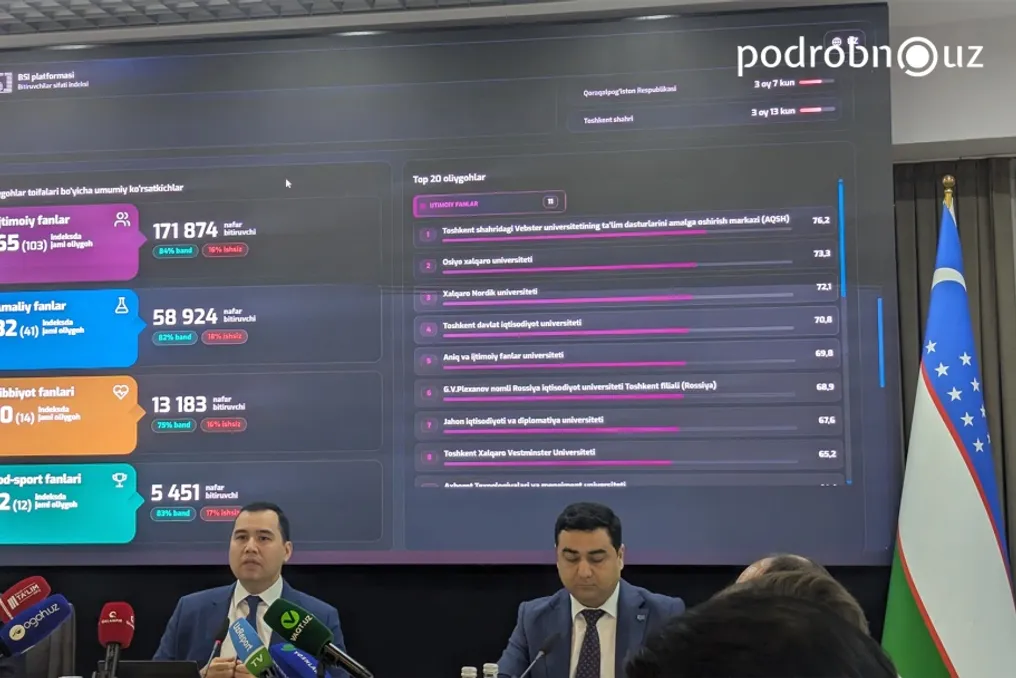
Although most higher education students in Uzbekistan find employment after graduation, about one in six graduates remain unemployed. This data was obtained from an analysis of the employment status of 249,432 graduates who completed the 2024/2025 academic year.

A correspondent from Podrobno.uz studied the results of the study titled 'Graduate Quality Index,' conducted by the National Agency for Education Quality Assurance. This analysis covered graduates from 170 different higher education institutions. On average, students required three months and five days to find their first job.

Differences in Employment Chances by Field of Study

Employment opportunities significantly depend on the specialty. The most favorable situation is observed among graduates in socio-humanitarian sciences, where 84% of specialists found employment. High rates were also noted in creative and sports fields (83%) and practical sciences (82%), while the percentage of employed graduates in medical sciences was 75%.

It should be noted that the statistics for the medical field require further verification, as the provided information states that 16% of graduates could not find a job, although the overall employment rate for this sector is 75%.

Job Search Duration and Employment Stability

The fastest job search period was recorded among graduates of private universities—they found jobs in an average of two months and ten days. In state universities, the average period was two months and twenty-nine days, and at branches of foreign universities—three months and twenty days.

Nevertheless, having a job does not guarantee long-term stability. Only 42.9% of all graduates managed to maintain permanent employment over the last six months. This figure was lower among graduates of state universities (42.1%), higher among private ones (46.7%), and highest among graduates of branches of foreign universities (49.8%).

Income and Rating Leaders

The average official salary of graduates is estimated at 4.9 million soms per month. In the capital, Tashkent, this figure is higher—6.6 million soms. The highest earnings were recorded at Inha University in Tashkent (12.6 million soms), Westminster International University of Tashkent (12.5 million soms), and the University of World Economy and Diplomacy (10.6 million soms).

According to the study results, the State Conservatory of Uzbekistan was recognized as the leader of the Graduate Quality Index, scoring 81.5 points. Second place was held by the Nukus Branch of the State Conservatory with a score of 79.6 points, and third place went to the Webster University Educational Programs Implementation Center in Tashkent, which received 76.3 points.

The index is calculated automatically using data from ten state information systems and takes into account parameters such as speed of job acquisition, employment stability, income level, and form of employment.

Timur Ishmetov presented a five-year strategy for the development of Uzbekistan's fintech until 2030
Read more
podrobno.uz

Timur Ishmetov presented a five-year strategy for the development of Uzbekistan's fintech until 2030

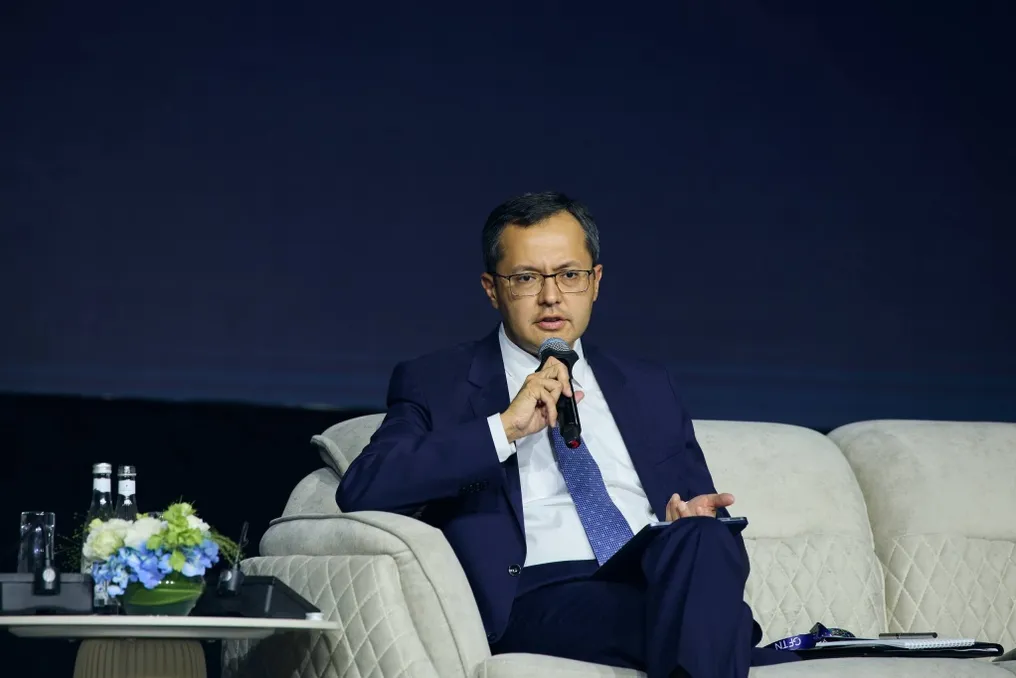
The Chairman of the Central Bank, Timur Ishmetov, announced the introduction of a national strategy for the development of Uzbekistan's fintech at the Silk Road Finance & Technology Forum, which is designed for the period from 2026 to 2030.

The event gathered participants from 74 different countries. The head of the regulator emphasized that the global fintech sector demonstrated significant growth last year, generating approximately $500 billion in revenue with a 22% increase, and 75% of leading companies in this field have already achieved profitability.

According to the Central Bank head, Central Asia possesses great potential, driven by its young population and digitalization processes. In Uzbekistan, 57% of all payments are already made in non-cash form.

In line with the tasks set by the president, the plan is to attract $1 billion in foreign investment to the fintech sector by 2030 and prepare 5 thousand young specialists.

Key directions of the strategy

The strategy developed by the regulator focuses on five key areas of development. These include creating favorable conditions for bringing new products to the market, strengthening financial links between Central Asian regions, improving infrastructure for instant payments, studying digital assets, and increasing investment in training qualified personnel.

Furthermore, an improvement in financial accessibility for women was noted: the share of women with bank accounts increased from 39% to 61%.

Uzbekistan proposes establishing career centers in all universities across the country
Read more
uzdaily.uz

Uzbekistan proposes establishing career centers in all universities across the country

The National Agency of Uzbekistan for Ensuring Quality of Education has proposed introducing a system of career centers in all higher education institutions in the country, regardless of their ownership form. The draft resolution has been published for public discussion.

According to the presented draft, career centers will begin operating in every university in Uzbekistan starting January 1, 2027. The main objective of these centers is to enhance the competitiveness of graduates in the labor market, provide students with systematic career counseling, organize internships and practical training, and support employment.

The Ministry of Higher Education, Science, and Innovation will oversee the creation of the career centers. Starting in 2028, new private universities will be obliged to open such a center no later than the second year of their operation, while state universities must establish one immediately after opening.

University leaders will also be required to conduct annual surveys among students, graduates, and employers to assess the quality of the career services provided. Separate work plans and Key Performance Indicators (KPIs) will be developed for the centers, and a graduate monitoring system will be implemented.

The project includes training for managers and staff of the career centers. A special program will cover labor market analysis and employment trends, strategies for developing career services, counseling technologies, as well as cooperation with companies and the development of corporate partnerships.

The program will integrate dual education, practical training, and internships with the local labor market. Work with digital platforms such as LinkedIn, hh.uz, and Inplatform is also planned, alongside individual counseling. Participants will receive training on resume writing, interview preparation, personal branding, psychological testing, and the use of artificial intelligence in career counseling.

The training duration will be 144 hours, including 72 hours of online classes, 36 hours of in-person classes, and 36 hours of practical training. Upon completion of the training, participants must pass a three-stage certification, which includes testing, a practical assignment, and project defense.

Under the terms of the project, all positions in the career centers must be filled by graduates of this program by September 2027. Center managers will receive salaries at the same level as deans. Furthermore, the centers will be allocated full-time specialist positions at a ratio of two employees per 3000 students, with compensation levels comparable to deputy deans.

To improve information exchange with employers, electronic systems from the Ministry of Labor and Poverty Reduction, the Chamber of Commerce and Industry, and other relevant bodies will be integrated with the career.edu.uz platform. These institutions will also be obligated to provide career centers with data on employer personnel needs.

The project also includes financial support measures for private universities that establish career centers. The Ministry of Economy and Finance and the Tax Committee have been instructed to submit relevant proposals to the Cabinet of Ministers. The resolution remains open for public discussion until August 27.

Popular