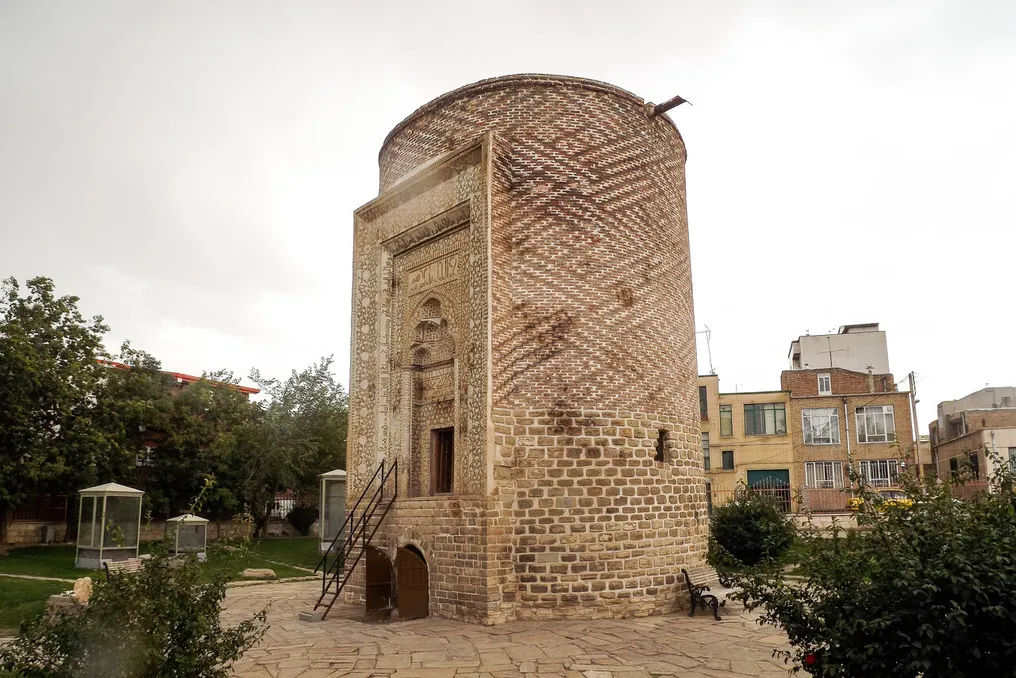
The Se Gonbad Tower-Mausoleum rises amidst the historical architecture of Urmia, located in northwestern Iran, and is one of the most recognizable surviving monuments from the Seljuk period in this city.
This cylindrical structure made of stone and brick was built about 800 years ago and allows visitors to learn about the architectural traditions, burial practices, and artistic achievements of medieval Iran.
Initially, the tower was situated on the southeastern outskirts of the city, but the gradual expansion of urban development led to the centuries-old structure ending up in the very center of modern Urmia.
The name 'Se Gonbad,' which translates from Persian as 'Three Domes,' is related to the unusual arrangement of the domed structure. The monument includes two separate domed spaces, with a smaller dome situated above the main structure. This distinctive shape contributed to the formation of the tower's unique identity, making it one of Urmia's significant historical attractions.
An inscription at the entrance dates the construction of the tower to the year 580 AH, corresponding to the Seljuk period. This inscription was deciphered by Nikolai Khanikin, a Russian orientalist, geographer, and ethnographer of the 19th century, who helped introduce the monument to a wider audience. According to the interpretation of the inscription, the tower was erected by order of Sheikh Kate al-Muzaffari, who is considered one of the rulers of the Seljuks.
It is believed that the monument served as a mausoleum because numerous graves were discovered in the vicinity, suggesting that the area around the tower may have previously functioned as its courtyard. Some evidence suggests that people of great importance were buried there due to the sanctity of the place.
Various hypotheses exist regarding the origin of Se Gonbad. Some believe the tower was built on the ruins of a Sasanian fire temple, but there is no convincing evidence for this version. The architectural appearance of the tower has also been compared to towers from the Toghrul era. Nevertheless, existing evidence, including the inscription at the entrance and the similarity to other mausoleums from the 6th century AH, points to its origin during the Seljuk period.
The tower is approximately 13 meters high and has a diameter of about five meters. Its cylindrical body combines two main building materials: stone and brick. The lower part of the structure, about 3.6 meters high, is made of gray, finely worked stone, while square bricks were used above.
Architecturally, the monument is divided into two levels. The lower level, known as the basement or crypt, is separated from the upper level by an arched ceiling. Access to the lower section is through a small iron door measuring approximately one meter by 70 centimeters. The upper level, or burial chamber, is located above the crypt and is accessible via a wooden staircase about 2.5 meters high.
Another notable feature is the light shafts on the north and south sides. Four channels connect the upper and lower parts, providing illumination and ventilation to the interior, while also complementing the tower's architectural character.
The exterior is particularly distinguished by the decoration at the entrance. Stone and gypsum elements form geometric patterns and Kufic inscriptions around the entrance, demonstrating the decorative vocabulary of medieval Iranian architecture.
Inside the cylindrical structure is a square burial chamber. Its corners are decorated with cross motifs, and sharp crescent arches and finely executed carvings add detail. The ceiling of the chamber is domed, with bricks arranged in a circle towards the center.
Although part of the lower dome and its floor has collapsed, remnants of decorative brickwork are still visible around the corners and edges. Since the ceiling is damaged, the original dimensions of the lower dome cannot be determined; studies estimate its height to be approximately 1.5 meters.
The monument is known for its high main dome, which is reported to have been about nine meters high. However, the dome is only one element of its architectural significance. The combination of stone decoration, cross motifs, geometric ornament, and carved details gives Se Gonbad a special character that distinguishes it from other medieval tower-mausoleums.
The structure has survived centuries, largely preserving its walls and main ceiling. Conservation measures have been taken to protect it from damage. A certain adjacent area and protective boundaries now separate the monument from the pressure of the growing city. Se Gonbad is listed in Iran's national heritage list, emphasizing its importance as part of the country's architectural heritage.
For travelers, the monument also serves as a gateway to the broader history of Urmia. The city is the capital of West Azerbaijan Province and is located at an altitude of about 1330 meters on the Urmia plain, near the Shahar River. To the east lies Lake Urmia, one of the world's largest salt lakes, and to the west runs the Turkish border. Its location has long made Urmia an important crossroads between Iran, Anatolia, and the wider northwestern region.
The cultural history of Urmia is equally diverse. Over the centuries, Azeris, Kurds, Persians, Assyrians, and Armenians have lived in and around the city. In different periods, the city was also home to Muslim, Christian, Jewish, and Sufi communities. By the beginning of the 20th century, Christians constituted a significant portion of the city's population, although war, violence, and migration drastically changed the demographic landscape in subsequent decades.
A visit to Se Gonbad can be combined with visiting other historical and cultural attractions in Urmia. The tower's location within the old urban fabric makes it particularly accessible to tourists interested in discovering the city beyond its modern streets and contemporary identity.
Se Gonbad is open to visitors year-round. However, spring and summer generally offer more comfortable conditions for travelers unaccustomed to the cold climate of northwestern Iran. Winters in the region can be harsh, with heavy snowfall, while warmer months provide more favorable conditions for studying the monument and other Urmia attractions.
For visitors interested in medieval Iranian heritage, Se Gonbad offers more than just an imposing historical structure. Its inscription, funerary function, architectural details, and location within the developing urban landscape together tell the story of a monument that remained part of Urmia for approximately eight centuries. Standing today amidst the city's historical fabric, the Seljuk-era tower provides a tangible link between modern Urmia and a much earlier chapter of Iranian history.