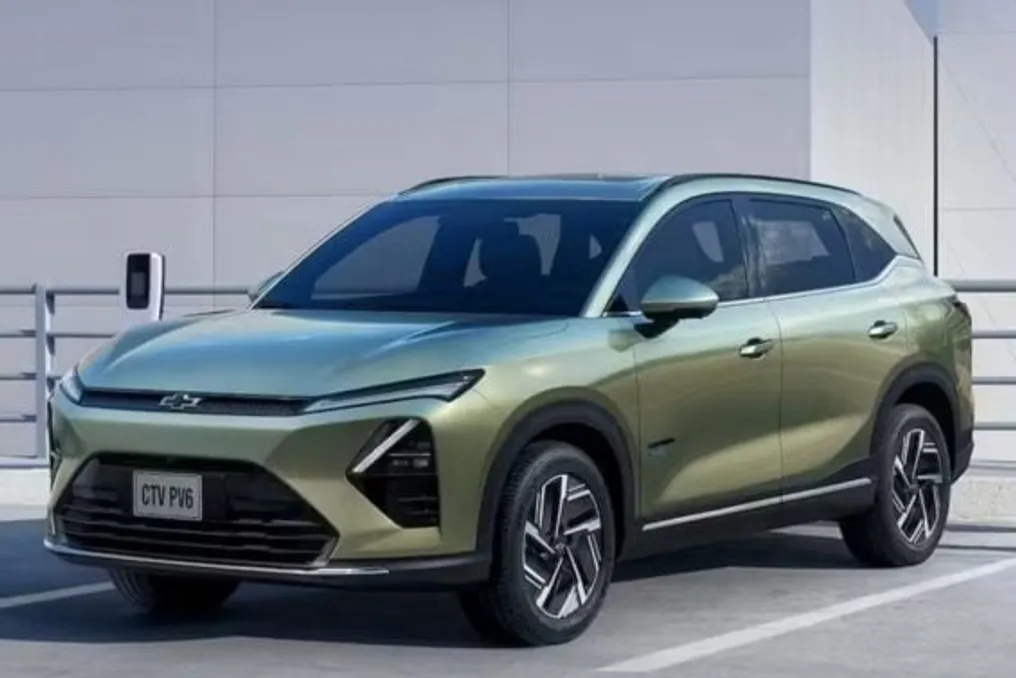
General Motors announced on Wednesday, the 26th, that the Chevrolet Captiva PHEV will be manufactured at the Ceará Automotive Plant (PACE) as early as 2026. This model will represent the first plug-in hybrid vehicle from Chevrolet to be assembled in Brazilian territory, aiming to compete directly with models such as the GWM Haval H6 and the BYD Song Plus.
With this new version, General Motors plans to respond to the dominance of Chinese manufacturers in the mid-size SUV segment. The main purpose of this plug-in hybrid variant is to reduce production costs and offer a more attractive final price compared to established competitors, including the GAC GS4 and Toyota Corolla Cross.
The new Chevrolet Captiva, which was seen undergoing tests in the interior of São Paulo by specialized portals like AutoPapo and Autos Segredos, is a tropicalized adaptation of the Wuling Starlight S. It derives from an international collaboration between General Motors and SAIC, which is also a partner in the production of the compact Spark EUV.
The powertrain system of the Captiva PHEV was designed to balance energy efficiency with dynamic performance. The mechanical unit combines an electric motor with a 1.5-liter gasoline, naturally aspirated engine, which generates 106 hp and 13.2 kgfm of torque, resulting in a combined power of 204 hp.
The SUV will be available with two traction battery configurations. Following Chinese standards, the projected combined range is 1,100 km. Although official dimensions have not yet been disclosed, it is expected that the Captiva PHEV will maintain the wide proportions of the Wuling Starlight S, presenting a length of 4.75 meters, a width of 1.89 m, a height of 1.69 m, and a wheelbase of 2.80 m, which will ensure good interior space and a trunk capacity of 610 liters.
In terms of design, the interior adopts the minimalist aesthetic of the Chinese Starlight S, incorporating the Chevrolet gold tie emblem in the center of the steering wheel. The onboard technological architecture includes various features.
Industrial Production History
The assembly line designated for the new Captiva PHEV has a unique industrial history in Brazil. It operates under the SKD (Semi-Knocked Down) scheme, where vehicles are assembled using imported parts kits. PACE functions as a contract manufacturing model, meaning it only performs the final assembly of the automobiles without producing components locally.
This complex was inaugurated in 1995 and initially served as an assembly site for Troller jeeps. In 2007, the structure was sold to Ford, which maintained Troller production until 2021 to comply with state tax incentives required by the government of Ceará, subsequently ending all its industrial activities in the country.
After a three-year period of inactivity, the plant was acquired and modernized by the Comexport group, based in Espírito Santo, transforming it into a multi-brand industrial platform under contract. General Motors was the first client of PACE, importing parts to assemble the Spark EUV, followed by the Captiva EV and the Captiva PHEV. Subsequently, MG Motors, a subsidiary of the SAIC group, also signed a contract with PACE to manufacture the MG4 hatchback and the S5 SUV.