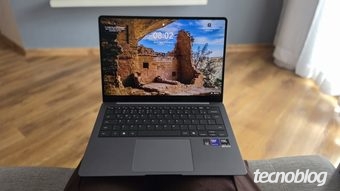
Samsung confirmed the arrival of the Galaxy Book 6 line in the Brazilian market this Wednesday, the 26th, marking the return of premium notebooks after more than a year of absence in the country. Internationally presented in early 2026, the family includes the Galaxy Book 6, Galaxy Book 6 Pro, and Galaxy Book 6 Ultra models.
These notebooks are equipped with Windows 11 Home and use Intel Core Ultra Series 3 processors, integrating artificial intelligence features and connectivity functionalities with other Galaxy devices. The starting price for the basic model begins at R$ 8,199.
The standard Galaxy Book 6 is primarily aimed at productivity and multitasking activities, available in 14 and 16-inch sizes, featuring a metallic finish and anti-glare screen. A notable difference is the diversity of ports, including RJ45, HDMI, two USB-C, and two USB-A, a feature uncommon in thin notebooks.
Samsung guarantees up to 24 hours of video playback on this model, representing an advance of nine hours compared to the Galaxy Book 4. It can be configured with Intel Core Ultra 5 or Core Ultra 7 Series 3, supporting up to 32 GB of RAM and 1 TB of storage. In the most advanced version, CPU performance increases by 34% and GPU by 92% compared to the Book 4, in addition to incorporating a new NPU with a capacity of up to 49 TOPS.
Artificial intelligence is applied in daily functions, such as tools for quick selection of texts and images. Furthermore, Samsung emphasized integration with the Galaxy ecosystem, enabling the use of tablets as a second screen, file sharing via Quick Share, and control of multiple devices through a single cursor.
The Galaxy Book 6 Pro concentrates many of the innovations of the new generation and will be offered in 14 and 16-inch versions, weighing 1.24 kg and 1.59 kg, respectively. The 16-inch model has only 11.9 mm thickness, while the 14-inch measures 11.4 mm. Samsung highlights this combination of lightness, slim design, and performance for professionals working in a hybrid setup.
This model features a touchscreen that uses Dynamic AMOLED 2X technology, offering 3K resolution, a refresh rate ranging from 30 to 120 Hz, and brightness up to 1,000 nits in HDR. The panel also has an anti-glare treatment and features to reduce blue light emission. Samsung seems to have addressed consumer concerns about risks in the previous generation, reinforcing display protection with Gorilla Glass DX.
Other improvements include the adoption of a haptic touchpad for the first time in the line, eliminating moving parts to ensure more uniform clicks, faster response, less noise, and better palm rejection. The thermal system was also redesigned, incorporating a larger vapor chamber to optimize heat dissipation and reduce noise.
In its maximum configuration, the Galaxy Book 6 Pro combines Intel Core Ultra X7 Series 3, 32 GB of RAM, and a 1 TB SSD, equipped with Intel Arc B390 graphics and up to 180 TOPS for AI tasks. The battery life of this model is another strong point, promising up to 30 hours of video playback, which represents an increase of 12 hours compared to the Galaxy Book 4 Pro.
The Galaxy Book 6 Ultra occupies the top of the line and is designed for more intensive demands, such as 4K and 8K video editing, 3D modeling, AutoCAD, graphic design, gaming, and streaming. This model incorporates a dedicated GPU, specifically the NVIDIA GeForce RTX 5060, which supports ray tracing and DLSS 4. The configuration announced for Brazil includes an Intel Core Ultra 7 Series 3 processor, 32 GB of RAM, and a 1 TB SSD.
Despite the robust hardware, Samsung assures up to 30 hours of video playback autonomy. The 140W USB-C charger is capable of recharging up to 65% of the battery in just 30 minutes. The notebook weighs 1.89 kg and has a thickness of 15.4 mm, making it 7% thinner than the Galaxy Book 4 Ultra. The sound system has been enhanced with six speakers compatible with Dolby Atmos, distributed across four woofers and two front tweeters.
After omitting the launch of the Galaxy Book 5 line in Brazil, Samsung acknowledges that entry-level notebook prices have increased. During the press conference, Leandro Iglesias de Abreu, Samsung Brazil's Notebook Manager, suggested the Galaxy Book 4 as a more economical alternative for certain consumers.
The strategy adopted by the company consists of keeping the Book 4, launched in 2024, as an option for those who do not need the new features and processors of the Book 6 family. The price adjustment in the initial models is mainly due to the change in platform and the costs of the latest components. Thus, the Galaxy Book 6 establishes itself as a more complete and updated option, while the Book 4 better suits the economic profile.
This approach reflects Samsung's tactic in the Brazilian market: not all consumers need to migrate immediately to the new generation. Besides hardware, the company focuses on the Galaxy ecosystem as a major differentiator. Users can connect the computer to Galaxy phones and tablets, use a tablet as a second screen, manage devices with a single cursor, and share files between them.
The company also introduced improvements in storage sharing and reinforced artificial intelligence features that operate integratedly across its products. Therefore, Samsung's strategy with the Galaxy Book 6 line transcends mere processing power; it aims to consolidate the notebook as a central piece of a complete ecosystem encompassing computers, phones, tablets, and other Galaxy devices.
In Brazil, the Galaxy Book 6 line starts at R$ 8,199. The Galaxy Book 6 Pro has a starting price of R$ 10,699, and the Galaxy Book 6 Ultra reaches R$ 18,999 in the presented configuration. It is important to note that the RAM remains soldered to the board, requiring the consumer to choose the desired amount at the time of purchase.