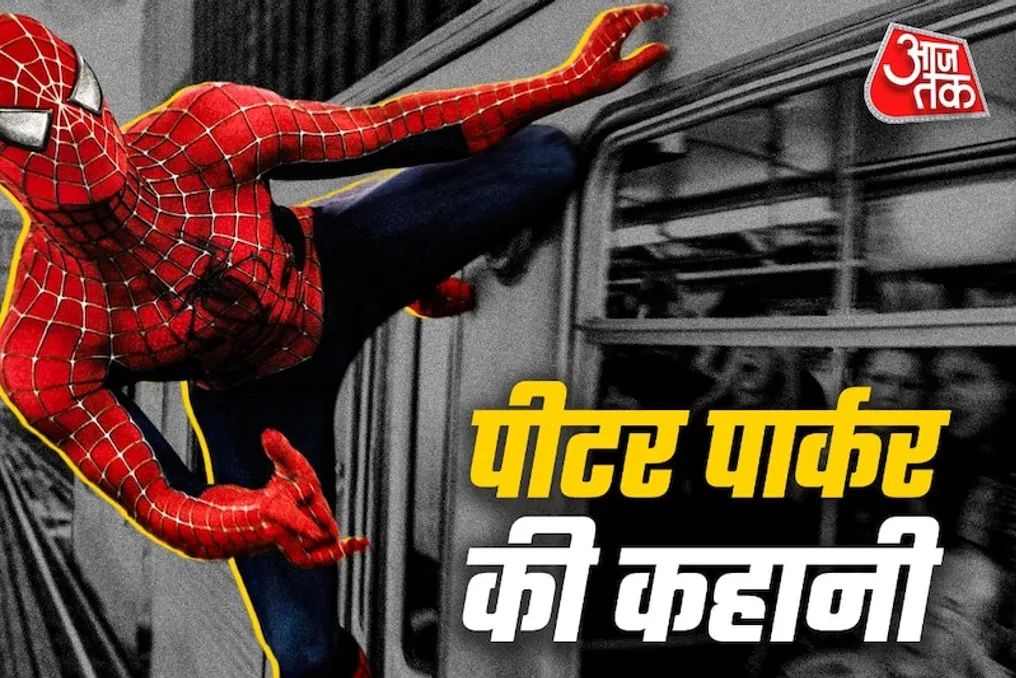
How the Spider-Man idea, which was initially rejected, became one of Marvel's most profitable characters
Read more
Aaj Tak
www.aajtak.in

How the Spider-Man idea, which was initially rejected, became one of Marvel's most profitable characters

Recently, there has been a great buzz around Spider-Man films in India; his Indian version has collected significant box office revenue, comparable to what Indian films dream of. Spider-Man is one of Marvel's highest-earning characters, but it is noteworthy that this character was not originally planned and was rejected.

The story began about 60 years ago when Marvel publisher Martin Goodman completely rejected an idea proposed by Stan Lee.

Stan Lee aimed to create a superhero who would not be bright and perfect, but an ordinary teenager named Peter Parker from New York. This character was supposed to face problems typical of teenage life: acne, financial difficulties, academic pressure, romantic troubles, and school mischief. Although this young man, who gains powers after being bitten by radioactive spider, was initially rejected, he became Marvel's best-selling comic when he appeared in the last issue of 'Amazing Fantasy' in 1962.

Spider-Man is not alone among major pop culture ideas that were initially met with ridicule and scorn. For example, Stephen King's manuscript 'Carrie' was rejected 30 times, and his wife had to throw it in the trash. American band RIM was told that the song 'Losing My Religion' would never be a hit because of the use of the mandolin.

In 1961, Stan Lee and artist Jack Kirby created the team 'Fantastic Four.' This team differed from previous superheroes by having human weaknesses and internal conflicts. After the success of this team, Martin Goodman asked Lee to create another superhero. Lee proposed the idea of Spider-Man, which Goodman disliked entirely.

Lee mentioned in an interview that Goodman stated that people hate spiders, so the hero could not be called Spider-Man. Furthermore, the teenager could only be a minor character, not a hero. Goodman believed that if a character was not popular with girls, not very handsome, not strong and macho, but looked like a skinny teenager with acne, then he did not fit the image of a hero. Goodman called it 'the worst idea in history' and even forbade Lee from writing the book.

Nevertheless, Stan Lee did not give up. He later noted that if this character had not been important to him internally, he would not have tried so hard. Since he was not allowed to start a separate comic, he placed this character in the regular Marvel anthology 'Amazing Fantasy,' which was set to conclude after the last issue.

Lee, along with Steve Ditko, brought Spider-Man to life in 'Amazing Fantasy #15,' which hit shelves at the end of 1962. Jack Kirby created the cover, depicting Spider-Man hanging over a New York street, holding a rescued person. The last line of the comic contained a variation of the famous phrase: 'With great power comes great responsibility.' This issue was a big success, and 'Amazing Fantasy #15' entered Marvel's bestseller list. One copy of this issue was sold for $3.6 million last year.

Following this, Goodman immediately instructed Lee and Ditko to create the 'Spider-Man' series, which began in March 1963. Steve Ditko, who developed the characters of Spider-Man and Doctor Strange, passed away in 2018.

After the success of the 'Fantastic Four,' over the next two years, Stan Lee helped introduce many characters to the world, including Ant-Man, Hulk, Spider-Man, Iron Man, Nick Fury, Warp, Doctor Strange, X-Men, and Thor. During this period, a long and strong line of Spider-Man villains was also formed.

Perhaps this is why the idea, once called the worst in history, remains today Marvel's most human and influential superhero. The essence of this lies in Pete's slight smile, in the fact that hardly anyone wanted to be bitten by a radioactive spider.

The list of actors and films includes: Tobey Maguire in 'Spider-Man' (2002), 'Spider-Man 2' (2004), 'Spider-Man 3' (2007); Andrew Garfield in 'The Amazing Spider-Man' (2012), 'The Amazing Spider-Man 2' (2014); Tom Holland in 'Captain America: Civil War' (2016), 'Spider-Man: Homecoming' (2017), 'Avengers: Infinity War' (2018), 'Avengers: Endgame' (2019), 'Spider-Man: Far From Home' (2019), 'Spider-Man: No Way Home' (2021) and 'Spider-Man: Brand New Day' (2026).
Similar stories

Marvel sold rights to characters like Spider-Man and Hulk during the financial crisis, then achieved success.
Read more
www.aajtak.in

Marvel sold rights to characters like Spider-Man and Hulk during the financial crisis, then achieved success.

Spider-Man is a famous Marvel character. In his latest film, Tom Holland played Spider-Man. Reports suggest he received 1 billion rupees for this role, including salary and profit share. This demonstrates how large and wealthy a company can be, capable of paying such sums to an actor.

However, looking back, it becomes clear that Marvel was not always so successful; there was a period when the company was completely bankrupt.

In the 1990s, the idea arose to sell comics as an investment asset, assuming that low-priced issues today would become expensive in the future, similar to collectibles. Marvel noticed this demand, raised prices, but subsequently fell into debt.

The situation worsened to the point where the rights to major characters such as 'Spider-Man,' 'X-Men,' 'Fantastic Four,' and 'Doctor Strange' (originally 'Daredevil') had to be sold to various studios. After this, Marvel focused on characters that were not finding buyers at the time, such as 'Iron Man,' 'Captain America,' and 'Thor.'

Interest in these hobbies became popular in the American world by the 1980s. Reports came in that gold editions of comics were worth thousands of dollars. Publishers released versions with different covers, foil stamping, and glossy printing, which were bought by both readers and people hoping to profit in the future.

During this period, businessman Ron Perelman took notice of Marvel. In early 1989, he acquired Marvel Entertainment Group from New World Pictures for $82.5 million. Over two years, Marvel went public, after which it made several acquisitions in the toy sector, two trading card companies, Panini stickers, and the distributor Heroes World, totaling $700 million according to reports. Thus, Marvel suddenly established a presence in many markets.

In the early 90s, sales of 'Spider-Man' and 'X-Men' grew very rapidly. The first release of the new comic 'X-Force' was also sold in large volumes. At the same time, one of five different trading cards was given in the pack, forcing collectors to buy several copies of the same comic to collect all five cards. It was said that some fans kept five copies in perfect condition and bought a sixth for reading.

Then what was warned about happened. From 1993 to 1996, revenue from comics and trading cards began to drop sharply. In 1993, the company's stock fell to $35.75, and three years later—to $2.375. At that time, Marvel Chairman Scott Sassa stated: 'When the business turned around, it seemed everything that could go wrong, went wrong.'

By 1995, Marvel had accumulated huge debt. Amid growing losses, Perelman founded Marvel Studios and developed a plan to merge the remaining toy biz shares with Marvel Studios to create a strong structure and bring major characters, long involved in legal disputes, to the big screen.

However, shareholders opposed this idea, arguing that it would lead to a further decrease in Marvel's stock value. In response, Perelman filed for Chapter 11 bankruptcy in 1996, which allowed him to reorganize the company without shareholder approval.

This was followed by a power struggle that lasted about two years. Shareholder Carl Icahn opposed Perelman, stating: 'It's like giving money to a plumber to start a business, and he comes and breaks your house, and then says he wants the house for free.'

After the boardroom battle subsided, Marvel refocused on the film business. Avi Arad, from Israel, reached the position of CEO of toy biz, and after Marvel acquired a 46 percent stake in the company in 1993, he received 10 percent. Initially, he managed Marvel figures, but later took over Marvel Films from Steven Levy.

Under pressure from debt, Marvel sold the rights to many of its major characters. The rights to 'Spider-Man' transferred to Sony, and the rights to 'Hulk' were passed to Universal Pictures. Century Fox took the rights to 'Doctor Strange,' 'X-Men,' and 'Fantastic Four.' After this, Marvel Studios was left without the rights to the most profitable characters.

Marvel did not expect high revenue from films, but believed they would serve as excellent advertising for toys. The question was not who children would want to see on the big screen, but which specific toy they would want to play with. The answer turned out to be 'Iron Man.'

In 2007, Kevin Feige was appointed head of Marvel production, and the company strengthened this strategy. In 2008, Paramount released 'Iron Man.' This was the very film about which doubts previously arose regarding who would come to see it in theaters. Later, this film brought in $318.4 million in domestic net revenue and $585.2 million worldwide.

Feige noted that it all started with comics.

Popular