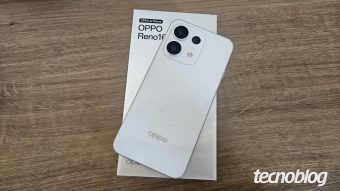
The Oppo Reno 16 F, an intermediate device from Oppo, was launched in Brazil with a price comparable to premium smartphones, offering features such as elegant design, a 7,000 mAh battery, AMOLED screen, and versatile cameras. At the time of this analysis, the Chinese giant was selling the device for R$ 3,699.
After testing the Reno 16 F for fifteen days, its functionalities were detailed. The packaging includes the manual, a transparent case, a SIM ejector pin, and a USB-A to USB-C cable. Although the international version comes with an 80W charger, buyers in Brazil receive an adapter conforming to the local standard, as informed by the brand.
Design and Build Characteristics
One of the strengths of the Reno 16 F is its design, which resembles previous iPhone models. It is available in two shades: purple and white. The light version features a three-dimensional detail on the back that changes depending on the viewing angle. The purple model has an entirely plastic structure with rounded edges, while the white version uses glass on the back.
Despite its large 7,000 mAh battery capacity, the device maintains a light weight of 196 grams. With the included silicone case, the weight increases to 226 grams. This case also serves to protect the lens module against surface scratches.
The side dimensions contain power and volume buttons, as well as a dedicated key for specific tools. The speakers are located at the top and bottom, along with the SIM and microSD card slots. The Reno 16 F has IP69K certification, ensuring complete sealing against dust and high resistance to hot, high-pressure water jets. During practical tests, the smartphone maintained full functionality when submerged in water and has software features to expel liquids from the speakers.
Screen and Protection
Oppo equipped the intermediate device with a quality panel, featuring a 6.57-inch AMOLED screen with Full HD+ resolution and a 120 Hz refresh rate. This combination provides vibrant colors in audiovisual content, good sharpness, and fluidity when using applications. The maximum brightness reaches 1,400 nits, which is sufficient for use under sunlight in light mode, although dark mode should be preferred in dimly lit environments to avoid visual difficulties.
A negative aspect of the screen is the absence of HDR10 technology in contrast optimization, a feature present only in the higher-end version, the Reno 16. Regarding protection, the device uses Crystal Guard, the brand's proprietary glass that replaces the former Gorilla Glass, boasting a hardness level of 5 on the Mohs scale. The Chinese manufacturer also provides a protective film.
For security, the device offers biometrics through facial recognition or in-display fingerprint scanning, a function that operated satisfactorily even with wet fingers.
Audio and Cameras
The audio system of the Reno 16 F meets the basic requirements, maintaining a balance between bass, mid, and treble frequencies without offering significant prominence. However, in large or noisy places, watching or listening to music can be challenging, even using the 300% sound boost mode via software, as the author did not feel any evolution in volume.
The camera setup focuses on versatility, featuring three rear lenses and one front lens. The main camera and, particularly, the 50MP telephoto lens are highlights. The 3.5x optical zoom produces excellent quality images, with great sharpness, texture preservation, and almost no noise interference during close-ups. The post-processing applies vivid colors without looking artificial.
The 8MP ultrawide camera, on the other hand, is a major disappointment. Although it offers a wide field of view, it presents serious problems in direct sunlight situations, resulting in reduced contrast, sharpness, and detail. In low-light environments, Night Mode performs well, and the Optical Image Stabilization (OIS) on the rear ensures quality recordings without blur caused by hand tremors.
The device also includes a High Resolution Mode and integrated camera style features, such as the Pop Cam function, which allows applying filters and tones before capturing the image. The Portrait Mode, however, could be more effective, as cropping complex backgrounds shows flaws, requiring good lighting for a natural blur.
The 50MP front camera performs better in well-lit environments. Its processing maintains natural skin sharpness and texture without exaggerating filters, resulting in detailed and natural selfies. In night photos, a loss of naturalness and sharpness is noticeable due to compensatory post-processing. In video recording, the phone achieves 4K at 30 fps, with optical stabilization working efficiently to control user movement.
The brand also provided the Oppo Bubble, a magnetic accessory with an AMOLED screen that functions as an external viewfinder for framing selfies or remote shooting. However, this item is sold separately for R$ 899 on the official website, a price considered high for an accessory that primarily serves as an auxiliary mirror for selfies.
Performance and Software
The Reno 16 F is equipped with the MediaTek Dimensity 7300 Energy processor, aimed at battery autonomy, along with 8 GB of RAM and 256 GB of storage, with microSD expansion option. Performance is pointed out as the main weakness of the Oppo intermediate device. Annoying freezes were observed when switching between various applications, especially in multitasking, such as opening Spotify, social networks, and banking apps simultaneously.
There were also difficulties editing videos in CapCut, as the phone showed slowness during file viewing. A recurring and curious behavior was the random flickering of the screen, particularly when browsing social media feeds, although the author did not know if this was a defect of the test model or a chronic problem with the line.
In gaming tests, there were no performance issues running Call of Duty and Genshin Impact with low or medium graphics, despite considerable device heating over time. However, when pushing the GPU to its limit, an FPS drop was noticed that negatively affected the gaming experience. In Geekbench 6 tests, the Oppo Reno 16 F scored lower than intermediate and flagship phones from three years ago.
The operating system is Android 16, running on the ColorOS interface. This is a positive point because it is simple, highly customizable, and has attractive animations, making it easy for users accustomed to Samsung or Motorola to adapt. The system incorporates a feature similar to Apple's Dynamic Island, allowing management of music, tracking transport, and other functions at the top of the screen.
Overall, ColorOS is an excellent system. Although it occasionally suggests apps from Oppo's own store, it does not overload the phone with intrusive advertising, unlike the experience reported with the Huawei Nova 15 Max. ColorOS natively integrates the entire Google services package, enabling the use of Google Wallet for contactless payments and compatibility with Google Gemini and Android Auto. Additionally, Oppo introduced the AI tool called 'Mind Space', promoted as 'Your second brain', which allows capturing information from the screen and suggesting actions, such as scheduling events or logging expenses.