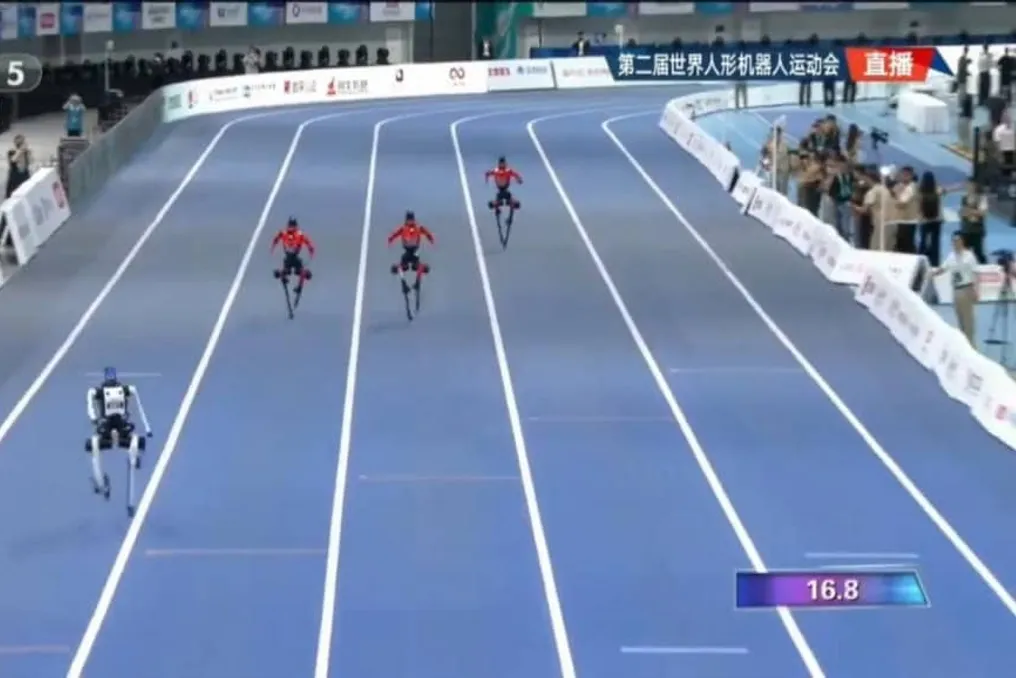
The final of the World Championship of Humanoid Robots – the 'Robots' Olympic Games' – took place in China on Wednesday (26). New records were set at the event.
A robot from X-Humanoid surpassed the record of athlete Usain Bolt. In 2009, Bolt set the world record for the 100-meter sprint, running the distance in 9.58 seconds at the World Athletics Championships in Berlin, Germany. However, the model from X-Humanoid ran 100 meters in just 9.39 seconds on the first day of the Olympic Games, on Saturday (22).
The X-Humanoid robot is not the first to break Bolt's record. On August 17, the company Unitree, also based in China, published a video of its robot named Superman that 'breaks the limits of humanity.' At the time this article was published, the video had garnered about four million views.
Attracting attention to robots setting human records brings views and headlines. This was one of the goals of the current year's 'Robots' Olympic Games' in China. Another goal of the event is not related to jumping higher or running faster.
A major task for companies in robotics and technology for the 2026 World Games was to demonstrate the practical usefulness of their models. It is necessary to show that they can be used both on industrial production lines and in home environments.
'Robots' Olympic Games 2026 in China gathered 2056 humanoid robots and 666 teams from 16 countries. The robots competed in 51 categories. Thirty categories were sports-related (athletics, football, table tennis), and twenty-one were based on practical scenarios (rescue operations, hotel business, and manufacturing tasks).
Overall, the event served as a showcase for astonishing progress in the speed and physical strength of the models. Nevertheless, some moments generated memes, such as a robot falling after a 'Looney Tunes'-style run.
Despite the memes, humanoid robots still face two critical challenges for real-world application: autonomy and fine precision. Only by overcoming these obstacles can the models function outside strictly controlled environments.
Anderson Moreira, Professor of Control and Automation Engineering and coordinator of the Robotics Team at Maua Institute of Technology, noted in an interview with Olhar Digital: 'Home, from a robotics perspective, is much more unpredictable than a factory.'
The professor also emphasized that 'the competition demonstrates technological capability, not industrial maturity.' That is, one fact is breaking a world sports record, and another is being useful in a factory, for example.
Moreira explained: 'A robot that completes a competition once is very different from performing the same task thousands of times over months with safety, low failure rates, and lower costs than a human alternative or traditional automation.'
Chinese media itself acknowledged the gap between sporting performance and real-world application while covering the games. A comment from the state news agency Xinhua of China stated: 'An industrial robot is not obliged to win a race, and a service robot does not need a medal.' However, any increase in speed, stability, and accuracy in the competitive arena can slightly bring robots closer to becoming truly useful outside of it.
The true battle in the next stage of humanoid robotics lies precisely in transforming demonstration characteristics into reliable performance.
Anderson Moreira, Professor of Control and Automation Engineering and coordinator of the Robotics Team at Maua Institute of Technology, added in an interview with Olhar Digital that events like the World Humanoid Robotics Games contribute to the improvement of models. He observed: 'The United States, Europe, Japan, and Korea may continue to lead in certain technologies, but they are beginning to compete with the Chinese ecosystem, which is capable of experimenting with many architectures in parallel and rapidly industrializing those that perform best.'
Humanoid robots mark a new chapter in the rivalry between China and the United States. On the Chinese side, robotics events started as 'science fairs,' but thanks to a decade of large investments in the sector, they have transformed into strategic showcases for companies.
It is also worth mentioning American companies such as Tesla and Boston Dynamics, which attract public attention. More importantly, they attract contracts. In January, Elon Musk's company announced the discontinuation of Model S and X car production to release the Optimus, its humanoid robot. And Atlas from Boston Dynamics supported South Korean Hyundai.
There are several opinions regarding the size of this market. Analysts and consulting firms predict that by 2026, the market will be between 2 and 11 billion US dollars (approximately 10 to 57 billion Brazilian reais). For the next ten years, growth is projected to reach 35–200 billion US dollars (approximately 180 billion to slightly over 1 trillion Brazilian reais).
Morgan Stanley went further: it predicted that the humanoid market would reach 5 trillion US dollars (26 trillion Brazilian reais) by 2050, including related supply chains, as well as repair, maintenance, and support. By the middle of the century, more than a billion humanoids may be in use. In this race, China leads.