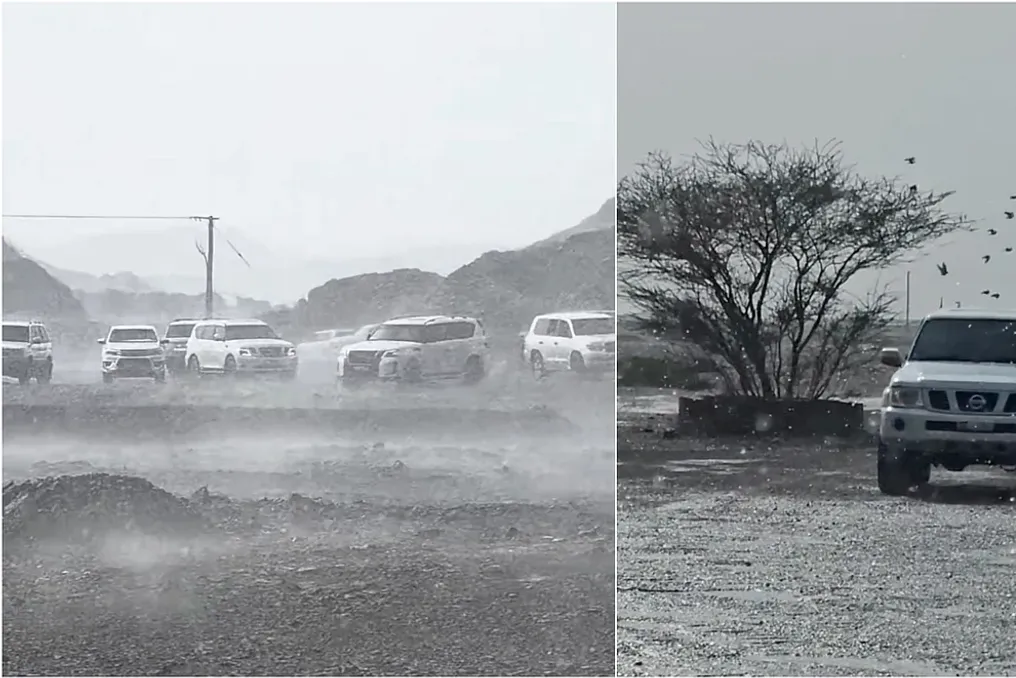
On Wednesday, heavy rains fell in some areas of the United Arab Emirates (UAE), caused by changing weather conditions during the transition from summer to autumn. The National Center of Meteorology (NCM) issued yellow warnings for numerous territories across the Emirates, advising residents to exercise caution when engaging in outdoor activities.
Precipitation is expected between 13:30 and 22:00 in certain eastern and southern regions, and it is also set to spread to inland areas. Previously, the Storm Center had forecasted rain in Al Ain due to cloud formation supported by moist easterly winds over the Hajar Mountains. Intense thunderstorm activity was also anticipated over the mountains of Madha wilayat in Oman and its northern part.
Near noon, the weather forecast indicated a decrease in moist sea breezes in the cloud formation zones. Thunderstorm activity is likely to begin from the northwest towards the central region—Al Madam, Malihi, and Al Dhaid. These breezes will move towards the southeast of Dubai—Markab and Al Fakah, as well as north of the city of Al Ain—Al Hudairah and Al Khair.
Video footage published on accounts shows heavy downpours in the Shawka region of Ras Al Khaimah and parts of Al Ain, accompanied by squalls. The lowest temperature recorded today was in Al Farfar (Fujairah) at 6 am, reaching 25.5ºC. Meanwhile, the highest temperature reached 49.7°C in Madinat Zayed (Ad-Dhafra region) at 14:45.
Under these weather conditions, the Abu Dhabi Police urge drivers to exercise caution and adhere to variable speed limits displayed on electronic signs. Precautions have been taken throughout the capital city of Abu Dhabi due to recent weather conditions. The Municipality of Abu Dhabi has temporarily closed all parks, recreational areas, and adjacent beaches, and has suspended events until further notice.
The Municipality explained that these measures were taken to protect residents and ensure public safety amidst fluctuating weather and heavy rainfall in different parts of Abu Dhabi. Meteorological systems in the region are drawing moisture from the Gulf of Oman. Combined with rising temperatures and the influence of the eastern mountains, local convective cloud formation is expected over parts of the country, especially in the afternoon, according to NCM. These clouds may bring precipitation of varying intensity.
The weather in the UAE will depend on the expansion of the surface low-pressure system from the east, as well as the influence of an expanding weak upper low-pressure system. Temperatures are planned to drop starting with the appearance of the star Suhail on August 24th. It is believed that after observing this star, also known as the 'Yemen Star', a 40-day transitional period will begin, during which the weather changes from extreme heat to cooler temperatures. This phase is called 'Sufriya.'
Previously, NCM informed Khaleej Times that clouds were seeded upon detecting suitable clouds during the previous rainy season. The Center explained that intense summer heat stimulates the development of convective clouds through surface heating, but heat alone is not enough for precipitation. Humidity, moist air masses, atmospheric instability, upper troughs, and favorable winds are also necessary for this. When these elements coincide, thunderstorms and rain can develop even when temperatures approach 50°C.