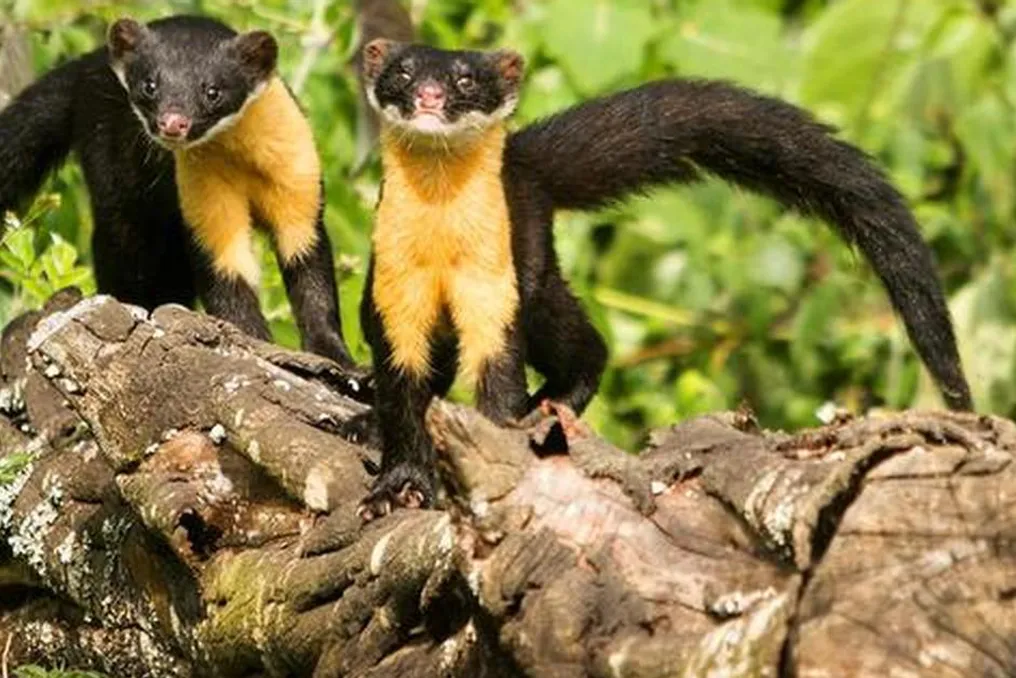
The Nilgiri langur, a small predator with thick chocolate-brown fur, reddish front parts, and a characteristic yellow-orange throat, is found exclusively in the Western Ghats and is one of India's rarest mammals.
Recently, a photograph of this elusive animal attracted attention online after Indian Civil Service officer Supriya Sahu shared it on X on World Endangered Species Day, May 15th. She described the Nilgiri langur as 'one of nature's happiest little secrets,' referencing its unique coloration and life among shola forests.
The reaction to the photo showed that many people had never seen or even heard of this animal. Others thanked Sahu for introducing them to a species that is rarely discussed in the context of Indian wildlife.
This rare endemic species, possessing tiny paws and golden-chocolate fur, impresses with its playful agility, jumping through shola forests. It is found only in the Western Ghats, and its global population is estimated at fewer than 1000 adult individuals, with the International Union for Conservation of Nature (IUCN) classifying it as vulnerable.
Getting to know the langur
The langur belongs to the langur family and is the sole representative of this species originating from South India. Its range covers parts of the states of Karnataka, Kerala, and Tamil Nadu, with the Nilgiri Hills forming the central part of its distribution. Records are also documented in places such as the Charādi Ghat, Neyyar, and Peppara reserves.
It is not a large animal. An adult langur can reach a length of about 55–65 cm from head to body, and its bushy tail is 40–45 cm long, weighing approximately 2 kg. It is easily recognizable by its coloration: most of the body is dark brown, the front part is reddish, and the throat has a bright yellow-orange hue.
Unlike many predators that become active at night, the Nilgiri langur is diurnal, meaning it is active during daylight hours. It spends a lot of time in trees, although it sometimes descends to the forest floor. Its diet is varied: it includes birds, small mammals, and insects such as cicadas, as well as fruits and seeds.
This allows the langur to occupy various positions in the forest food chain, acting simultaneously as both a predator and a frugivore.
Life connected to sholas
To understand the significance of this animal, one must consider not only the langur itself. The Nilgiri langur is closely associated with the montane forests and mosaics of forests and grasslands of the Western Ghats. In a 2023 study, scientists analyzed 165 random records collected over 10 years in the Nilgiris.
Of these, 67% were obtained in shola forest ecosystems, and another 22% in grasslands. The records covered altitudes from approximately 857 meters to 2583 meters above sea level, with most sightings occurring around 2000 meters.
The langur moves between trees and ground in search of food. By eating small animals and insects, it participates in the functioning of the forest ecosystem. Its consumption of fruits and seeds can also contribute to seed dispersal across the landscape.
Why observing it is unusual
Another reason why the recent photograph caused a stir is that researchers themselves faced difficulties in gathering sufficient information about this species. The Nilgiri langur occurs at low density and is capable of moving unnoticed through dense forest.
A study conducted in the Pampadum Shola National Park recorded 42 sightings between 2013 and 2015, many of which lasted less than a minute. Researchers also used camera traps and local observations to build a picture of its distribution and behavior.
The absence of sightings does not necessarily mean the animal is absent. A species living quietly in a complex environment may simply be difficult to detect. This makes every reliable record valuable, as it adds a new element to the picture of the langur's life and needs.
Landscape is the main story
The vulnerability of the Nilgiri langur is closely linked to the vulnerability of its habitat. Studies in the Nilgiris also highlighted the importance of forest patches outside officially protected areas. Of the 165 records studied, 11% were obtained on plantations, and researchers emphasized the need for further surveys and protection of reserve forests adjacent to the Mukurthi National Park.
It is in this context that the photograph of one small animal becomes part of a broader story of nature conservation. The Nilgiri langur depends on the interconnected forest, grassland, and mountain ecosystems of the Western Ghats. Protecting these landscapes will help preserve not only this elusive predator but also the wider community of species sharing its habitat.