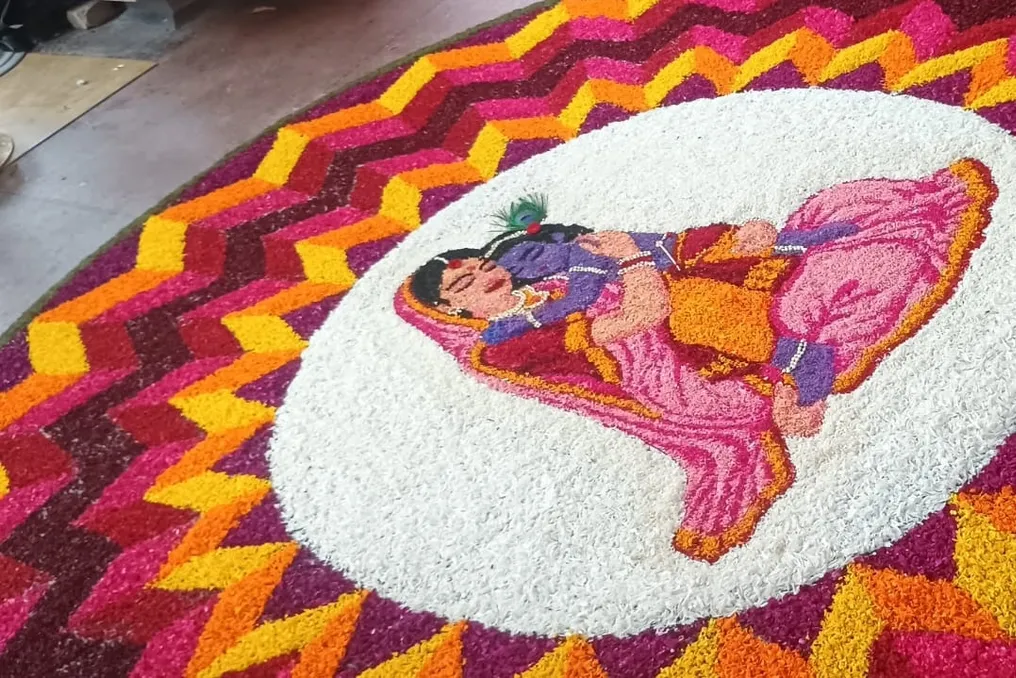
Despite the event taking place in Delhi, the atmosphere resembled Kerala. The author visited the Uttara Guruvayurappan temple in East Delhi for the Onam festival and immediately felt the spirit of South India.
There was a special ambiance before entering the temple: women adorned their hair with garlands of mullappu (frangipani flower), while men were dressed in traditional Keralan attire—mundu. About 80-90 percent of people were present. Some participants held offerings, others lit lamps, while the youth took selfies and photos using mobile phones.
Although Malayali culture was visible in Delhi, despite language differences, the joy of the festival seemed very personal. People congratulated each other with 'Happy Onam,' conversed, and women fanned themselves with handkerchiefs to dispel the stuffiness, while girls wiped their cheeks with paper napkins.
The culmination of this experience was the serving of Sadya—a dish traditionally served on banana leaves and comprising 15 to 17 different items. Apparently, the banana leaves were brought from Kerala, and some people carefully shaped them.
In an air-conditioned hall designed for approximately 700 people, tables and chairs were arranged, and dishes were laid out on banana leaves sequentially. Here, food was not just sustenance but an entire tradition. Among the many dishes were: matta rice, parippu curry (lentil stew), sambar, rasam, avial, olan, kalan, erisery, thorn, pachadi/ichchadi, pulisseri, inji puli, achar, uppiyeri (banana chips), sharkara varatti, papadam.
Additionally, two types of kheer were served on two leaves: kheer made from lentil flakes and palm jaggery, as well as a melt-in-your-mouth rice kheer. There were about 15-16 dishes in total. A full meal took between 10 to 15 minutes, as 500-700 people sat down in one round at the table, creating significant complexity.
The start of the feast was challenging due to the freshness of the leaves, a portion of rice, and the light aroma of coconut oil. Ultimately, taking advantage of the Bihari trait, the author started with rice (matta rice) and sambar. The first experience was very pleasant.
Next, he tried inji puli—a paste of ginger and palm jaggery. This mix of spicy, sweet, and sour evoked a storm of flavors. It was important to maintain outward composure among hundreds of Malayalis, caring about one's image.
Gradually, all the items were eaten. Although people usually eat sweets at the end, the author decided to try the lentil flake kheer (Kadala Parippu Payasam) earlier. This brought a feeling of bliss; the kheer was thick, aromatic, and rich with the sweetness of palm jaggery. It was important to eat it, not swallow it.
The rice kheer also left a strong impression—it was incredibly soft and melt-in-your-mouth. The harmonious combination of milk and rice was so light and divine that it seemed it couldn't pass down the throat while eating with closed eyes.
The papadams here are slightly different from local ones, but the taste remained unchanged, even if some dishes were cold. The crispy banana chips added pleasure between the main courses. The combination of sweet, sour, salty, and spicy on one leaf reminded one that all the tastes of life were gathered on one plate.
The author ate with his hands, as is customary in Kerala. He liked most that in this entire experience, food and culture were inextricably linked.