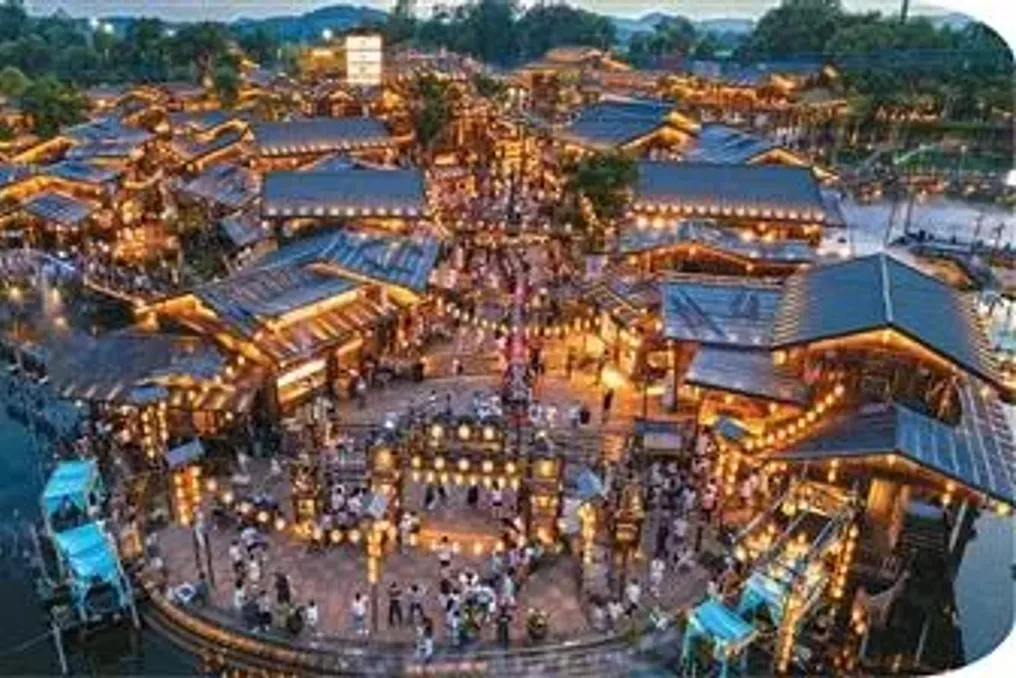
China's summer tourism season is undergoing changes: in addition to typical sightseeing, travelers are increasingly immersing themselves in deep cultural experiences. Museums, sporting events, theatrical performances, and literary sites are adding variety, contributing to a cultural upswing this year.
Cultural venues across the country have extended their operating hours this summer, offering themed exhibitions, immersive tours, and opportunities to experience intangible cultural heritage (ICH) to attract families.
In Beijing, at the National Museum of Natural History of China, a special 'Museum Night' program has been launched, allowing visitors to explore the dinosaur hall after dark. In Shanxi Province, northwestern China, the Weinan Museum has gone beyond traditional exhibits by hosting outdoor concerts that combine classical music with local history.
In Shunde City, Guangdong Province, southern China, a tour scenario based on the exhibition of valuable traditional silk fabric, Xianyunsha, has been organized. Tourists are invited to participate in role-playing as owners of dyeing workshops or fashion designers, solving plot-related tasks.
Similar programs have appeared in Tongjiang, Heilongjiang Province, northeastern China, where a local museum combines fish skin painting, an ethnic group craft of the Hezhe people, with local history. In Anshun, Guizhou Province, southwestern China, visitors attracted by the Huangguoshu waterfall also try their hand at painting Dixi operetta masks and learn about other ICH products.
In Yunnan Province, southwestern China, batik workshops in Dali and folk entertainment in Yuhu Village in Lijiang help integrate agriculture, culture, and tourism.
Cai Hong, director of the Tourism Research Center at the Capital University of Economics and Business, noted that 'intangible cultural heritage is moving beyond static exhibitions and being integrated into daily life.'
In Harbin, Heilongjiang Province, northeastern China, the 'Harbin Ice Show' is taking place. Furthermore, sporting events and theatrical performances are stimulating spending on culture and tourism. In Weifang, Shandong Province, eastern China, a grassroots football tournament offers ticket holders free entry to several scenic spots and discounts at hotels, along with a fan fair selling local products and ICH crafts.
Similar 'ticket economy' models are observed at the Youth Theatre Festival in Changsha, Hunan Province, central China, and during the months-long Summer Music Season in Harbin, Heilongjiang Province.
Another trend this summer is visiting literature-related sites rather than following traditional routes. Readers are visiting literary landmarks, including Ditan Park (Earth Temple) in Beijing, the setting of Shi Tianshen's famous essay 'The Earth Temple and I', as well as Wukan Street in Shanghai, associated with Eileen Chang's works.
In recent years, various locations across China have utilized cultural heritage related to former residences of writers and literary attractions to develop a wide range of tourism initiatives, transforming travel from mere photography into a deeper experience.