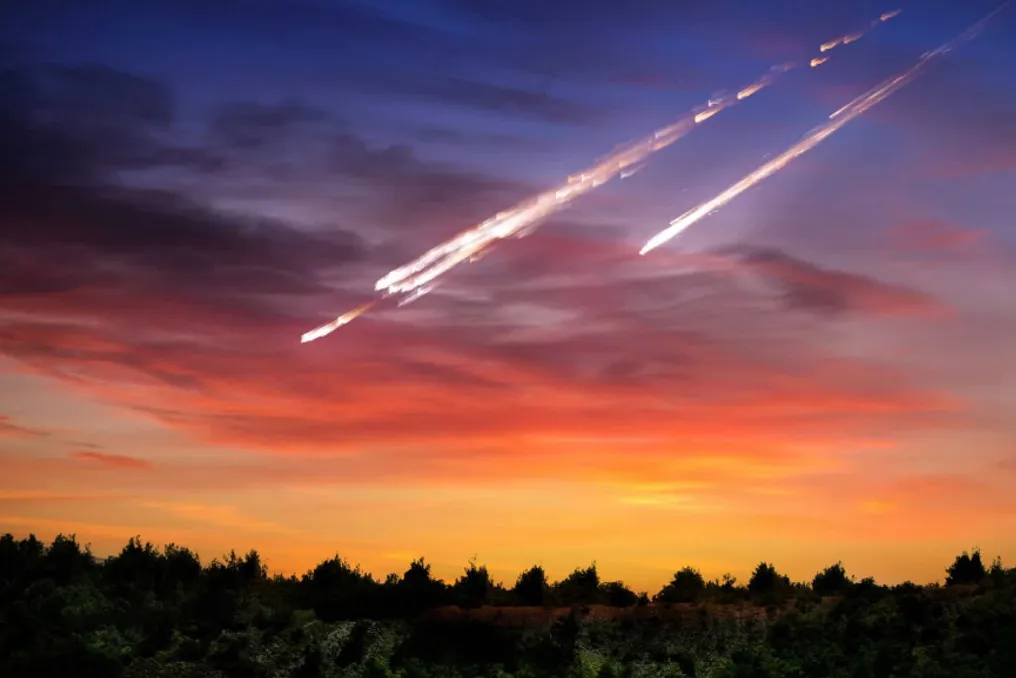
When a space rock enters the Earth's atmosphere, it does not completely disintegrate due to combustion. A new investigation analyzed 75 meteorite fall events recorded in images and videos, successfully mapping seven distinct stages of this process. Scientists concluded that fragmentation and melting are crucial for both mass loss and the reduction of the rocks' velocity until impact with the ground.
According to the findings, the material undergoes several modifications while passing through progressively denser atmospheric layers. Initially, the rock begins to emit light, loses some of its mass, melts, breaks into fragments, and finally decelerates enough to cease luminous emission. The cycle ends when the remains hit the ground as meteorites.
The first stage occurs at the highest altitudes of the atmosphere, where the air already has sufficient density to generate a shockwave in front of the object. Collisions with air molecules heat both the body and the surrounding gas, generating the glow known as a meteor or 'shooting star'. As the rock descends, the increase in atmospheric density intensifies this phenomenon.
In the second phase, some meteors exhibit periodic variations in brightness, attributed to the rotation of the object itself. Among the cases examined, those that rotated faster completed one turn in intervals of 0.5 to 5 seconds. Subsequently, in the third phase, the meteor transforms into a fireball, at which point melting becomes the main factor in mass reduction.
About 60 kilometers above the surface, the rock reaches the fourth phase, entering a state of fusion equilibrium. At this point, its brightness remains constant or increases slowly. In this phase, the object can lose up to 40% of its mass solely due to melting caused by atmospheric penetration.
The fifth phase begins when the atmospheric pressure increases enough to cause the rock to rupture. Researchers observed that fragmentation starts when the frontal pressure reaches only about one-fifth of the resistance recorded in meteorites found on Earth. Heating and fissures accumulated during previous collisions in space may justify this lower resistance.
When pieces of the rock separate, the object reduces its size and decelerates more rapidly. If the rear section remains intact, it generates a low-pressure zone that aids in attracting smaller fragments. Consequently, these pieces tend to land in a restricted area.
In the sixth phase, the rear part finally breaks off. This fragmentation causes a final flash and projects pieces at higher relative velocities. Since the rock is already slower, these final flashes generally have a reddish hue, distinct from the green seen previously.
In the seventh phase, melting and fragmentation continue until the last vestiges reduce their speed to the point of stopping the glow. Melting ceases, forming a thin layer of fusion on the surface of the fragments. After this, the wind may modify the trajectory of these darkened pieces before they reach the ground.
The researchers also used the 75 analyzed events to compare different types of meteorites and determine the altitudes at which each material goes through the seven phases. The study also contributes to understanding the behavior of larger rocks, including asteroids with potential for atmospheric explosion. According to experts, asteroids up to a few dozen meters can also be composed of solid rock and undergo analogous processes during atmospheric entry. The approximately 20-meter asteroid that exploded over Chelyabinsk, Russia, in 2013, would have gone through these same phases before the 'airburst' event.