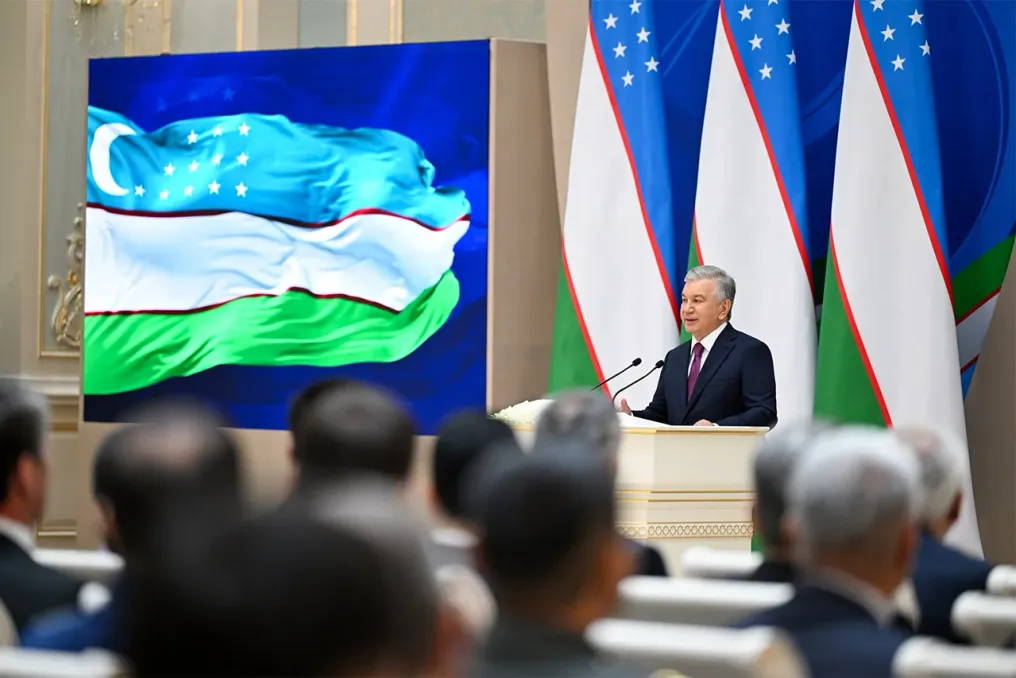
Uzbekistan's President Shavkat Mirziyoyev announced that the country's economy has increased by more than 2.5 times over the past decade, and the volume of foreign investment attracted has exceeded 160 billion US dollars. This statement was made by the head of state during an awards ceremony dedicated to the 35th anniversary of Uzbekistan's independence.
Congratulating participants on this important date, Mirziyoyev noted that although 35 years is a relatively short period historically, the past decade has been marked by massive transformations and significant achievements for the nation.
The President emphasized that the citizens of Uzbekistan are the main creators of these changes. He specifically highlighted the contribution of farmers, teachers, healthcare workers, scientists, industry leaders, entrepreneurs, builders, architects, cultural and sports figures, civil servants, as well as local mahalla activists.
The head of state also focused on the role of military personnel and law enforcement officers in maintaining public order and peace across the country. Mirziyoyev stated: 'In short, the greatest result of New Uzbekistan is the transformed person—a citizen confident in their own abilities—and a society that feels a direct stake in tomorrow.'
According to the President, economic growth was accompanied by active job creation and the development of social infrastructure. Over the last ten years, 5.7 million permanent jobs have been created in the industrial, service, and agricultural sectors.
Thanks to joint state and private initiatives, modern schools with a total capacity of 1.2 million places, kindergartens providing 342,000 places, and medical institutions with 62,000 beds have been built in the country.
It is projected that Uzbekistan's gross domestic product (GDP) will exceed 180 billion US dollars in 2026. Infrastructure projects of the decade included the construction and repair of 83,000 kilometers of public roads. For the first time, centralized access to drinking water has been provided to residents of 8 million households, and the quality and availability of water supply have improved for another 11.5 million people.
Furthermore, over the past decade, 650,000 families have received new modern housing, which has improved the living conditions for at least 2.5 million citizens.