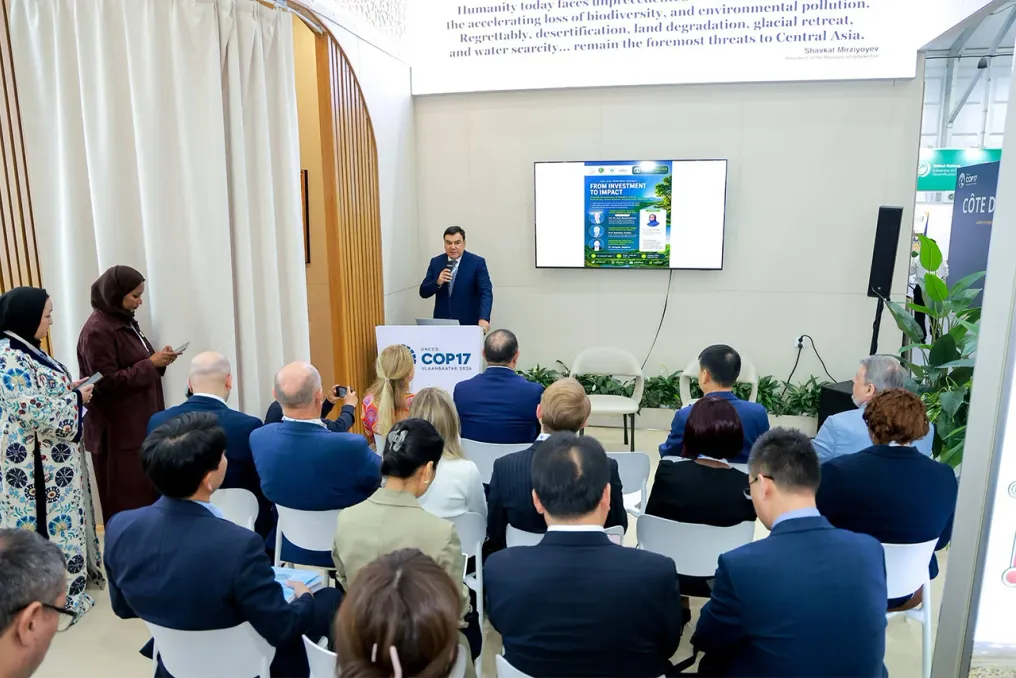
At the 17th session of the United Nations Convention to Combat Desertification (UNCCD COP17), Uzbekistan presented initiatives aimed at attracting investment for degraded land restoration and scaling up climate-resilient solutions. The event, titled 'From Investment to Results,' took place on August 24, 2026, at the National Pavilion of Uzbekistan.
Discussion Participants
The discussion included Aziz Abdukhakimov, Advisor to the President of Uzbekistan on Environmental Issues and Chairman of the National Committee on Ecology and Climate Change; Tarifa Alzabi, Director General of the International Centre for Biodiversity Agriculture (ICBA); Bakhtiyor Pulatov, Rector of Green University; and Marguba Rejapova, Research Fellow at ICBA CAC.
Project Examples and Program Expansion
Abdukhakimov highlighted Karakalpakstan, where targeted investments facilitated the implementation of sustainable agriculture projects in degraded territories. With support from the Abu Dhabi Fund for Development amounting to $5.1 million in 2023, the National Committee on Ecology and Climate Change and ICBA established three demonstration plots, tested drought-resistant crops, and developed methods for managing soil, water, and agriculture.
From 2025 to 2026, the program was expanded to cover an additional 4,144 farmers across all 15 districts of Karakalpakstan, who produced and distributed over 20.9 tons of high-quality seeds.
Proposals for Future Cooperation
A joint concept for future cooperation between Uzbekistan and ICBA was presented at the event, envisioning the establishment of the Central Asian Centre for Biodiversity Agriculture and Climate Resilience (CABACRH) at Green University. This center will integrate laboratory research, field projects, specialist training, and practical technology implementation.
Under this initiative, the creation of a $5 million spirulina research laboratory is planned to study microalgae, water resources, and salinity, which will also serve as a training center for students, researchers, and farmers.
Development of Standards and Training Centers
Participants also discussed establishing a Laboratory of Projects for Arid Lands at Green University. This laboratory would prepare land restoration projects for financing by determining baseline indicators, budgets, environmental and social guarantees, key performance indicators, and potential funding sources. The initial international intake is planned for 2027 and will include specialists from Central Asia, Mongolia, and other arid regions.
Another proposal concerned the development of a Regional Standard for Land Restoration Quality alongside a Monitoring, Reporting, and Verification (MRV) system. This standard would assess the area of restored land, vegetation and soil condition, water balance, productivity, and socio-economic impact, with initial testing planned in five to ten pilot projects.
Furthermore, delegates considered creating a Central Asian Center for Land Project Training, which would assist projects in conducting feasibility studies, developing baseline data and MRV systems, ensuring environmental and social guarantees, economic analysis, and financial structuring. After preparation, projects can be submitted for consideration by financing mechanisms, including the Global Environment Facility, the Green Climate Fund, international financial institutions, bilateral partners, and private investors.
The session also covered issues of building scientific and institutional capacity, personnel training, and interaction with farmers and state structures. Representatives from Green University and ICBA reviewed the activities of AquaBio Lab as a platform for innovation, research, and technological development. Participants emphasized the importance of turning successful investments into the basis for future projects through accumulating evidence, developing skills, disseminating technologies, and forming portfolios of investment-ready projects.