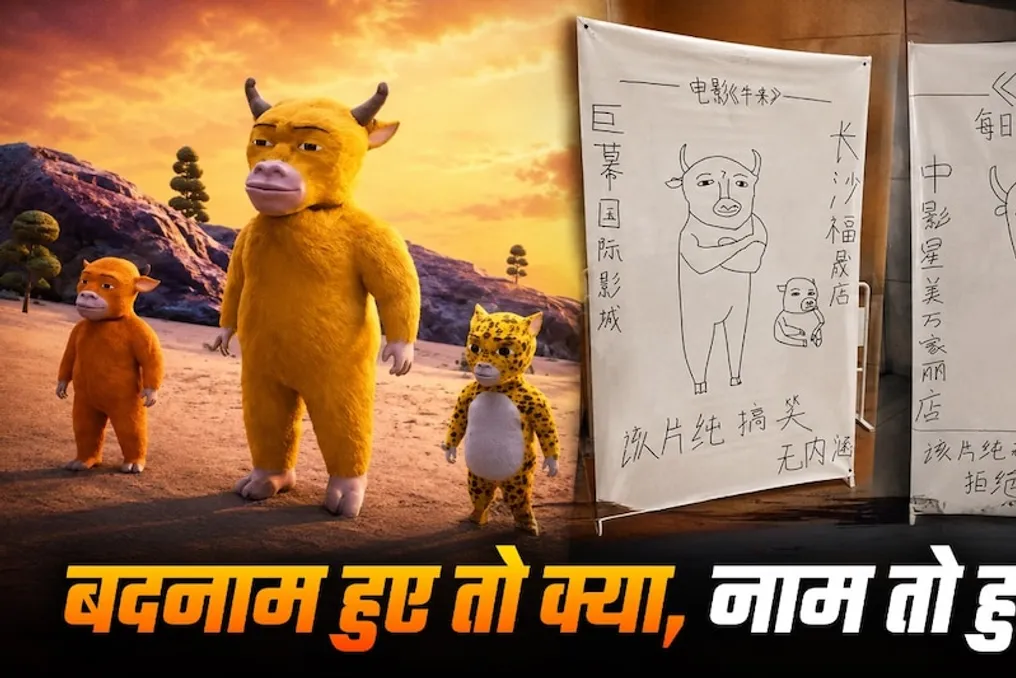
Sometimes a film's fate is determined not by its merits, but by its flaws. The Chinese animated picture Niu Lai is a prime example of this unusual and interesting phenomenon. At the beginning of its run, it was difficult to attract even 300 viewers; screenings were constantly reduced, and the film's presence in cinemas diminished, making its future resemble that of many films that are released but do not remain in the collective memory of viewers.
Then, social media began mocking the strange characters, poor animation, and convoluted plot of this film. However, this mockery had an unexpected effect. It was precisely these flaws that people criticized which gradually became the main feature of the film. The more comments appeared about the film, the more attention it attracted. Criticism generated discussion, and discussion led to curiosity, which ultimately brought viewers to the theaters.
Now, people went to see the film not because it was good or bad. They wanted to find out for themselves how bad the film being so negatively covered on social media actually was. Thus, the success story of Niu Lai at the box office turned into a fascinating study of viewer psychology. In the digital age, the desire to watch a film is not always dictated by its quality. Sometimes ridicule serves a promotional function; failure can spark interest, and a film's biggest weakness can become its most effective marketing strategy.
Niu Lai is a rather simple animated picture. The plot revolves around a newborn calf growing up in a fictional world, experiencing things like friendship, family, sacrifice, and struggle. A small bird named Skylark also plays an important role in this story. Through the calf's journey from childhood to adulthood, the film attempts to touch upon serious themes such as life, relationships, and struggle.
However, the problem was not only what the film wanted to say. The problem was also how it said it. Events feel disjointed in many places, disrupting the narrative flow. Instead of following the characters' journey, viewers are forced to constantly try to understand where the story is going. That is, the film's weakness was not only its technical level; the plot also struggled with emotionally retaining the viewer until the end.
But if the plot was a weakness, the animation became the reason that turned it from an ordinary flop into an internet sensation. The characters in Niu Lai seem extremely unnatural. Their faces and 3D models are simple, voice modulation sounds awkward in many places, and the visual effects do not match the level that today's audience expects from a film released in a cinema.
There was a flurry of memes about the film on social media. Screenshots of the strange characters and animation were shared, and they were actively commented on. This happened at a time when Chinese animated films, such as Ne Zha 2, impressed audiences worldwide with advanced technology, grand visual effects, and magnificent animation. The appearance of Niu Lai on screen at such a time was almost the opposite experience.
But the irony is that what made Niu Lai an object of ridicule gradually became its most powerful advertising engine. Before its release, the film had neither major stars, nor the backing of a large studio, nor an expensive advertising campaign capable of bringing its name to millions of viewers. The film was released in theaters almost in silence. But social media accomplished in a short time what millions could have spent.
This raises an interesting question: why are people drawn to what they consider bad? The human brain is attracted not only to good and beautiful things; it notices unusual things too. If someone says a film is very good, you might postpone watching it. But if thousands of people start saying you have never seen such a bad film, another question arises in the mind: how bad is it? This is where the Curiosity Gap effect comes into play.
In it, some information is presented, but the most interesting part is missing. You are told something is unusual, but the reality itself remains inaccessible. This incomplete information creates a void in the brain, and the person strives to experience it themselves. Something similar happened with Niu Lai. People heard about the film, saw its frames, saw the memes, but now they wanted to know for themselves how true it was. The film turned into a kind of challenge. Another psychological effect is also at play here—the Bandwagon Effect.