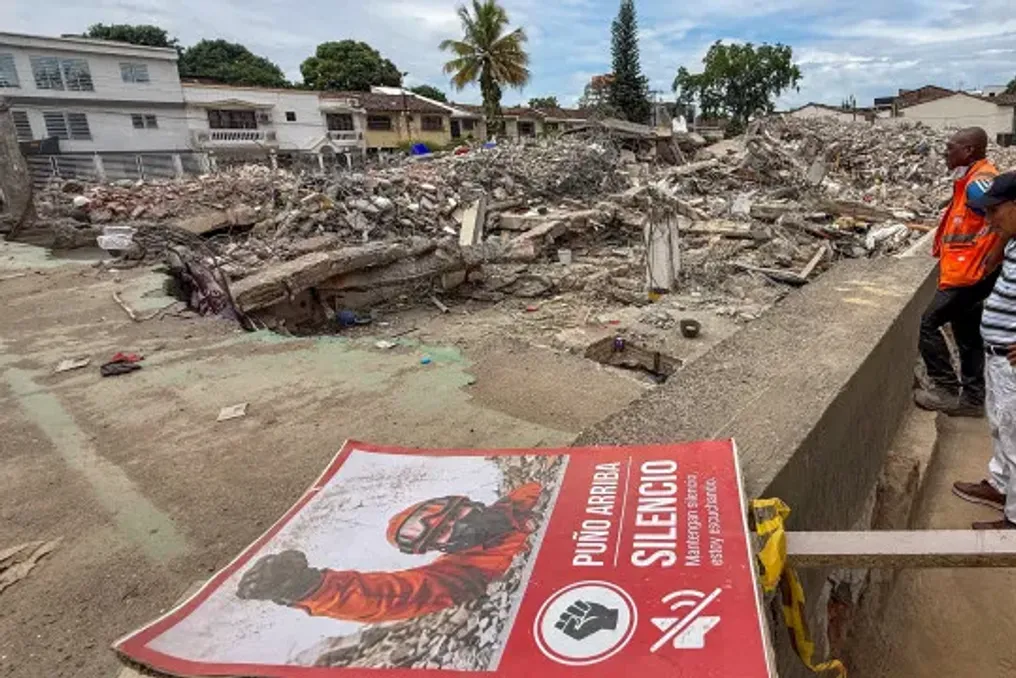
A 7.4 magnitude earthquake on the Richter scale caused a significant number of victims and damage in Colombia, resulting in at least 329 deaths, 234 missing people, over 150,000 damaged residences, and nearly 600 collapsed buildings.
Luis Fernando Mejía, director of Lumen Economic Intelligence, estimated that the seismic event would decrease Gross Domestic Product (GDP) growth by 0.27 percentage points in 2026. However, he predicted that the recovery of economic activity and reconstruction efforts could offset part of this impact, contributing 0.20 points in 2027 and 0.08 points in 2028.
The study, released on Tuesday, takes into account the Government's projection that the total cost of reconstruction, managed by the Miracle Fund, will reach 30 billion Colombian pesos, equivalent to approximately 8.4 billion euros.
The economic loss will be most severe in the five provinces hardest hit by the earthquake. According to the analysis, growth in Risaralda may suffer a reduction of 2.5 percentage points this year, followed by Chocó, where the epicenter was located, with a projected drop of 2.34 percentage points.
The analysis firm stated in a press release that these indicators reflect how much the growth of each province would be lower if the earthquake had not occurred. Together, these five provinces represent 14.5% of Colombia's national GDP.
The study details that the economic impact mainly stems from the loss of productive capacity caused by the destruction of public structures, temporary suspension of activities due to infrastructure damage, mobility limitations, and inherent reconstruction costs.
Colombian President Abelardo de la Espriella announced on Monday the start of reconstruction work in the areas affected by the earthquake. The Government also announced the delivery of the first 4,480 tons of materials intended for repairing damaged homes and implemented an assisted repair and reconstruction strategy, in which each owner must manage the process with support from engineers and other specialists.
The business conglomerate Grupo Argos initially promised 300 rapid construction houses, but this number was raised to one thousand units during the event, with 600 of them potentially allocated to Chocó, as clarified by De la Espriella.
Families whose homes have minor damage will receive repair materials, while those whose residences cannot be recovered will receive a new unit. From now on, families with destroyed or uninhabitable homes will begin to receive a monthly aid of 875,452 pesos (about 245 euros) for three months, totaling 2.6 million (approximately 726 euros) per household.
De la Espriella emphasized that the approach will not just be about replacing what was lost, but about rebuilding something superior, with greater safety, more robust infrastructure, and more job opportunities. He took the opportunity to confirm that the economic aid announced by the Colombian Government would begin to be paid today to the affected families, amounting to 875,452 pesos (244 euros) per family, for a period of three months.