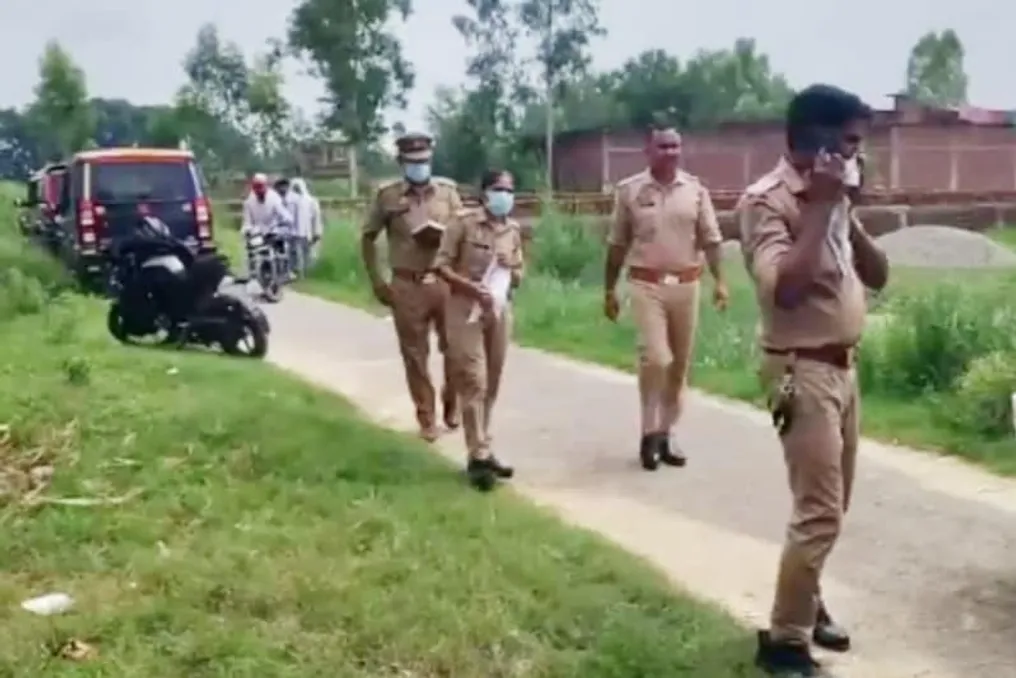
Mass protests in Bangladesh following murder of Hindu family
Read more
Aaj Tak
www.aajtak.in

Mass protests in Bangladesh following murder of Hindu family

The government of Tariq Rahman in Bangladesh is under pressure due to mass protests sparked by the murder of a Hindu family. Residents are holding demonstrations, leveling accusations of murder and rape.

Local residents claim that more people were involved in the killing than admitted, and that attempts are being made to conceal evidence. Although the report states that the murder was committed by strangulation, no evidence of women's rape has been found; however, people suspect that the police are deliberately hiding cases of gang rape.

Following the start of the protests, the investigation was transferred from the police to the Detective Department. The bodies of school teacher Ganpati Chakravarty, his wife Pritilata, daughter, and son were found in his home in the Rangpur area on Saturday.

Although the police registered the case, the protests began because of the case review itself, which led to the transfer of the investigation to the Detective Department.

Similar stories

Police in Bangladesh allegedly concealing evidence in Hindu family murder case; questions of violence arise
Read more
www.aajtak.in

Police in Bangladesh allegedly concealing evidence in Hindu family murder case; questions of violence arise

A dispute has intensified in the Rangpur district of Bangladesh surrounding the murder of four members of a Hindu family. Hindu organizations in Bangladesh are criticizing the government, alleging that the police are concealing evidence in this case.

The bodies of school teacher Ganpati Chakravarty, his wife, daughter, and son were discovered in his home on Saturday. Police arrested Ganpati's cousins, Mugdho Das and Siddhartha Das. The official police version states that they killed the family by strangulation. However, local residents and Hindu groups accuse the police of attempting to protect other perpetrators, who they believe are involved. The public is also questioning the investigation and the police forensic reports.

According to the police report, the family members were killed by strangulation. The police report did not mention any sexual violence against the women. Nevertheless, a morgue employee, speaking to local media during an unscheduled inspection, claimed the presence of semen on the women's bodies. This assertion has not been confirmed. Despite this, local residents insist that the police are trying to shield other culprits in this case.

As disputes grew, the investigation was transferred from the police to the Detective Department. Protests by Hindu organizations continue, with demonstrations scheduled for Thursday outside Bangladeshi embassies in various countries worldwide. The case gains traction as the government of Tarique Rahman marks six months in power. Hindu organizations assert that even during this period of rule, the government has failed to stop violence against Hindus.

According to a report by The Daily Star, the Detective Department believes the murder occurred between August 20 and 21. A sequential review of events revealed that the suspects came to Ganpati's house from the roof of a neighboring building. They were consuming 'Kaba' drugs there. When Ganpati suspected movement on the roof, he went up. An argument ensued with the suspects, and they strangled him using his own handkerchief. Subsequently, his wife went onto the roof, and the suspects also killed her by strangulation.

The suspects then descended and saw Ganpati's daughter. They killed her as well. Then they went down to a room where they found Ganpati's young son, Priyam. They feared that Priyam might recognize them because he was friends with one of the suspects' brothers. Due to the fear of being identified, they also killed Priyam.

Afterward, the suspects did not flee but remained in the house for 6-7 hours. During this time, they continued to consume 'Kaba' drugs, which they had taken on the roof. They then attempted to destroy evidence by trying to burn Pretilata's bracelets, but they did not burn completely. After that, they ate, taking food from the refrigerator, and showered for a long time. Later, they cut off the electricity in the house and stole valuables. After 6-7 hours, both left the crime scene.

When Ganpati's family could not be reached, their relatives became worried. The family's phone had been switched off since Thursday. On Saturday, relatives arrived at their home and found the main gate locked. They reported this to the police. The police arrived at the scene and discovered the bodies of all four in different locations.

Ganpati's nephew expressed suspicion that a large gang was involved in the murder. He stated that Ganpati was having difficulties building his house, and some people were bothering him. He mentioned that Ganpati shared this information with him, and he advised him to contact law enforcement, but Ganpati refused, stating that he wanted to live in the area and did not want to get into big trouble.

Woman's body found in decaying state in locked house in Bijanaur; son accuses father of murder
Read more
www.aajtak.in

Woman's body found in decaying state in locked house in Bijanaur; son accuses father of murder

The body of a mother, covered in insects, was discovered in a locked house in Bijanaur, causing alarm among local residents. The body was located under a cot and emitted a strong odor. The deceased's son accused his father of murdering his mother. The police have sent the body for forensic examination.

This incident occurred in the Mandavali police station area, in Mirzapur Said, also known as Naigaon. On Tuesday, panic ensued after the woman's body was found in the locked house in the area. The body was found on a cot inside the house, emitting a pungent smell.

Upon receiving information, the police arrived at the scene, inspected it, collected the body, and sent it for post-mortem examination. The deceased's eldest son leveled a serious accusation against his father, claiming that he murdered his mother. However, the police are currently investigating the case and will take further action based on the autopsy results and other evidence.

The deceased was identified as Shenaz Parvin, wife of Ahmad Hasan, a resident of Mohanpur village. It is reported that Shenaz Parvin lived with her husband Ahmad Hasan and children in Srinagar, Uttarakhand. According to family information, they came here on Tuesday to discuss a land issue, after which this incident took place.

According to relatives, Shenaz Parvin had six children: three sons and three daughters. All three of her sons work in Srinagar, Uttarakhand. Upon hearing the news, the family was overcome with grief, and relatives rushed to the scene.

The deceased's eldest son, Asif, seriously accused his father, Ahmad Hasan, of murdering his mother. Asif stated that there had been long-standing disputes between his parents, and they often argued. He alleged that his father had previously beaten his mother and repeatedly tried to harm her.

According to Asif, on Wednesday evening, he spoke to his mother on the phone, after which contact with her was lost. Asif reported that he returned home from Srinagar on Tuesday morning. The house was locked. Due to suspicions, he unlocked it and found his mother, Shenaz Parvin, dead on the cot.

Asif noted that the body emitted a very strong odor. Seeing his mother's condition, he immediately reported it to the emergency service 112. The police arrived at the scene after receiving the report.

After receiving the information, Mandavali police station chief, Virendra Kumar, arrived at the scene with a police team. The police thoroughly examined the crime scene and interviewed neighbors and family members. The body was then removed and sent for post-mortem examination. The police state that the true cause of the woman's death will only become clear after receiving the autopsy report. Furthermore, all aspects of the incident, including the accusations made by the deceased's son, are being investigated. The police are also determining the circumstances of the woman's death and how long she remained in the locked house.

Numerous questions remain regarding the woman's death. The future of the investigation will be determined by the autopsy report, evidence found at the scene, and the testimonies of relatives. If the accusations of murder are confirmed during the investigation, appropriate legal action will be taken against the perpetrator.

Tragic incident in Lucknow: murder, suicides, and criticism of the social system
Read more
www.aajtak.in

Tragic incident in Lucknow: murder, suicides, and criticism of the social system

The incident that occurred in Lucknow on Thursday is not just news of a murder or suicide, but a grim reflection of modern society. An SBI employee called his wife, who worked at ICICI Bank, to meet him outside the office and shot her. Afterward, he calmly took a taxi for about one and a half to two kilometers to his home, where he shot his sister and then committed suicide. Three people died as a result of this chain of events.

However, the most alarming aspect of this case is not the murder itself, but the subsequent events: did no one pursue the killer after the wife's murder? Was information immediately reported to the police? Were the people near the bank merely bystanders? Have we reached a level of indifference where someone shooting at another person could calmly take a taxi home and kill two more people there?

Perhaps at that moment, people were afraid, or they simply failed to understand what happened. But it is also true that if the reaction of society and the system had been faster, at least two lives could have been saved. The killer could have been detained before reaching home. If the police had been active, he could have been caught before arriving home. Local residents could have been vigilant, but this did not happen.

This case testifies not only to the failure of law enforcement but also to the passivity of society. Another side of this tragedy is even more serious. It is reported that the husband and wife lived separately for a long time, and the divorce process was underway. A natural question arises: are our family courts, counseling centers, and social institutions handling such cases in a timely manner? The court's task is not only to issue a legal decision; in family disputes, dialogue, counseling, and mediation often hold no less importance.

Undoubtedly, responsibility for every murder cannot be placed on the family court. Sometimes the criminal inherently possesses an aggressive mentality. However, it is also true that the number of murders and suicides related to marital disputes, relationship breakdowns, accusations of illicit affairs, and family tension is constantly growing in the country. Almost every week, similar reports come from some city: the husband killed the wife, the wife orchestrated the husband's murder, the whole family died due to love affairs, or someone committed suicide with their children.

Essentially, India is going through a period of massive social transformation. On one hand, there is modernity, economic independence, increasing female participation, and new definitions of personal freedom. On the other hand, traditional family structures, old expectations regarding relationships, and emotional vulnerability persist. When these two worlds collide, many people cannot cope with these changes.

The problem is that our social institutions have failed to adapt to the pace of these changes. Emotional education is absent in schools. Dialogue within families is becoming increasingly rare. Mental health is still considered a weakness. People perceive counseling as a disgrace. Court proceedings drag on for years. The result is a gradual accumulation of tension, which eventually explodes.

In this case, the suspect allegedly posted a WhatsApp status message indicating his intentions after the murder. This is not just a crime, but a sign of deep psychological and emotional breakdown. The question is, did anyone around him try to understand his condition earlier? Could family, friends, society, or institutions have recognized the warning signs?

The government needs to strengthen law enforcement, but the police alone cannot solve this problem. Society must also play its part. Family courts must become more effective. The possibility of mandatory counseling in marital dispute cases should be considered. Mental health services need to be made accessible. And most importantly, we must build a society where the end of a failing relationship happens not in a court or a cemetery, but at the table of dialogue.

This incident in Lucknow is not just a story of three deaths; it is a warning of a social crisis knocking at our doors. If we do not wake up now, in the coming years, such news will cease to be an exception and become the norm. Then the question will not be who is guilty, but where we all were when society collapsed?


Popular