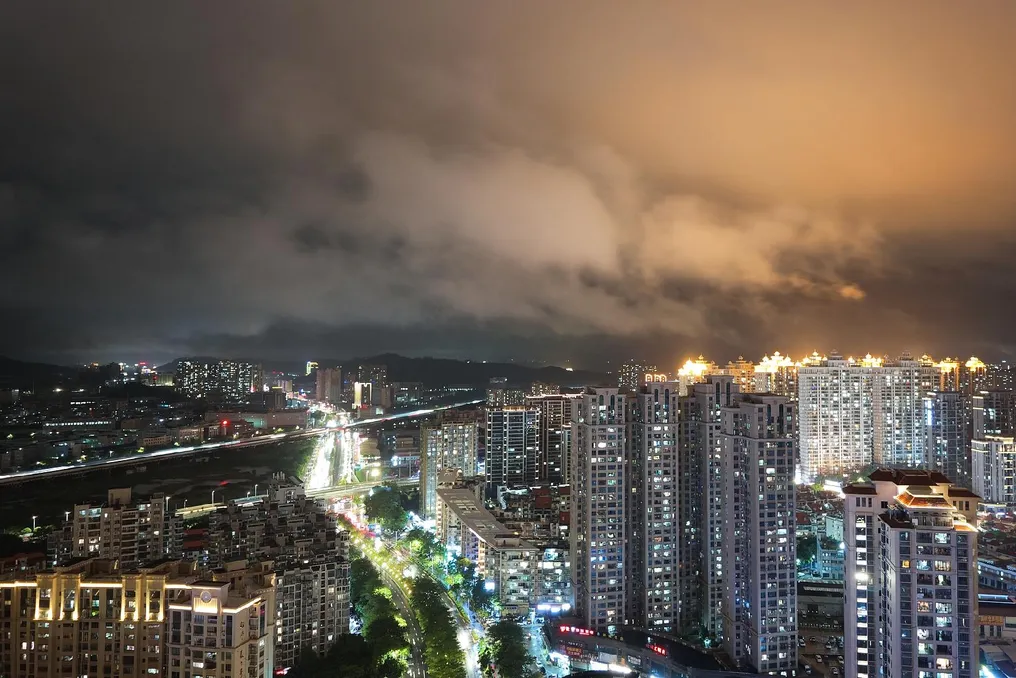
The parallel movement of four typhoons over the Northwest Pacific Ocean and the South China Sea on Monday marked an unusually active period in this year's typhoon season. Typhoon Narra (the 19th named typhoon this year) caused destruction in Bibu Bay; Typhoon Gaenari (the 20th) made landfall in Fujian province in southeastern China; Typhoon Saudel (the 18th), after traveling over 3000 kilometers across the Western Pacific, approached the warning line within 48 hours. Meanwhile, the new Typhoon Atsuani (the 21st) continued to intensify and could pose a threat to China. Thus, typhoon activity in the Northwest Pacific has reached its seasonal peak.
Climatologically, between January and August, an average of 13 to 14 numbered typhoons typically form in the Northwest Pacific and the South China Sea. This year, 21 numbered typhoons have already been recorded, significantly exceeding the long-term average. This hyperactive typhoon season has attracted widespread public attention: is global warming truly making typhoons more frequent?
This seemingly simple question touches upon a complex ocean-atmosphere interaction and cannot be resolved with a simple 'yes' or 'no' answer.
Increase in Frequency and Intensity
Theoretically, typhoons originate over warm tropical oceans. The global rise in sea surface temperature expands warm oceanic zones and concentrates thermal reservoirs in the upper layers of the ocean, providing sufficient thermal fuel for the development and intensification of typhoon embryos. However, warm water is only one condition. Typhoon formation depends on a combination of meteorological factors: favorable humidity and wind conditions, as well as suitable initial disturbances that serve as 'seeds' for typhoons over the respective ocean areas. These competing factors mean there is no simple link between global warming and the overall number of typhoons, leading to inconsistent research results.
Adding to this complexity is the observed self-suppression effect of typhoons. The powerful winds of typhoons cause strong vertical mixing of seawater, bringing cold deep waters to the surface and lowering the sea surface temperature, which effectively hinders the formation and intensification of subsequent typhoons. Nevertheless, over the last three decades, scientific research has formed an important consensus regarding changes in tropical cyclones under global warming: the frequency and peak intensity of strong typhoons are increasing worldwide, confirmed by observations and numerical modeling. This means that strong winds, extreme rainfall, and storm surges are creating growing risks for coastal and marine communities.
Climate-Driven Shift
In addition to changes in intensity, global warming is altering the spatial behavior of typhoons. Warming is expanding tropical warm water areas towards the poles, which contributes to the northward shift of typhoon activity. A typical example is Typhoon Doksuri in 2023. After making landfall, its residual circulation moved northward, causing record rainfall and severe flooding in Hebei, Beijing, Tianjin, and parts of northeastern China.
The increasing destructive power of natural disasters also illustrates climate-driven shifts. The current typhoon naming system was launched in 2000, where 14 countries and regions in the Asia-Pacific typhoon-prone area contributed 10 names each, forming a rotating list of 140 names. Names are permanently retired after catastrophic damage. Historically, between zero and three names were retired annually, with a long-term average of about 3.3. However, since 2020, the number of such retirements has sharply increased: nine names were retired in 2022 and 2024, and eight in 2025. This statistical data indicates a noticeable increase in the number of extremely destructive extreme typhoons.
Distant Impacts
Of particular concern is the growing effect of distant impacts from typhoons under climate change. Even without reaching the coastline, typhoons can trigger extreme rainfall in inland and northern areas of China, which has become the main cause of frequent extreme rainfall disasters in non-coastal areas in recent years.
In the 2026 typhoon season, Typhoons Bavi and Dolphin transported large amounts of water vapor to Northeast China through long-range peripheral circulation transport. The constant influx of moisture combined with local atmospheric instability triggered heavy rains and urban flooding in several populated areas, fully reflecting the outstanding characteristics of modern typhoons causing distant disasters.
El Niño Lengthens Paths of Destruction
Beyond the long-term backdrop of global warming, interannual air and sea anomalies strongly modulate typhoon behavior, most notably El Niño events. During El Niño, abnormally high sea surface temperatures in the equatorial central-eastern Pacific Ocean shift the main genesis zone of typhoons in the Northwest Pacific eastward. Typhoons forming further east travel longer paths over the ocean, accumulating moisture and energy over extended periods, and thus tend to become stronger and more destructive. Typhoon Dolphin in early August of this year illustrates this pattern: it traveled over 6000 kilometers over the ocean in two weeks, bringing constant wind and rain to vast areas of Eastern China.
In short, global warming does not simply mean more typhoons globally. Instead, it profoundly transforms the behavior of typhoons in the Northwest Pacific: strong typhoons are becoming more frequent and intense; typhoon activity is expanding northward; and highly destructive extreme cyclones are occurring more often. When modulated by interannual air and sea anomalies like El Niño, typhoon hazards exhibit greater extremity and compound disaster characteristics. Faced with this new reality, it is necessary to strengthen climate monitoring, improve typhoon forecasting capabilities, and modernize disaster prevention and mitigation systems. Only in this way can society effectively confront the risks of extreme typhoons and build safer protection for both coastal and inland communities.