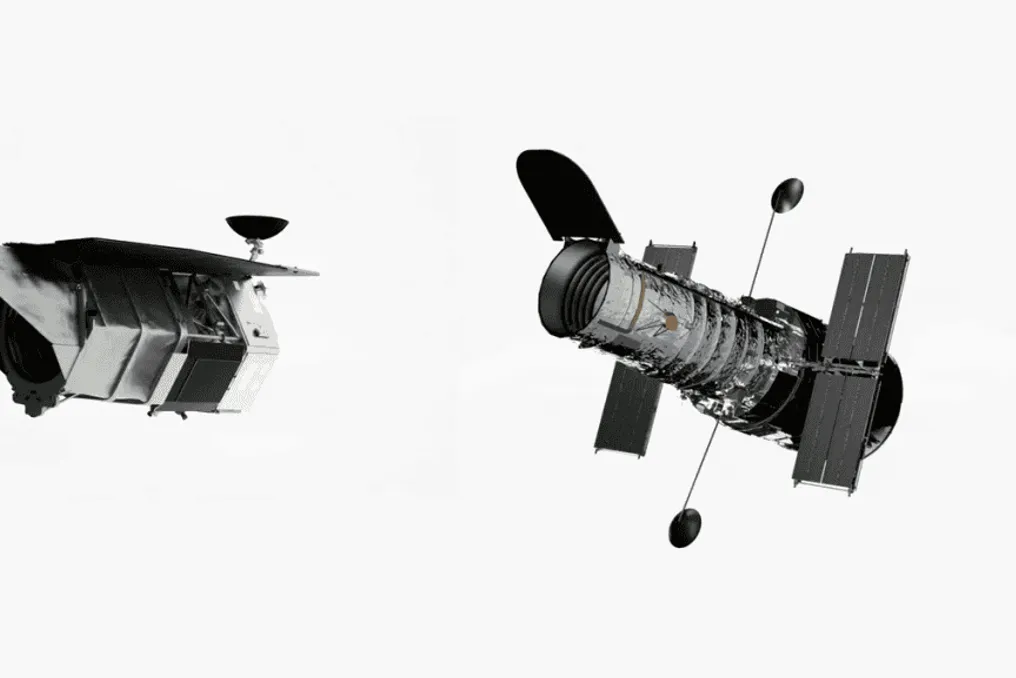
NASA is preparing the launch of a new space observatory, the Nancy Grace Roman Space Telescope, which promises to change how astronomers investigate the Universe. This telescope is scheduled to launch on August 30, using a SpaceX Falcon Heavy rocket, and will offer observational capabilities distinct from those of the current Hubble and James Webb.
Although all three instruments share common scientific goals, Roman was designed to monitor a much larger extent of the sky simultaneously. This functionality will enable vast astronomical studies and the analysis of complete populations of stars and galaxies, in contrast to the concentration of observation in smaller areas.
With a length of about 12.7 meters, Roman will be positioned in a space region near Lagrange Point 2, approximately 1.5 million kilometers from Earth. Like the James Webb, it will observe the Universe in the infrared spectrum, allowing for the investigation of extremely distant objects and challenging regions at other wavelengths.
The fundamental distinction lies in its purpose: while James Webb was optimized to obtain highly detailed observations of specific targets, Roman's main advantage is its ability to perform extensive mapping. In practice, the two telescopes will function complementarily; Roman can identify notable phenomena or objects in large portions of the sky, and then researchers can direct James Webb to these targets for more detailed analyses.
NASA itself defines Roman as an observatory that will complement other major space telescopes, not replace them. One of Roman's central missions is to help scientists understand dark energy, one of cosmology's greatest mysteries, given that the expansion of the Universe is accelerating, and the exact cause of this phenomenon is still unknown.
By analyzing large volumes of galaxies, measuring their distribution and temporal evolution, Roman will provide crucial data to unravel this mystery. Furthermore, the telescope will study dark matter, a substance that neither emits nor reflects light, but whose gravitational influence can be detected on other celestial bodies. Roman's surveys will help better understand the distribution of matter in the Universe and how cosmic structures have developed.
Another important focus will be the search for exoplanets. For this, Roman will employ techniques such as gravitational microlensing, which occurs when the gravity of a body acts as a lens, momentarily magnifying the light of a more distant star. This effect has the potential to reveal the existence of planets difficult to detect by other means, with expectations that Roman will find thousands of exoplanets.
The arrival of Roman signals a shift in the scale of astronomical research. While Hubble revolutionized observation with detailed images across various wavelengths, James Webb expanded this capability by focusing on the infrared and the first post-Big Bang galaxies. Roman will adopt a different approach: rapidly capturing large areas of the sky and accumulating enormous volumes of data, allowing for the construction of much more comprehensive cosmological maps and the discovery of phenomena that would go unnoticed in restricted observations.
The observatory's launch is scheduled for August 30, 2026, departing from the Kennedy Space Center in Florida (USA) aboard a SpaceX Falcon Heavy rocket. After leaving Earth, Roman will head toward Lagrange Point 2 to begin its scientific journey.