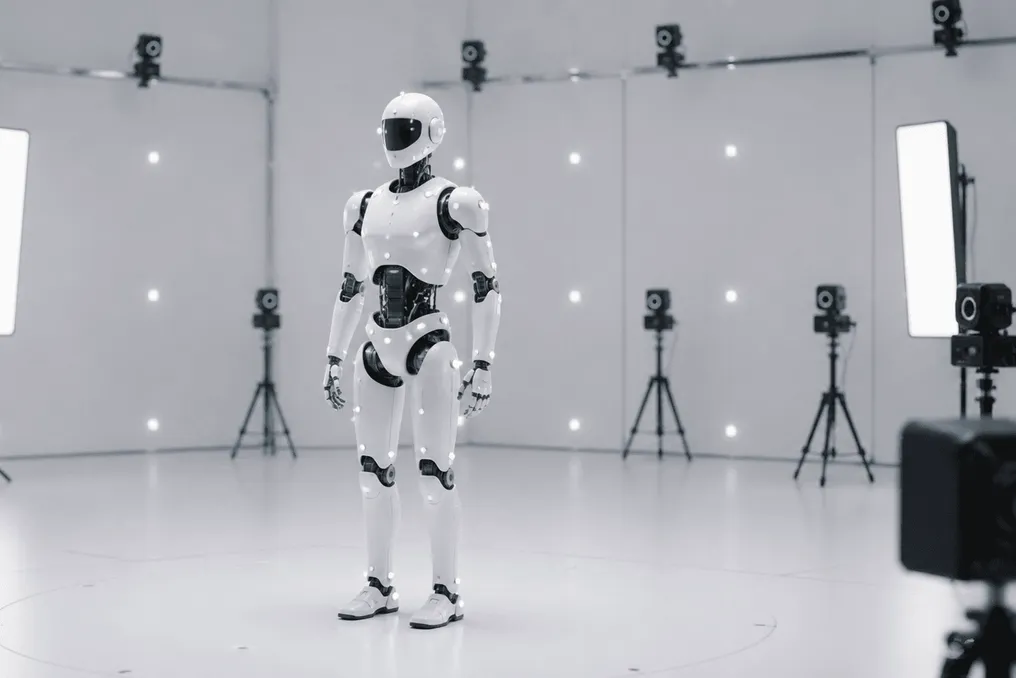
At the World Robotics Conference held in Beijing's Yizhuang district, the focus shifted from robot operational speed to data collection efficiency. Research conducted by Interact Analysis showed that China already has or is building at least 90 centers for collecting and training humanoid robots. This indicates how quickly investment logic is transforming from creating physical bodies to extracting data.
Exhibitors presented various data collection devices. Lightwheel AI demonstrated its largest open embodied dataset to date, EgoSuite-Open100k, which covers over 100,000 hours across more than 15,000 scenarios. ORBBEC presented a bodyless hardware matrix including first-person capture and manual mounting, while BrainCo showcased gloves for data collection combined with full-palm tactile dexterous hands. GigaDevice exhibited a product line including microcontrollers, memory, and analog components for embodied intelligence.
Researcher Tian Feng from the SenseTime Institute of Intelligent Industries described six parallel data collection paradigms: from teleoperation and motion capture to synthetic data and collection on real production lines. The fastest-growing is bodyless assembly, which sellers say can reduce costs by approximately one-fifth compared to collection on a physical robot. However, Tian warned that this method leads to the loss of dynamic information, such as joint torque and contact force, which can cause errors in delicate assembly tasks, and that samples biased towards collectors rather than actual workers carry systematic bias.
A deeper question is whether the scaling laws that worked for large language models apply to robots. An experiment conducted by Generalist AI in November 2025 showed that smaller models struggled to assimilate complex sensorimotor arrays, establishing a threshold of about seven billion parameters, which the authors termed 'model ossification.' Meanwhile, the fragmentation of robotic equipment hinders the reuse of data collected on one chassis on another, leading to the dilution of the overall volume into 'island data.'
Analysts also warn that many centers operate on an accounting cycle based on state funding, mass robot procurement, and data buyback, which artificially inflates overall figures without verifying real demand. IDC data shows that performance, research, and data collection scenarios still account for 78.4 percent of humanoid robot shipments in 2025, while production line work occupies a negligible share. According to Tian, the bottleneck is not so much the lack of data as the ability to converge data, standardize equipment, and generate commercial revenue.