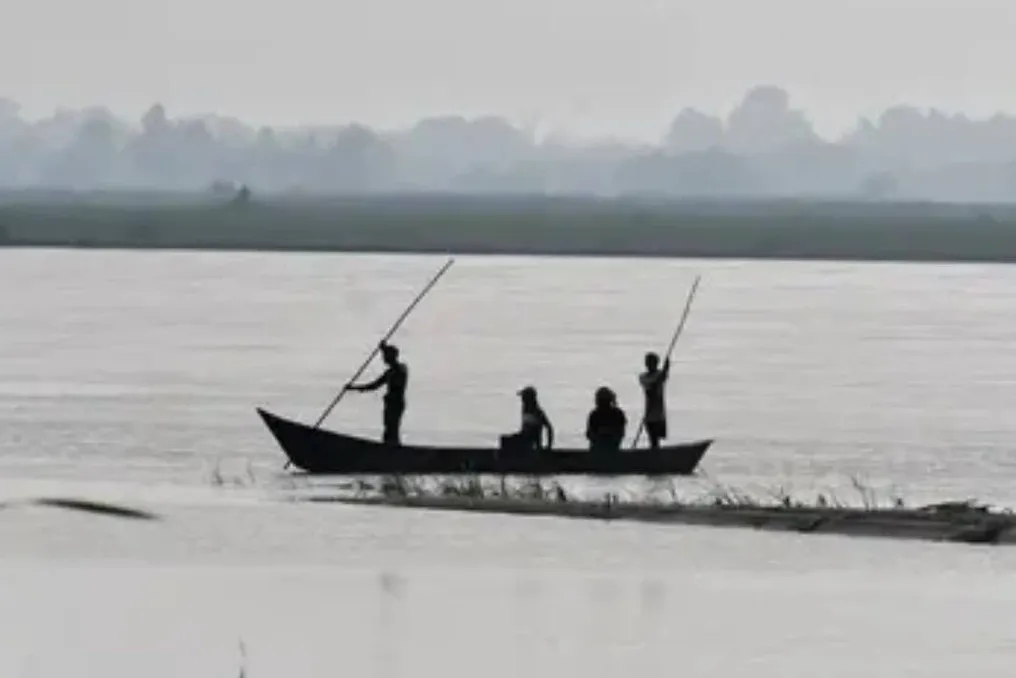
The Hilsa fish, which used to make a long journey from the Ganges estuary near Allahabad to the Yamuna in Agra, was common until 1975. This was documented according to numerous reports from the Central Institute of Fisheries Research. However, after the construction of a dam on the Ganges River in Bengal in 1975, this migratory route of the Hilsa was permanently cut off.
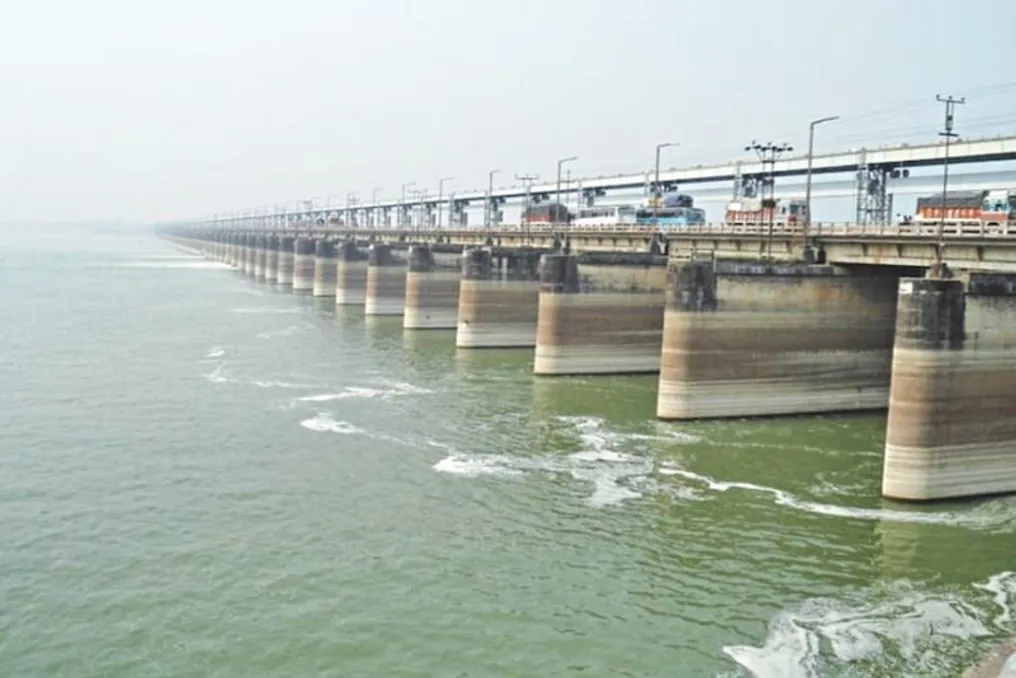
This dam, known as the Farakka Barrage, is a major structure on the Ganges River in West Bengal, located in Murshidabad district, just 16–18 kilometers from the border with Bangladesh. The barrage is about 2.25 kilometers long and equipped with 109 gates.
The reason for building this structure was the excessive accumulation of silt in the Hooghly River, which led to shallow waters and hindered large vessels from approaching the ports. Experts proposed diverting some water from the Ganges into the Hooghly to flush out the silt and maintain port operations. A similar proposal was put forward by British engineer Sir Arthur Cotton back in 1853, who recommended building a barrage near Farakka to divert water into the Hooghly, but it was not implemented at that time.
To understand the Farakka Barrage, one must examine the flow of the Ganges in Bengal. The river, which flows through Bihar and Jharkhand, enters West Bengal in Malda district, where it is called the Ganga. It then reaches Farakka, where the barrage controls its flow. Near the barrage, the Ganga splits into two branches.
The right branch remains in India (West Bengal) and is called the Bagirathi, later turning into the Hooghly River. Important areas such as Kolkata and Haldia are located along this branch, and it is for this branch that the Farakka Barrage was built. Water from the Ganges is diverted into the Hooghly via a feeder canal 38–42 kilometers long to prevent the silting up of the Kolkata port. The left branch flows into Bangladesh, where it is called the Padma.
When water was diverted into the Hooghly, the water level in Bangladesh decreased. During the dry season, water scarcity arose in Bangladesh, negatively affecting agriculture, fisheries, and drinking water supply. This led to prolonged disputes between India and Bangladesh. Bangladesh argued that the reduced water levels during the dry season damaged their agriculture, fisheries, and environment. As a result of these disagreements, temporary agreements were concluded in the 1970s and 1980s.
A breakthrough in the issue between India and Bangladesh occurred in 1996 with the signing of the Farakka Water Agreement, also known as the 'Ganges Water Sharing Treaty.'
The Farakka Water Agreement regulates the distribution of Ganges River water between India and Bangladesh. This treaty was signed on December 12, 1996, in New Delhi by the then Prime Ministers H.D. Deve Gowda and Sheikh Hasina, and it is valid for 30 years, expiring in December 2026. Although water availability issues do not arise during the monsoon season, the agreement primarily defines the division of water available at the Farakka Barrage during the dry period (from January 1 to May 31).
The water distribution formula is as follows: if 70,000 cusecs or less are available at the Farakka Barrage, both countries receive an equal share of water. With a volume between 70,000 and 75,000 cusecs, Bangladesh receives 35,000 cusecs, and the remainder goes to India. If the volume is 75,000 cusecs or more, India is allocated 40,000 cusecs, and the rest goes to Bangladesh. Additionally, from March to May, both countries are guaranteed 35,000 cusecs of water alternately. Water monitoring is carried out by a joint committee.
For a long time, this agreement functioned satisfactorily between India and Bangladesh. However, after a change in power in Bangladesh, the country's stance has changed, and Bangladesh now demands more water. Bangladesh adopts a confrontational position and intends to raise this issue in the United Nations. Bangladesh argues that at the time the agreement was signed, the population of Bangladesh was smaller, the climatic balance was different, and the environmental situation was more positive than it is today. Today, the situation is vastly different due to climate change, irregular rainfall, and drought, which has increased uncertainty in the river's flow.
Bangladesh's Minister of Water Resources, Shahidur Rahman Chowdhury Ani, stated that in the new agreement, he will demand a 'guarantee clause.' A guarantee clause is a condition that obligates the downstream country to provide a minimally defined volume of water. The minister added that they want to conclude a treaty, but if necessary...
3.