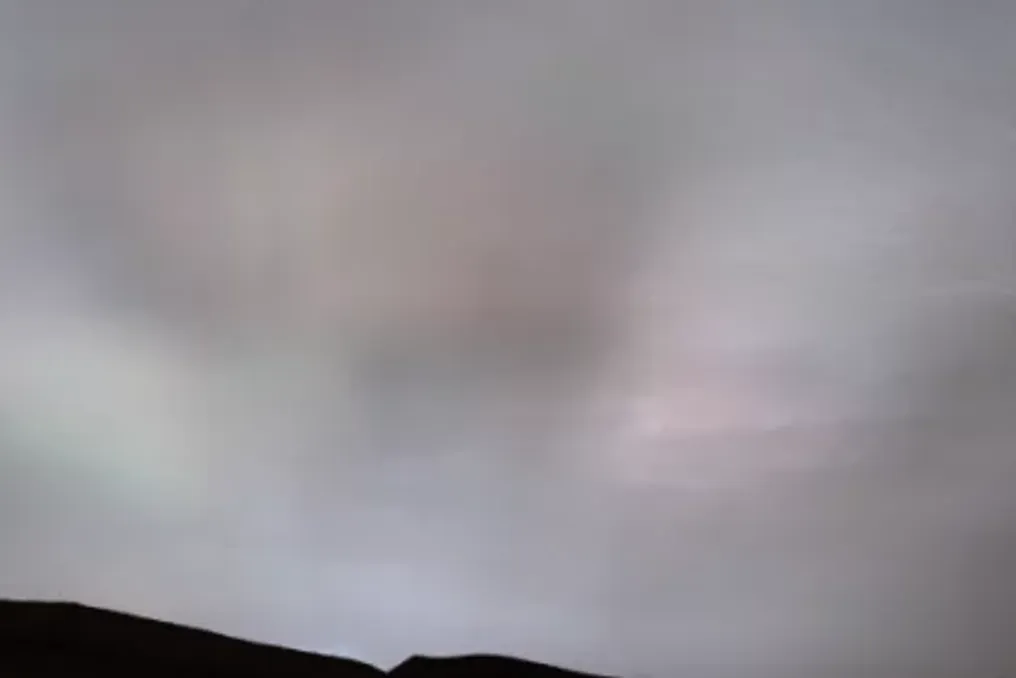
The Martian sky displays reddish hues, and the sunset can exhibit a bluish tint near the Sun, unlike on Earth. This chromatic distinction is primarily due to the presence of fine dust suspended in the Martian atmosphere, which interacts with light differently from the molecules found in Earth's air, according to NASA.
Several NASA missions have documented this phenomenon. The Spirit rover captured a Martian sunset in 2005, Curiosity recorded a colorful sequence in 2015, and Perseverance obtained its first sunset record using the Mastcam-Z camera in 2021. These images demonstrate how the celestial appearance changes depending on the solar position and atmospheric dust concentration.
Although the Martian atmosphere is considerably thinner than Earth's, it contains dust particles that remain suspended. These particles are crucial in determining how sunlight is scattered across the sky. According to NASA, Martian dust concentrates blue light in the area adjacent to the Sun, while longer wavelengths, such as yellow and red, are scattered more diffusely across the sky.
This scattering explains why the area near the Sun can take on a bluish tone during sunrise or sunset. Further away from the Sun, red and yellow tones spread out, giving the characteristic look of the Martian sky during the day. However, the intensity of these colors is not constant because the amount of dust varies, altering the sky's appearance. In the case of Perseverance, NASA noted that the 2021 sunset had a less pronounced bluish effect due to the lower amount of dust during that period.
On Earth, the dominant mechanism for the blue sky is Rayleigh scattering, which occurs when sunlight interacts with molecules much smaller than the wavelength of light, such as nitrogen and oxygen. In this process, shorter wavelengths are scattered with greater intensity than longer wavelengths. Consequently, blue light reaches the eyes from various directions, resulting in the blue appearance of the Earth's sky during the day.
At sunset on Earth, sunlight travels a longer path through the atmosphere before reaching the observer. During this journey, much of the blue light is deflected, while yellow and red tones become more visible on the horizon. On Mars, the dynamic is distinct, as dust particles play a much more significant role in the aesthetics of the sky, not merely replicating an intensified version of terrestrial Rayleigh scattering; the size and characteristics of these particles cause different light scattering.
Spirit recorded a sunset on May 19, 2005, in Gusev Crater, where the panoramic camera captured the Sun setting behind the horizon, displaying a bluish region near the solar position. NASA points out that such observations help scientists study dust distribution in the Martian atmosphere.
More details about the records
On April 15, 2015, Curiosity recorded its first colorful sunset. The sequence, captured by the Mastcam camera, lasted 6 minutes and 51 seconds. NASA explains that the concentration of blue light near the Sun occurs because the dust scatters this part of the spectrum differently from longer wavelengths.
Subsequently, Perseverance added another record on November 9, 2021, using the Mastcam-Z. In this event, the lower amount of dust in the atmosphere generated a more subtle bluish effect.
Therefore, the Martian sky cannot be seen merely as the opposite of the terrestrial one. The perceived color results from the interaction between sunlight, the atmosphere, and suspended particles. While Rayleigh scattering generates the known blue sky on Earth, on Mars, dust causes more reddish tones during the day and can generate a bluish zone near the Sun at twilight.