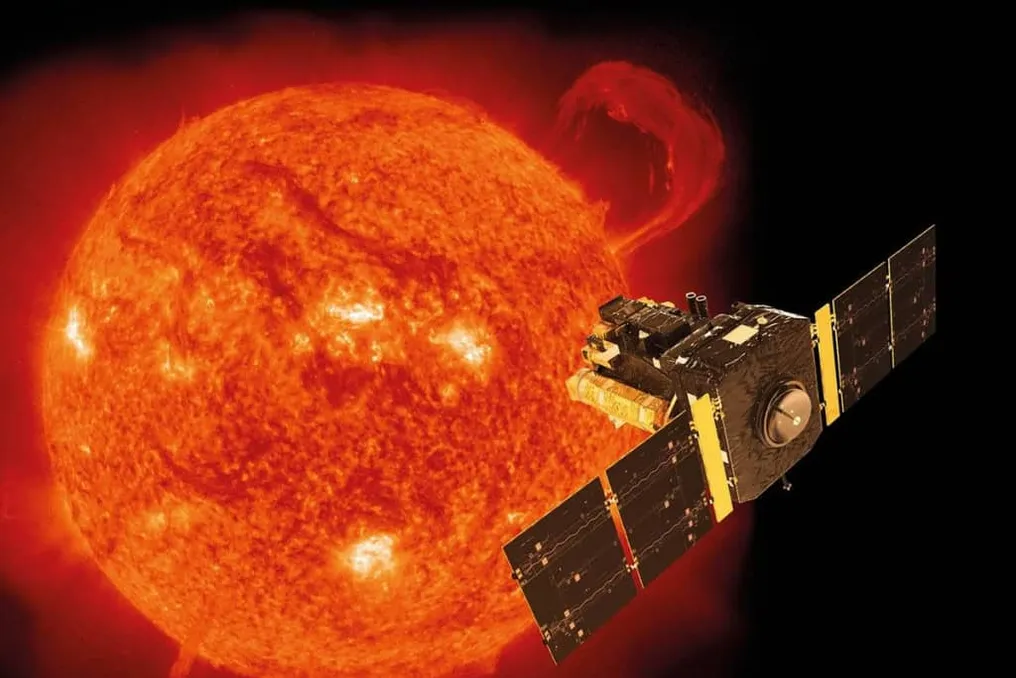
The Sun is responsible for approximately 99.8% of the entire mass of the Solar System, although some NASA surveys indicate a slightly higher value, reaching 99.86%. This small variation is due to the difficulty in accurately determining the mass of dust, comets, and smaller asteroids. Consequently, less than 0.2% remains for all other components of the system.
This remainder includes the eight planets, over 200 moons, millions of asteroids and comets, as well as all the gas and dust dispersed among them. Of this small remaining percentage, Jupiter has the largest share, corresponding to about 71% of everything that is not the Sun. After Jupiter, Saturn occupies the second position, followed by Neptune and Uranus. Together, these four giant planets concentrate almost all the mass that does not belong to the Sun, while the four rocky planets of the inner system—Mercury, Venus, Earth, and Mars—represent a very small fraction.
To make this proportion easier to understand, one can imagine a package of one kilogram of flour symbolizing the total mass of the Solar System. In this scenario, the Sun would occupy almost the entire package, weighing about 998 grams. A little more than one gram of flour would remain for all other elements: the seven remaining planets, all the moons, asteroids, comets, and scattered dust.
Of this residual gram, Jupiter alone would consume almost all the weight, a considerable portion. For the other planets, including Earth, only minimal traces would remain; Earth would be equivalent to less than three milligrams of flour, which is less than a grain of fine salt.
Although the comparison uses rounded values, the actual proportion is similar. Data provided by NASA indicates that the Sun has approximately 333 thousand times the mass of the Earth and 1,047 times the mass of Jupiter. Jupiter, in turn, has about 318 times the mass of the Earth.
Mass defines the amount of matter of a celestial body and, consequently, determines the intensity of the gravitational force it exerts on its surroundings. Because the Sun concentrates almost all the mass of the system, its gravitational attraction dominates all other bodies. It is this force that causes the planets to orbit the Sun, regardless of the vast distance separating them.
This physical principle derives from the law of universal gravitation, formulated by Isaac Newton in the 17th century and later refined by Albert Einstein through the theory of general relativity, two centuries later. It is a scientific consensus that the greater the disparity in mass between two objects, the more the smaller body will be subject to the orbit of the larger one.
This mass distribution also explains the genesis of the Solar System itself, which occurred 4.6 billion years ago. When the initial cloud of gas and dust that gave rise to everything collapsed under the influence of its own gravity, most of this material accumulated in the center, giving rise to the Sun. The planets emerged later, from the materials that remained in orbit.
In Brazil, the National Astrophysics Laboratory (LNA), located in Itajubá (MG), constructed a physical model of this great disproportion. In 2013, the institution distributed a scaled model of the Solar System throughout the city, where the Sun was represented by a 1.5-meter diameter sphere on the campus of the Federal University of Itajubá (Unifei), and Neptune was positioned five kilometers away.
This model serves to illustrate the distances, but if built to scale of mass, the Sun would weigh tons, and all the planets together would not exceed a handful of sand. When watching the sunset, it is important to remember that that luminous disk represents, by itself, almost all the material existing between the Earth and the orbit of Neptune.