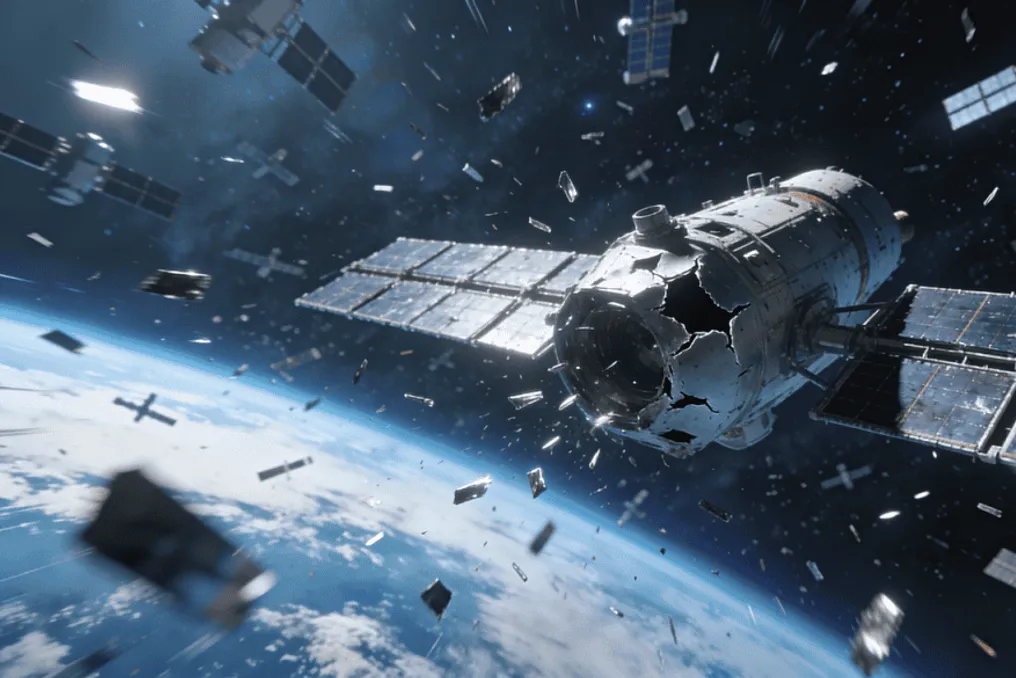
The European Space Agency (ESA) is currently tracking over 46.4 thousand objects orbiting the Earth. These objects include operational satellites, discarded rocket parts, and fragments resulting from collisions and explosions.
According to the latest report from the ESA Space Debris Office, updated in July 2026, the total mass of these cataloged objects exceeds 17 thousand tons. However, this is only part of the problem.
Radars and telescopes can only detect large items. By adding estimates for fragments ranging from one to ten centimeters (1.2 million) and over ten centimeters (54 thousand), ESA calculates that there are about 1.25 million particles larger than one centimeter in orbit, significantly exceeding the actual 46.4 thousand cataloged objects.
It is important to distinguish between counting and estimation. The 46.4 thousand cataloged objects are measured directly by radars and telescopes with known orbits. The million small fragments, however, are based on a statistical model called Master, maintained by ESA itself. This model calculates the number of particles that should have been created as a result of registered collisions and explosions, even if they cannot be seen individually.
The risk behind these figures is known as the Kessler Syndrome. This hypothesis was proposed in 1978 by physicist Donald Kessler of NASA, together with Burton Kurpaste, in an article published in the Journal of Geophysical Research. They described a domino effect: the more objects in orbit, the higher the probability of collisions. Each collision generates new fragments, increasing the chance of further collisions until the area becomes too dangerous for new launches.
ESA views this process as a real developing trend, rather than just a distant hypothesis, although it is still in its early stages. Over the last two decades, the amount of cataloged debris has sharply increased due to two events: the accidental collision of the Iridium 33 and Kosmos 2251 satellites in 2009, and the Chinese anti-satellite test in 2007, which destroyed the Fengyun-1C satellite.
At these altitudes, fragments travel at speeds of several kilometers per second. At such speeds, even an unsecured screw has enough energy to disable an entire satellite.
Additional Information
Brazil has been participating in this monitoring since 2017, using a Russian-Brazilian telescope installed at the Pico dos Dias Observatory in southern Minas Gerais. This equipment is the result of cooperation between the National Astrophysics Laboratory (LNA), the Brazilian Space Agency (AEB), and the Russian space corporation Roscosmos. According to LNA, it maps 500 to 800 objects every night and transmits coordinates to international catalogs maintained by ESA and NASA.
Since 2024, the country has also been using the GSTT Orbit Guard collision warning system, employed by the Brazilian Air Force Space Operations Center and the Institute of Aeronautics Technology (ITA). Plans are underway to expand the network of monitoring telescopes to other states in the coming years.
Not all this debris remains in orbit forever. Objects in lower orbits gradually lose altitude due to friction with atmospheric remnants. They enter the atmosphere and are destroyed by heat reaching thousands of degrees. Most turn into dust before reaching the ground.
Denser parts, such as fuel tanks and rocket engines, sometimes survive and reach the surface. Nevertheless, the risk to humans is minimal: over 70% of the planet is covered by ocean, and space agencies try to direct large impacts toward uninhabited areas, such as the Bermuda Triangle, the point farthest from land in the South Pacific Ocean.
The next time a streak of light passes across the sky at night, there is a small but real chance that it is not a shooting star, but a piece of this debris returning home.