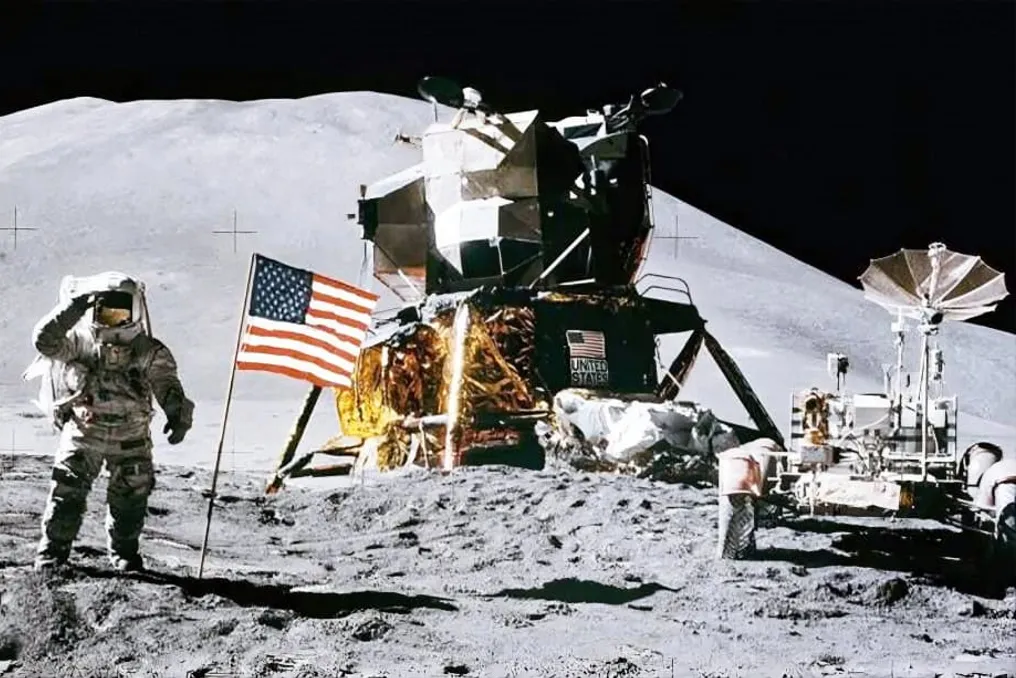
NASA confirms that the flags left by astronauts on the Moon have not completely disappeared. According to reports from Buzz Aldrin, the flag from the Apollo 11 mission was torn away by the jet generated by the lunar module during its ascent.
However, images captured by the Lunar Reconnaissance Orbiter (LRO) indicate that the flags from the Apollo 12, 16, and 17 missions are still upright. Nevertheless, these images only reveal structures and shadows consistent with vertically positioned flags, without guaranteeing they are intact.
For the Apollo 14 and 15 missions, the available images do not offer secure confirmation of whether the flags remain standing.
Installation and Fate of the First Flag
On July 20, 1969, Neil Armstrong and Buzz Aldrin placed the first American flag on the lunar surface. The fabric was attached to a horizontal pole to keep it extended, given that the Moon lacks an atmosphere and winds like those found on Earth. This structure was located near the Eagle lunar module.
When it was time to leave the site, the ascent stage engine lifted material from the surface, creating a strong jet over the area. Aldrin later reported seeing the flag fall while ascending. NASA documentation considers this account consistent with subsequent photos of the site, which do not show a shadow corresponding to a standing flag.
After Apollo 11, astronauts began positioning the flags further away from the lunar module. This change reduced the probability that the engine jet would have the same impact on subsequent missions.
Analysis of Orbital Images and Material Degradation
The LRO, launched in 2009, began photographing the old landing sites using cameras capable of recording surface details. By comparing photos taken under different lighting conditions, researchers were able to identify shadows related to the flag structures, with the clearest evidence at the Apollo 12, 16, and 17 sites.
It is important to note that even if some flags remain physically in place, their appearance has likely changed drastically compared to the original photographs. The flags were made of nylon and were not designed to maintain the fabric for decades under the lunar environment.
On the Moon, the absence of an atmosphere prevents the filtering of solar ultraviolet radiation, exposing the material directly to it for many years. This UV radiation can cause the degradation of nylon and the fading of pigments. Experts estimate that the red and blue colors probably suffered severe discoloration, although the hypothesis that the fabric has become very light is only an estimation, and not something directly visible in the LRO images.
Additional Deterioration Factors
In addition to radiation, nylon is subject to vacuum, large temperature fluctuations, and micrometeorite impacts. All these elements contribute to the wear of the material over time. For this reason, it is not yet possible to determine the exact current condition of these fabrics; a direct inspection of the landing sites would be the most accurate method.
LRO images show that certain structures still appear to be where they were installed more than fifty years ago. Although invisible to the naked eye from Earth, they remain on the lunar surface as physical records of the first human explorations on another planet.