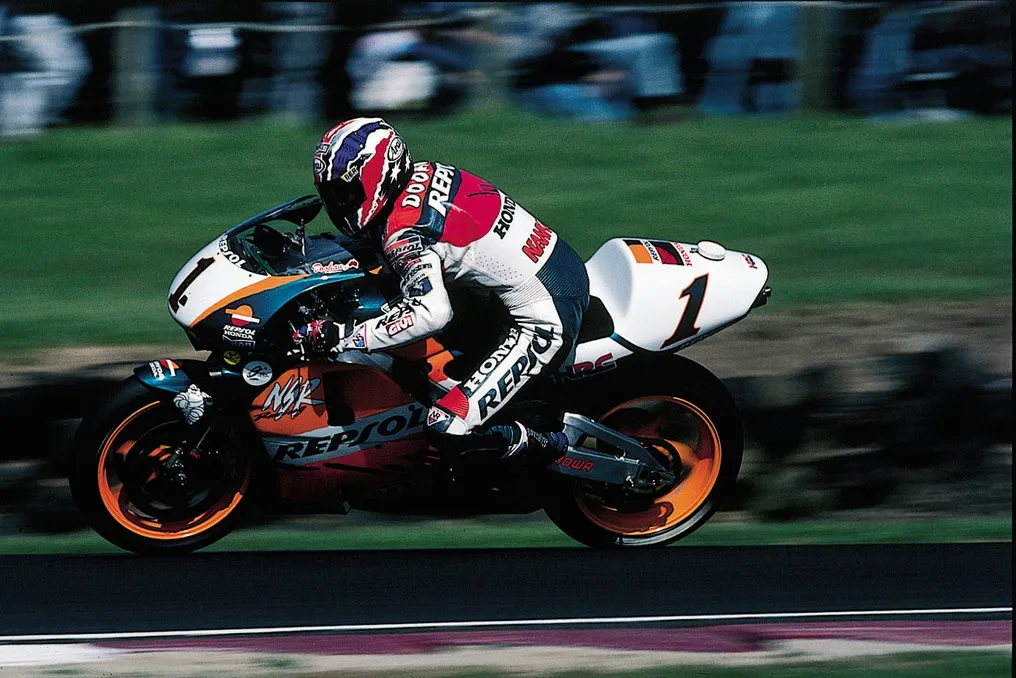
For many motorcyclists, a fall is a traumatic event that marks a division between the past and the present. However, for competition riders, falling is part of the routine and can be a motivational factor.
A notable example is the Australian Mick Doohan, one of the greatest riders in MotoGP history. He was knocked down countless times on his Japanese machine before winning five consecutive titles in the top category of the Grand Prix 500CC races, from 1994 to 1998. This occurred after a serious accident that nearly immobilized his right ankle, forcing him to use his left thumb to activate the rear brake. Currently, he lives a quiet life with his family, alternating between his residence in northeastern Australia and his apartment in Monaco.
The motorcycle responsible for so many falls and injuries was the Honda NSR500. Although two-stroke bikes were popular, especially around the turn of the 90s, the Honda NSR500 was recognized for its extremely powerful nature.
The NSR500 was conceived as a successor to the Honda's three-cylinder NS500. Its debut was in 1984, featuring a V4 engine with a 90-degree angle between the cylinders and a single crankshaft, making it more compact and lighter than competitors using dual crankshafts. Initially, the first version of the NSR500 was mounted upside down, and the engine was not its most prominent feature.
At that time, HRC was focused on innovations. To mitigate inclinations and prevent rear wheel slippage—a common problem in 500cc two-strokes—the engineering team sought to minimize the center of gravity. They placed the 32-liter tank, weighing about 24 kg when full, under the engine, where the exhaust expansion chambers would normally be located. Despite appearing normal with the bike assembled, the configuration caused confusion without the fairings.
To complement this eccentric design, the futuristic wedge tail section was designed by Yasuyuki Tsurumi, a motocross engineer who had never designed an asphalt prototype, molding the fairings manually with cardboard. The initial logic suggested that with 20 liters in the tank, the bike would have a center of gravity almost 30 millimeters lower than the previous NS500. However, an unforeseen factor was that as the race progressed and fuel decreased, the bike's center of gravity rose by more than 30 millimeters, drastically altering the dynamics lap by lap.
Additionally, the fuel fluctuated so much in the bottom that, even with internal dividers and protective foam, engineer Freddie Spencer reported feeling the weight of the gasoline swaying during the most intense braking. Despite these peculiarities, Spencer won three of the five races he participated in, validating his skill. However, the inverted layout proved to be excessively complex and problematic, lasting only the 1984 season.
In 1985, returning to conventional architecture, the NSR500 won the title. In 1987, Honda changed the V angle to 112 degrees, allowing the use of four 36mm Keihin carburetors and routing exhaust gases through four interconnected expansion chambers. With this modification, Wayne Gardner achieved the 87 World Championship.
By the end of the decade, the NSR500 evolved significantly. Redesigned in 1988 and perfected in 1989, the bike received an extremely rigid twin-spar aluminum frame, a curved swingarm, and a primitive version of the quickshifter system. The engine generated impressive 165 hp at 12,000 rpm, double that of a legendary 1960s Honda four-stroke engine, pushing the bike above 310 km/h. The challenge lay in power delivery, characterized by very abrupt peaks that required high RPMs. On fast tracks like Suzuka and Assen, the engine was excessive; on tighter circuits, the dynamics made the bike unpredictable.
The transition from the 80s to the 90s put the 500cc World Championship at a crossroads, as the machines were considered expensive, dangerous, and difficult to control, leading some private teams to abandon the grid. Meanwhile, Honda secretly investigated its bike's instability, discovering that the riding problem came from the V4 single-crankshaft engine itself, whose response was too abrupt.
In 1988, Honda tested a prototype with dual crankshafts and a new ignition sequence, where all cylinders burned simultaneously. Although traction improved drastically, the engine rapidly damaged the gearbox gears due to the impact of the combined explosions, causing the idea to be shelved due to transmission resistance.
The turning point came in 1991, when the FIM modified the regulations, increasing the minimum weight of the bikes by 15 kg (to 130 kg). Honda used this additional weight to reinforce the gearbox structure, which would now withstand the stress. In 1992, Honda launched its creation: the NSR500 Big Bang.
This reconfiguration caused the four cylinders to detonate almost in unison (within a short interval of 70 degrees). The secret was not in the explosions, but in the subsequent period: the engine allowed long 290-degree rotation periods to be completely free. In previous engines, known as 'screamers,' the cylinders burned alternately every 180 degrees, generating constant thrust that caused the rear tire to spin and overheat on corner exits. With the Big Bang engine, this brief moment of 'lack of power' allowed the rubber to regain grip on the asphalt, solving the waste of power.
The new engine was introduced with Mick Doohan, Gardner, and the young Alex Crivillé. Doohan dominated the grid, winning the first four races of the year with great ease. Crivillé reached the podium in his third race and won his first race shortly after.
In rival teams, the question was what Honda had done to the engine. The answer came through sound: the typical high-pitched scream of two-strokes was replaced by a deep, rough, 'popping' rumble. Rivals resorted to acoustic espionage, using portable oscilloscopes to record and analyze the sound peaks of the Honda's exhaust, discovering that the bike fired the cylinders almost at the same time. Thus arose the legend that Yamaha had sent cassette tapes to its music division so that piano tuners could decipher the Honda's rumble. The reality, however, is less romantic: the work was done by the telemetry engineers of the racing teams themselves, not just Yamaha's. Suzuki also carried out a similar procedure, being the first rival to decipher the sound wave and launch its own 'Big Bang' in Hockenheim, Germany. Later, Cagiva presented its version in Assen, and only then did Yamaha implement its concept at the Hungaroring.
The origin of this story dates back to the respect Yamaha paid to its music division. Both companies, although legally separate, work in synergy, occasionally collaborating on projects, such as the rumble of the Lexus LFA, where Toyota hired Yamaha to apply its knowledge of wind instrument resonance to the supercar's exhaust.
The Big Bang's debut season began with Honda's initial dominance but was tragically interrupted by a serious accident in Assen, Netherlands, which nearly resulted in the amputation of Mick Doohan's right leg. He was sidelined for several rounds and tried to return at the end of the year, but the title ultimately went to Wayne Rainey and his Yamaha. During his recovery, Doohan admitted that he did the impossible to keep his spot on the Honda factory team.
With almost total loss of strength and mobility in his right foot, he could no longer operate the brake pedal. At that moment, the team developed a revolutionary solution: a rear brake controlled by a small lever on his left thumb. By using his left hand to compensate for the function of his right foot, Doohan adapted his body and mind to the violent NSR500. It was after this that the Australian began his best phase. Adapted to his new physical condition and with the Big Bang engine taming the NSR500 monster, Doohan became invincible. In 1994, he won his first world title, starting a dynasty of five consecutive championships (1994 to 1998).
The peak of this success occurred in 1997. That year, Doohan dominated his rivals, winning 12 of the 15 races on the calendar and finishing second in two others. He did not score points in the last race, held at home in Australia, because he crashed while leading with over six seconds' advantage. His dominance was so pronounced that, in 1996, he was appointed Member of the Order of Australia (AM) for his contribution to motorsport.
Even competing against up to eight rivals on identical bikes to his, the Australian's superiority was almost unbelievable. His tactic consisted of accelerating to the maximum to build a comfortable lead in the opening laps and then riding well below the remaining limit of the race, merely 'cruising' to the checkered flag. Much of this technical difference, besides the rider's talent, came from his team boss, engineer Jeremy Burgess. It was Burgess who adjusted the geometry and suspension of the NSR500 with such precision that the bike became an extension of Doohan's body. This excellence generated dissatisfaction in the high technical circles of Honda, and Doohan gained unusual authority over the technical team between 1994 and 1998, given that the NSR500 underwent virtually no major changes during that period.